
Guide
B2 · Upper-intermediate
Reading
Read Online Reviews in English: Specific Experiences and Balanced Choices
Interpret review vocabulary, mixed judgements and specific experiences, then make a qualified comparison based on a fictional learner’s stated needs.
9 min read
1,600 words
Updated Oct 27, 2026

On this page (7 sections)
B2 • 19 minutes • 10 scored checks. Interpret review vocabulary, mixed judgements and specific experiences, then make a qualified comparison based on a fictional learner’s stated needs.
Before comparing the reviews, review practical reading strategies.
Read with a concrete need
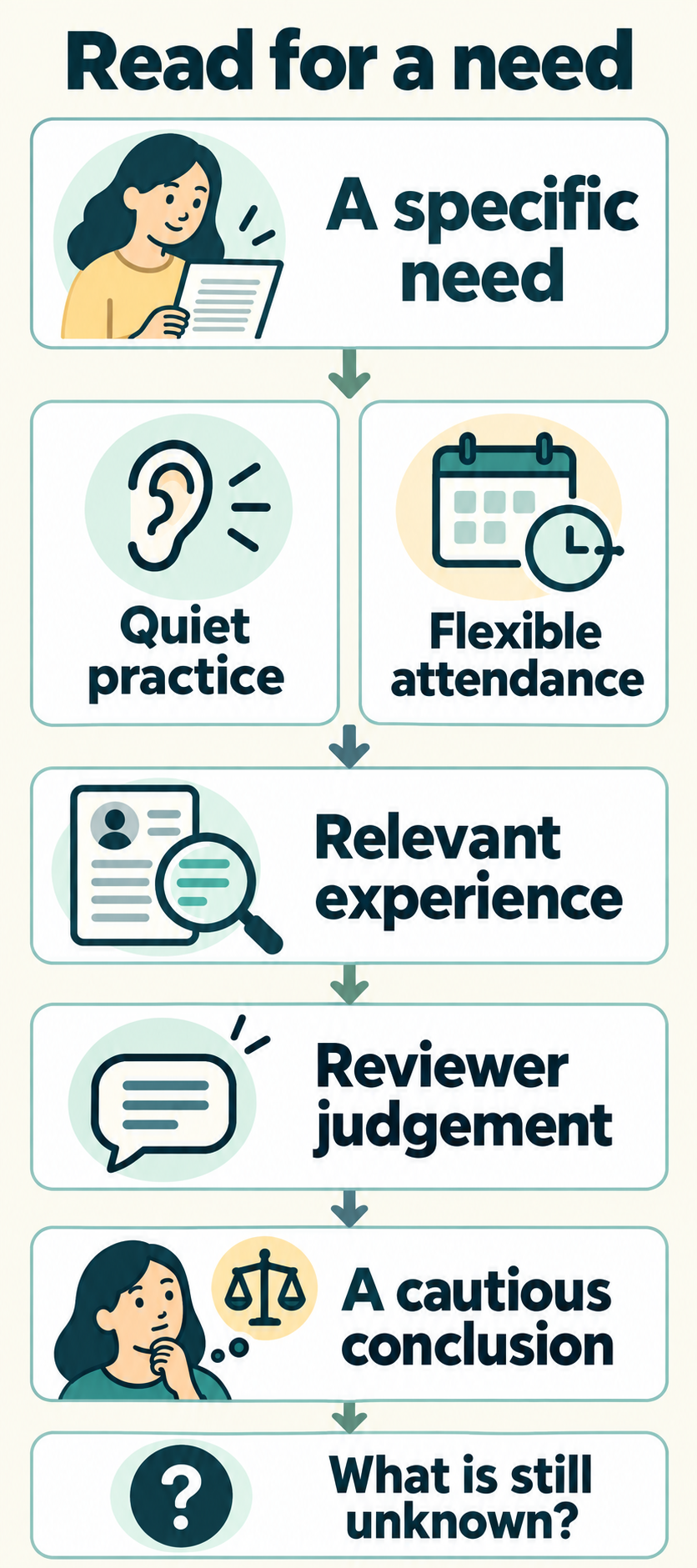
A useful review is relevant to a need. Imagine one adult learner who needs quiet practice and another who needs sessions that can be changed when work hours move. A strongly positive review about price may tell neither learner what they need to know.
Before reading, write one concrete priority as a question: How noisy was the room? or What happened when the reviewer changed a date? The four accounts below are original fictional examples. Use the details in these accounts to practise interpreting evidence.
Review | Reported experience |
|---|---|
A • Clay class • 4 September | The session was well organised and the tutor was easy to follow. The room was a little crowded, although everyone had a place to work. Overall, I enjoyed making one small bowl. |
B • Evening conversation • 12 September | The booking system was reliable: I changed my session twice without a problem. The final activity felt rushed, but the flexible dates suited my changing work schedule. |
C • Clay class • 18 September | My group had six learners and the room stayed quiet throughout. The instructions were clear. I cannot comment on larger groups because this was my first visit. |
D • Clay class • 25 September | The class started twenty minutes late twice during my four-week course. I liked the tutor’s demonstrations, but the late starts made the course poor value for my limited evening time. |
Common review vocabulary and chunks
Well organised suggests that arrangements worked coherently. Crowded describes a place containing many people in the available space. Easy to follow usually means understandable in a teaching context. Good value means the reviewer thought the benefit justified the cost or effort; the relevant cost should be read from context.
Rushed suggests too little time or a pace that felt too fast. Reliable describes something working as expected in the reported context. Not worth the time is a negative judgement about the benefit compared with time spent. None of these phrases proves a review genuine or false. Look for the experience attached to the judgement and the aspect it evaluates.
For more word partnerships like these, build useful English collocations.
Read a mixed judgement
Mixed judgements contain both praise and criticism. In A, although introduces a crowded room alongside an enjoyable activity. It does not erase the positive comment. In B, but contrasts a rushed ending with useful flexibility. A summary should retain both sides instead of selecting whichever fits your first impression.
Degree words matter. A little crowded is weaker than unbearably crowded. Overall introduces a whole-experience judgement, but can coexist with reservations. Despite the noise, I learned a lot would similarly preserve both noise and learning. When paraphrasing, keep the original strength: somewhat crowded is closer to a little crowded than impossible to work in.
Specific experience versus broad judgement
A specific experience names what reportedly happened: the class started twenty minutes late twice. A broad judgement such as everything was terrible gives less detail about which feature caused dissatisfaction. Specificity helps you connect a claim to a practical need, such as a tight evening schedule.
It is still reported evidence. The wording does not independently verify the event, show what happened in every class or establish a cause for the late starts. Separate three layers in your notes: the claimed event, the reviewer's evaluation, and your possible implication for a stated need. Do not silently turn one layer into another.
Match review detail to the reader’s priority
Build a priority-and-evidence grid. Quiet practice pairs directly with C's report that the room stayed quiet. Flexible attendance pairs with B's account of changing sessions twice. The room's crowding is relevant to space and perhaps noise, but it does not by itself establish whether explanations were clear.
Use exact detail before a general recommendation. Write: C reports a quiet six-person session, which is relevant to the learner's need. Avoid: C proves this class is always quiet. The first sentence states relevance and scope; the second adds a universal claim that the review cannot support.
Handle disagreement and missing detail
Accounts can differ without giving you enough evidence to decide why. A and C describe different visits and group conditions. Dates, group size and the reviewed session can matter, but these examples do not establish a definite cause of disagreement. Do not invent one or decide that either writer is dishonest.
Missing information remains missing even in an enthusiastic review. A does not say whether future group sizes are limited. B does not specify a current booking policy or any change fees. A sensible conclusion can name a promising feature and a question to verify before relying on it.
Ten checks and a cautious choice
Answer ten checks on contextual vocabulary, mixed meaning, relevance and qualified conclusions. Read the explanations only after responding. Each answer refers to the original wording and preserves its limits.
End with two sentences: identify a provisional option for a stated need, then name a reservation or unknown. For example, a quiet-practice learner might investigate the clay class because C describes a quiet small group, while still needing current group-size information. Words such as reports, suggests and based on this account help you avoid turning limited evidence into certainty.
Answer on paper, then open the explanations below. Enable JavaScript to check answers here.
Your turn · self-review
Your transfer task
Write your own response first, then open the model and compare. Check: relevant experience; cautious conclusion; one genuine unknown; no claim about truthfulness.
Practice only. Your writing stays on this page; it is not submitted or saved.
-
Model answer and explanation
B’s account suggests that the evening conversation class may suit changing work hours because the reviewer changed sessions twice without a problem. The review does not establish the current change policy or whether changes have a fee.
Related Guides






Continue learning this topic
Review an explanation, study examples or try a related practice test.
- Practice test Guardian seeks readers’ tips for wild escapes in Scotland — C2 English Listening Practice Test
- Practice test Guardian seeks readers’ tips for wild escapes in Scotland — C2 English Grammar Practice Test
- Practice test Guardian seeks readers’ tips for wild escapes in Scotland — C2 English Vocabulary Practice Test