
Guide
B2 · Upper-intermediate
Grammar
Participle Clauses: Shared Subjects, Time and Clear Meaning
Understand and safely build -ing, past-participle and having + participle clauses.
10 min read
1,739 words
Updated Oct 23, 2026

On this page (12 sections)
B2 • About 25 minutes. Identify the shared subject in a participle clause and main clause. Choose -ing, past participle or having + past participle for an intended relation. Recognise ambiguity in unstated time/reason relations. Repair dangling participles by restoring an explicit subject or finite clause.
Two clauses, one controlled subject
A participle clause can connect closely related information without repeating a subject and a finite verb. “Mina checked the map. Mina then left.” can become “Having checked the map, Mina left.” Mina performs both actions. The shorter sentence is successful because its reader can recover the actor and the sequence without guessing. Saving words is useful only if the relationship remains clear.
This reference uses opening participle clauses controlled by the main-clause subject. Find that subject before you shorten anything. In “Carrying a folder, Ravi entered the hall”, Ravi carries and enters. In “Carrying a folder, the hall looked unfamiliar”, the grammar misleadingly points to the hall as the carrier. Your knowledge of the real world may rescue the meaning, but a reader should not have to repair the sentence for you.
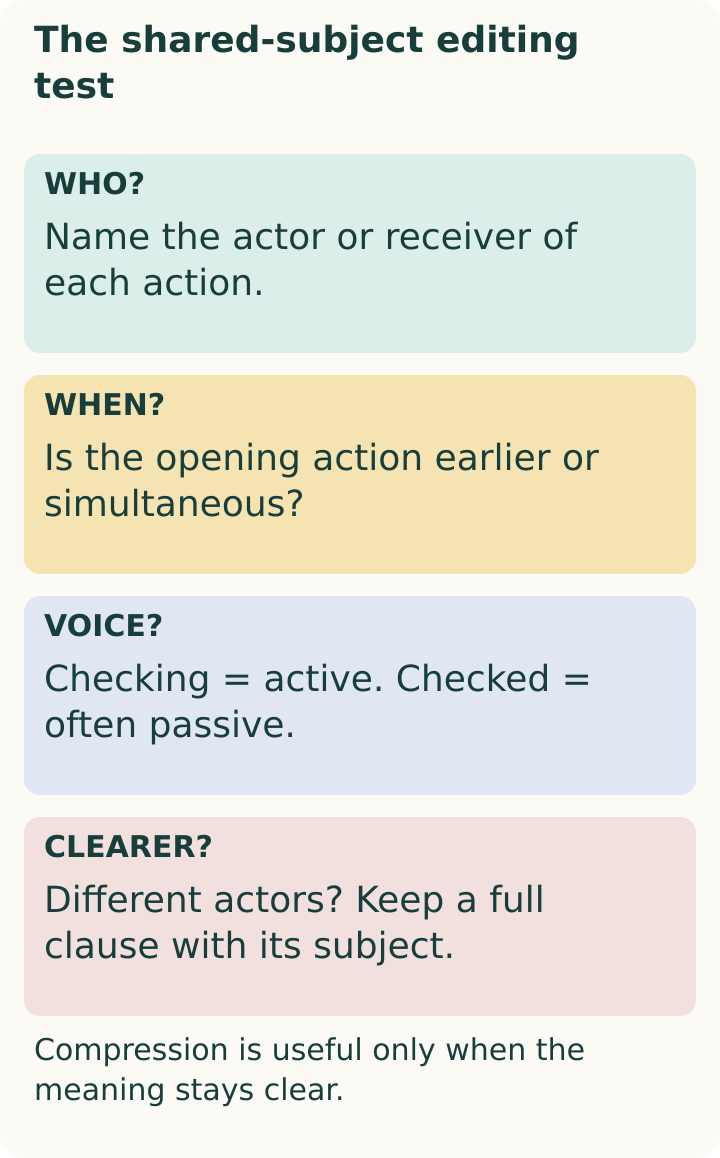
Use a four-question decision test: Who performs or experiences the opening idea? When does it happen relative to the main event? Is the meaning active, passive or a state? Is a reduced version clearer for this audience? If the answers are uncertain, retain a full clause with its own subject. A shorter sentence is not automatically a more advanced sentence.
-ing clauses: action and logical relation
“Carrying two folding chairs, Mina crossed the hall” presents an accompanying action. “Knowing that the door was unlocked, Mina went straight inside” gives a reason in context. The -ing form itself does not tell you whether an event is past, present or future. Compare “Carrying a folder, she enters”, “Carrying a folder, she entered” and “Carrying a folder, she will enter”. The finite main verb and the context locate time.
An -ing opening can leave the relation implicit. “Reading the notice, Mina changed her plan” could mean while she read it or because of what she read. If the exact relation matters, write “After reading the notice…” or “Because the notice announced a closure…”. Do not assume that every -ing clause means because. The writer must supply enough context to justify the intended connection.
A continuing state can also motivate an action: “Not knowing the room number, Arun asked at reception.” Not comes before knowing. The opening explains Arun’s information gap; it does not describe a different person’s ignorance. A clear full-clause alternative is “Because Arun did not know the room number, he asked at reception.”
Past participles: passive meanings and states
“Built in 1980, the hall has a narrow entrance” relates built to the hall: someone built the hall. “Painted in a pale colour, the doors were easy to identify” similarly describes something done to the doors. Past-participle openings often have a passive interpretation, but the main-clause subject remains the thing receiving that action.
“Tired after the walk, Mina sat near the window” describes Mina’s state. Tired functions adjectivally here; you do not need to invent a particular person who tired her. Likewise, “Interested in the display, Ravi stayed longer” describes his state. The -ed ending does not by itself prove a passive event or past time. Read the word’s meaning in its sentence.
Contrast “Checking the list, Asha noticed a missing name” with “Checked by Asha, the list was ready to print”. Asha checks in the first; the list is checked in the second. Replacing checking with checked without changing the subject would change who does what. Voice is a meaning choice, not a decorative variation.
Earlier completion: having + past participle
Use having + past participle when earlier completion is worth making explicit: “Having counted the chairs, Mina opened the hall.” The count is finished before the opening. “Having been checked, the list was sent to the printer” is the corresponding passive pattern: the list receives the check and is then sent.
Do not write “Having count” or “Having counted, the door opened” when Mina did the counting. Having requires a past participle and does not remove the shared-subject requirement. A full-clause alternative often sounds more natural in practical instructions: “After Mina counted the chairs, she opened the hall.” Choose that version if names and timing need to remain prominent.
An ordinary -ing clause can sometimes describe an immediately preceding action in a clear sequence, but it is not a precise timestamp. If a task explicitly asks you to show completed preparation before the main event, having checked or after checking makes the sequence easier to recover. Do not force every pair of past actions into a perfect participle clause.
Reduced adverbial clauses: keep helpful markers
While, when and if can sometimes remain before a participle: “While waiting outside, Asha checked her messages”; “When asked about the schedule, Asha showed the notice”; “If invited, Asha will attend.” In these examples the understood person is Asha. The linking word helps identify time or condition, but does not license an unrelated subject.
Not every adverbial clause can be shortened mechanically. “While Asha waited, the visitors arrived” contains different subjects. “While waiting, the visitors arrived” would make the visitors the ones waiting. Keep the original full clause unless that is what you mean. Conventional expressions and independent absolute constructions exist, but they are outside this shared-subject editing task.
Five misleading openings and clearer repairs
1. “Walking into the hall, the lights seemed bright.” The visitor is walking: “When the visitor walked into the hall, the lights seemed bright.” This preserves the main observation and names the walking subject.
2. “Having checked the list, the door was unlocked by Asha.” Make Asha the main subject: “Having checked the list, Asha unlocked the door.” The original passive subject door cannot check a list.
3. “Painted yesterday, the volunteer moved the chairs.” If the chairs were painted, write “The volunteer moved the chairs, which had been painted yesterday.” If the volunteer was covered in paint, a different description is needed. Ask before choosing.
4. “Reading the message, the meeting was postponed.” Name the decision-maker: “After the organiser read the message, she postponed the meeting.” The meeting does not read. Do not infer the message’s contents if the source does not give them.
5. “Turning the handle, the room was quiet.” If the writer means two observations rather than cause, keep two clear clauses: “Mina turned the handle. The room was quiet.” Good editing sometimes expands rather than compresses.
Eight checks: apply the rule
Answer before you check. For typed answers, use the requested wording; valid listed variants are accepted. Read the explanation even if your answer is right.
Trace the subject
Answer on paper, then open the explanations below. Enable JavaScript to check answers here.
Choose form for meaning
Answer on paper, then open the explanations below. Enable JavaScript to check answers here.
Choose a clear repair
Answer on paper, then open the explanations below. Enable JavaScript to check answers here.
Your decision card
Who? → Time? → Voice? → Clarity? Asha checks / Asha unlocks: Having checked the list, Asha unlocked the door. Asha waits / visitors arrive: While Asha waited, the visitors arrived. Keep the full clause when the actors differ.
Related learning
Companion resource: Before the Open Day: Participle Clause Editing Practice.
Related references for further study: Passive Voice: Describing Processes and What Happens; Defining Relative Clauses: Who, Which, That and Where; Past Simple vs Past Continuous.
For the structured course sequence, study Participle clauses and shared subjects. Use this standalone reference and its original exercises to diagnose and apply the patterns.
Related Guides






Continue learning this topic
Review an explanation, study examples or try a related practice test.
- Practice test Difficult times in agriculture are making it tough for the next generation of farmers — C2 English Listening Practice Test
- Practice test Difficult times in agriculture are making it tough for the next generation of farmers — C2 English Grammar Practice Test
- Practice test Difficult times in agriculture are making it tough for the next generation of farmers — C2 English Vocabulary Practice Test
- Course lesson Future time clauses – B1–B2: Grammar in Context
- Course lesson Participle clauses and shared subjects – C1: Precision and Expression
- Course lesson Checkpoint: time and possibility – B1–B2: Grammar in Context