
Guide
B1 · Intermediate
Reading
Read Job Adverts in English: Duties, Requirements and Working Hours
Read duties, essential and preferred requirements, schedules and missing details in an original role advert, then compare explicit fictional profiles.
8 min read
1,278 words
Updated Oct 24, 2026

On this page (7 sections)
B1 • 18 minutes • 8 scored checks. Read duties, essential and preferred requirements, schedules and missing details in an original role advert, then compare explicit fictional profiles.
The parts of a role advert
A role advert explains an opportunity and what it involves. It may describe duties, requirements, hours and a next step. These parts can appear under headings or inside a paragraph. Find their purpose rather than depending on one fixed layout. This guide uses a fictional volunteer advert for reading practice.
Cedar Library welcomes volunteer reading-room helpers. The role supports a calm space for adult visitors. Duties: greet visitors, organise returned books on the trolley and prepare tables for reading groups. Requirements: clear written English is essential. Previous library experience is preferred, but not required. Training is provided for the catalogue tasks. Hours: Saturdays, 10:00–13:00, on-site at Cedar Library. This is a part-time volunteer role. Next step: complete the fictional interest form by 18 October. No pay or travel-expense details are included in this advert.
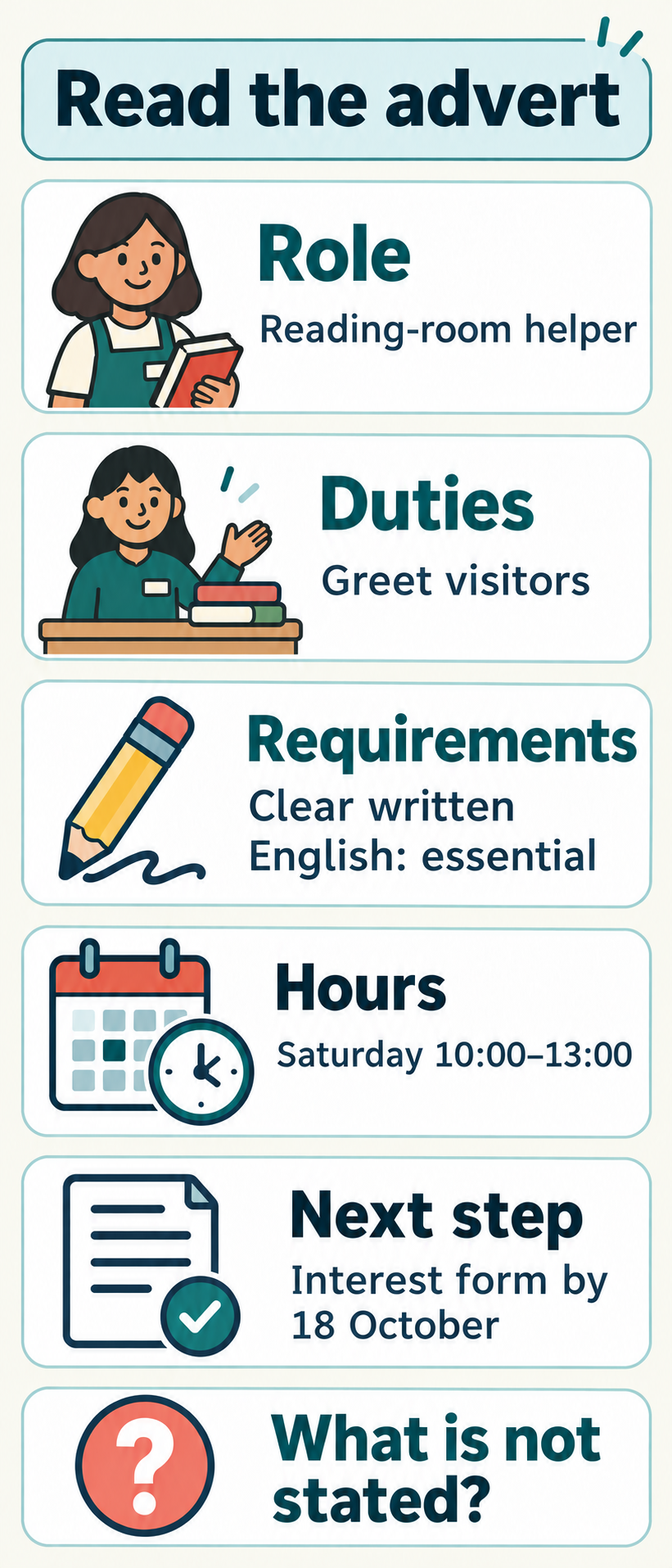
Duties: what the person does
Duties are tasks: what the person does. Assist means help someone with a task. Organise can mean arrange things into a useful order. Greet means welcome someone when they arrive. Maintain can mean keep something in its stated condition, such as keeping a list current. Prepare means make something ready. Support means help a person or activity continue.
Compare prepare tables with patient. The first is an action; the second describes a personal quality. An advert may require a quality, but it is not the same category as a duty. Look for a verb plus an object: organise returned books, greet visitors, or update a list. The object tells you the scope of the work.
Essential, preferred and training provided
Essential and required normally mark something the advert says the person must have. Preferred and desirable mark something useful but not compulsory when the advert makes that distinction. The Cedar example removes doubt by adding but not required. Do not turn a preference into a requirement.
No experience necessary means previous experience is not required for the stated role. Training provided tells you that some teaching will be offered, but read what it covers. Cedar names catalogue tasks. It does not say that every listed requirement will be taught.
Hours and working arrangements
Part-time describes fewer hours than a full-time arrangement in that context; it does not give one universal number. Full-time also needs the advert's actual hours. Weekend points to Saturday or Sunday, but the text must tell you which day. Flexible suggests some choice, but its limits need to be stated. Do not assume it means any time you prefer.
On-site means at the named place. Remote means away from the organisation's usual site, using the arrangement described. Cedar explicitly says Saturdays, 10:00–13:00, on-site at the library. That is stronger evidence than a general label such as flexible volunteering. Record exact days, times and location when comparing an advert with a profile.
Match evidence to a fictional profile
Fictional profile: Rina has clear written English, is free on Saturdays from 10:00 to 13:00 and has no library experience. Her stated skill and availability match Cedar's essential requirement and hours. The missing library experience does not conflict with a compulsory requirement because it is only preferred.
A fit in this reading task means the provided details are compatible. It is not a guarantee of selection. Another profile, Ben, is available only on Tuesday evenings. That conflicts with Saturday hours. You do not need to judge motivation or invent schedule flexibility. Compare only stated task-related skills and availability.
What is missing from the advert
An advert can leave details unstated. Cedar does not give pay or travel-expense information. Volunteer is part of the role description, but you should not invent a specific allowance or reimbursement rule. The example does not say whether Saturdays can be changed or how long the training lasts.
Use a missing-information column in your notes. Write not stated rather than no when absence is the only evidence. For example, training length: not stated is accurate. Training lasts one hour is unsupported. A practical reading question is: Which exact detail would I need to ask about before relying on this information?
Eight checks and an advert-reading grid
Complete eight checks: three section classifications, three requirement-strength checks and two fictional-profile comparisons. Answer first, then read the evidence in the feedback. Underline the small words that matter, such as essential, preferred, only and provided.
Finish with a five-column grid: role, duties, requirements, hours and next step. Add missing information in a separate note. This structure works across adverts with different layouts because it sorts by meaning. It helps you distinguish what the text establishes from what you would need to clarify.
Answer on paper, then open the explanations below. Enable JavaScript to check answers here.
Your turn · self-review
Your transfer task
Write your own response first, then open the model and compare. Check: two exact source details; preference kept optional; no selection guarantee or invented arrangement.
Practice only. Your writing stays on this page; it is not submitted or saved.
-
Model answer and explanation
Rina’s clear written English and Saturday availability match the advert. Her lack of library experience is not a required-skill conflict. Ben’s Tuesday-only availability does not match the Saturday hours; no schedule change is offered.
Related Guides






Continue learning this topic
Review an explanation, study examples or try a related practice test.
- Practice test Is your Medicare Advantage plan ending next year? Here's what to know — C2 English Reading Practice Test
- Practice test In Alaska, Some Early Voting Sites in Rural Villages Have Not Yet Opened — C1 English Reading Practice Test
- Practice test Scientists Move Toward a New Way to Keep Official Time — B2 English Reading Practice Test