
Guide
A2 · Elementary
Grammar
Someone, Anyone, No One and Everyone: Indefinite Pronouns
Learn someone, anyone, no one and everyone, plus words for things and places. Practise agreement, negatives and adjective order in 12 checks.
7 min read
1,160 words
Updated Oct 24, 2026

On this page (7 sections)
Someone is a person. Something is a thing. Somewhere is a place. These words help when we do not give an exact name. Learn the four word families, then try 12 short questions. This A2 guide takes about 18 minutes.
Choose person, thing or place
People: someone, anyone, no one, everyone. Things: something, anything, nothing, everything. Places: somewhere, anywhere, nowhere, everywhere. Nobody means no one. Somebody, anybody and everybody are also common. Write no one as two words.
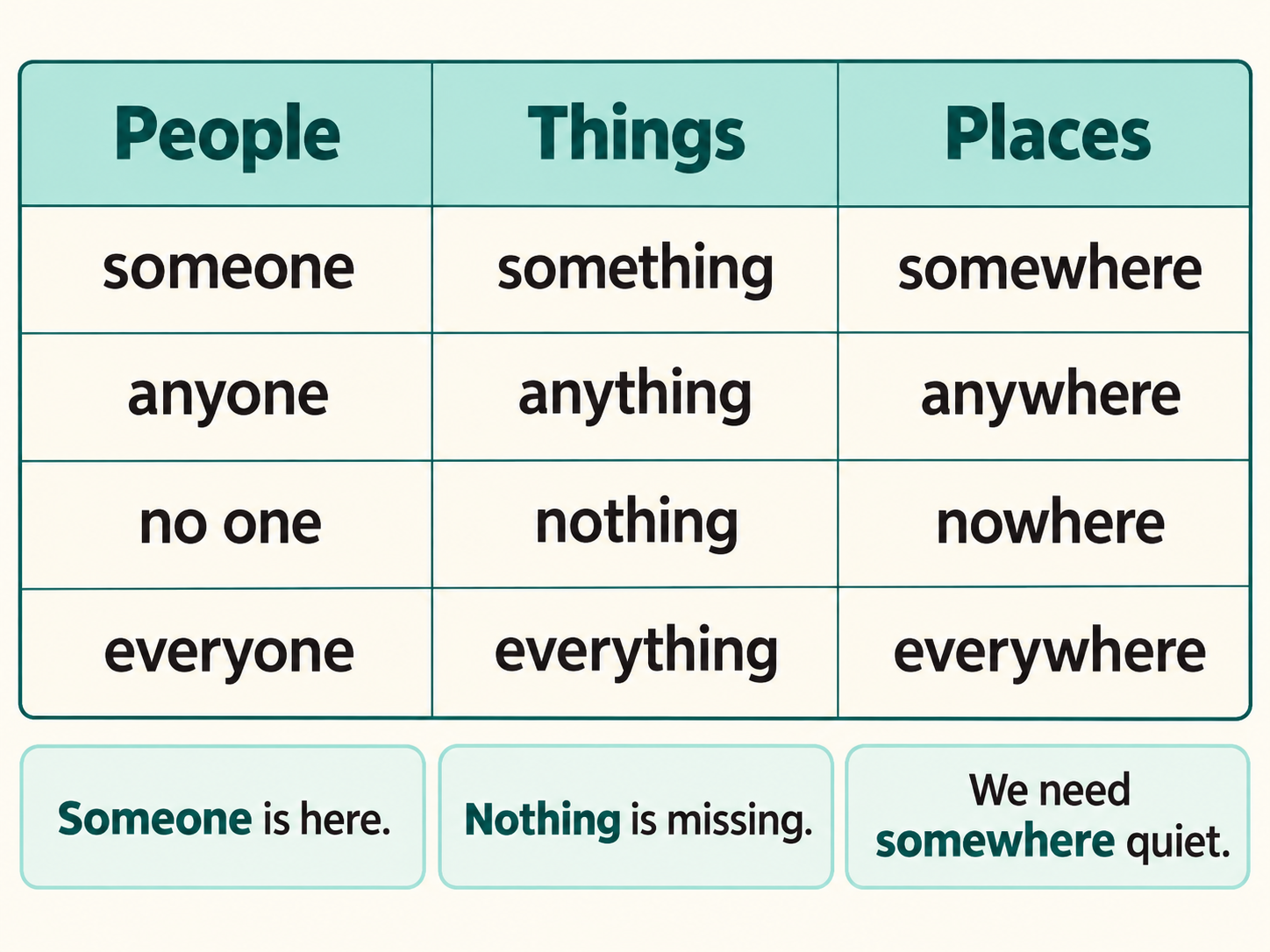
Use these words without another noun: “I saw someone”, not “I saw someone person”. Compare “some people” with “someone”. The first phrase has a noun after some; the second word already means a person. Also compare some and any before a noun, as in some people.
Some, any, no and every meanings
Some- often tells us that a person, thing or place exists: “Someone is at the door.” Any- is common in open questions and after a negative verb: “Did you find anything?” “I didn’t find anything.” No- means zero: “I found nothing.” Every- means all: “Everyone is ready.”
In standard English, choose one negative pattern: “I didn’t see anyone” or “I saw no one”. Do not combine didn’t and no one for this same meaning. Some English dialects use more than one negative, but these tasks practise the standard pattern.
Offers, expectations and free choice
Some- can be used in questions. “Would you like something to drink?” offers a drink. “Is someone at the door?” may show that you expect a person to be there, perhaps because you heard a knock. “Is anyone at the door?” is a more open check. The speaker’s meaning matters.
Anyone can also mean any person, with no special limit: “Anyone can join the game.” Similarly, “Choose anything you like” gives a free choice. Do not learn a rule that any- is possible only in questions or negative sentences.
Agreement and reference
Use a singular verb directly after these person and thing words: “Everyone is here”, “No one has a key”, “Something looks different”. Everyone refers to all the people, but the verb is singular.
You can use they and their later when a person’s gender is unknown: “Someone left their bag. I hope they come back.” This is natural English. It does not change the first verb: “Someone is waiting”, not “Someone are waiting”.
Add detail naturally
Put an adjective after the word: something useful, nothing strange, somewhere quiet. Say “I need something warm”, not “I need warm something”. You can also add a short to phrase: “There is nothing to do” or “I want something to read”.
Choose and repair
Answer on paper, then open the explanations below. Enable JavaScript to check answers here.
Apply to a final check
Your turn · self-review
Use it yourself
Make your own answer before opening the model. Other accurate answers are possible. Use the checklist to review meaning and form.
Practice only. Your writing stays on this page; it is not submitted or saved.
-
Model answer and explanation
Is anyone still here? Did I leave anything on the table? There is nothing in the drawer. Check person versus thing, singular is, and one negative meaning. Other clear questions are possible.
Now use these patterns in “Before Leaving the Guesthouse: Check for People and Belongings”. Read what the group knows before choosing a word.
Related Guides






Continue learning this topic
Review an explanation, study examples or try a related practice test.
- Practice test Question words: who, what, where, when, why, how, how often, and how many — A1 English Grammar Practice Test
- Practice test Past simple: regular and irregular verbs — A1 English Grammar Practice Test
- Practice test Daily life: a simple morning routine — A1 English Reading Practice Test
- Course lesson Subject pronouns and possessive adjectives – A1–A2: Grammar Foundations