
Guide
B2 · Upper-intermediate
Grammar
Cleft Sentences: Put the Important Information in Focus
Understand it-clefts and what-clefts and choose the fact that deserves emphasis.
10 min read
1,714 words
Updated Oct 22, 2026

On this page (12 sections)
B2 • About 22 minutes. Build it + be + focused phrase + who/that + clause. Use what-clefts with a singular clause as topic and an appropriate complement. Match a cleft to a correction or information gap without changing the original facts. Recognise when an ordinary sentence is clearer than an emphatic rewrite.
Start with the missing information
A cleft sentence divides a message so that one part receives special focus. Start with the ordinary event: “Leila booked the studio on Tuesday.” If someone asks who booked it, the useful new information is Leila. If they ask what she booked, it is the studio. If they ask when, it is on Tuesday. A correct cleft answers the actual question; a grammatically correct but wrongly focused sentence can still be an unhelpful reply.
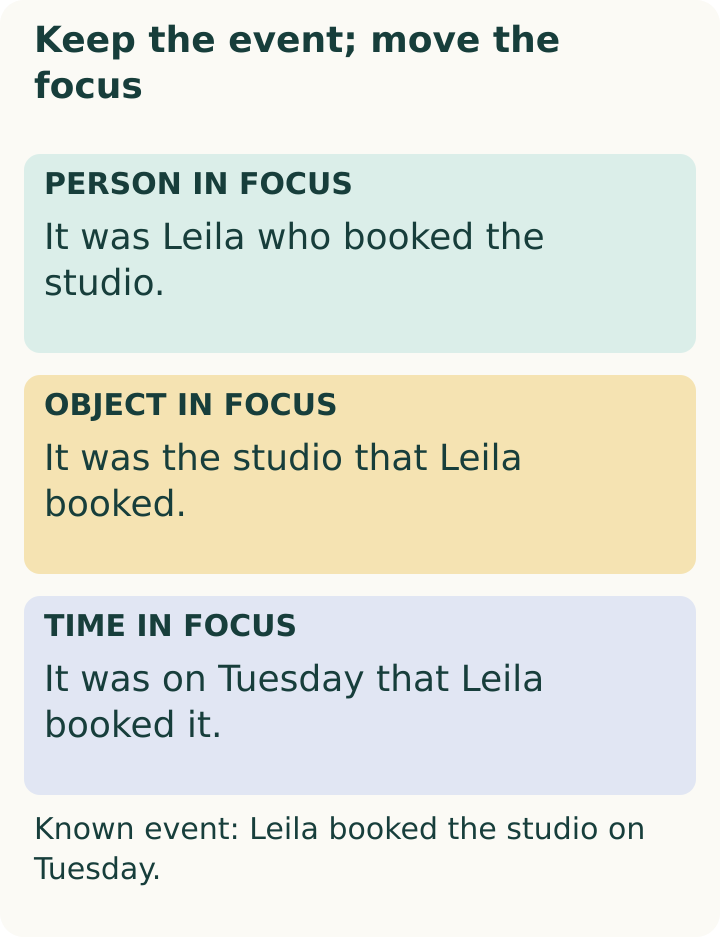
Compare three versions of one event: “It was Leila who booked the studio on Tuesday”; “It was the studio that Leila booked on Tuesday”; “It was on Tuesday that Leila booked the studio.” The person, place and day have not changed. What changes is the element offered as the correction or answer. This guide treats focus as an information decision before it becomes a sentence-building task.
You do not need a cleft for every answer. “Leila did” may be perfectly natural when someone simply asks who made a booking. A cleft is particularly useful when a wrong assumption needs correcting: “I think Omar booked it.” “Actually, it was Leila who booked it.” The surrounding context supplies the reason for the extra structure.
The it-cleft frame
The basic pattern is it + a form of be + the focused phrase + who/that + the remaining clause. In these examples, it is a structural subject; it does not refer to a previously named object. For a person, who or that is possible: “It was Maya who changed the booking” and “It was Maya that changed the booking.” For an object or time phrase in these patterns, use that.
Keep the grammar inside the background clause intact. “It was the assistants who were waiting” needs were because who refers to plural assistants. “It was the key that Lena needed” has no repeated object after needed. The focused key already fills that role. Do not write “It was the key that Lena needed it.”
Choose tense to match the intended time reference. These exercises use it was for a completed past event and it is for a present contrast. Natural discourse sometimes uses a present cleft to identify a past agent, but a controlled past-event rewrite is easiest to check when the time frame stays consistent. Never change Tuesday into Wednesday just to make a reconstruction fit.
What-clefts for needs, priorities and events
A what-clause can package the known question or topic, followed by be and the information that answers it: “What we need is a quiet room.” The clause what we need means the thing that we need. It takes statement order, not question order: what we need, not what do we need. The focused complement here is a singular noun phrase.
“What happened was that the door jammed” identifies an event through a that-clause. “What the team wanted was a written confirmation” identifies a need. These are different from the direct question “What happened?” and the embedded question “Tell me what happened.” A sentence containing what is not automatically a cleft.
With a form of do, the complement may be a bare infinitive or a to-infinitive: “What she did was change the room” or “What she did was to change the room.” This guide uses singular complements to keep agreement straightforward. In wider usage, plural complements can produce agreement variation, so do not turn the singular practice frame into an absolute rule for every possible what-cleft.
Keep four facts fixed while focus moves
Use this fictional evidence card: agent — Leila; action — booked; object — the studio; day — Tuesday. First write the neutral sentence. Then circle only the disputed detail. To correct the person, write “It was Leila who booked the studio on Tuesday.” To correct the room, write “It was the studio that Leila booked on Tuesday.” To correct the day, write “It was on Tuesday that Leila booked the studio.”
The complete time phrase on Tuesday belongs together. “It was Tuesday that…” can be used in some temporal constructions, but keeping on in this controlled frame makes the relationship transparent. The task is to preserve a supplied phrase rather than to test every conversational variant. After rewriting, read the sentence back as an ordinary statement. Can you recover exactly the original four facts?
Focus does not automatically change a statement into a claim that nothing else ever happened. Context determines the relevant alternatives. Avoid adding only, never, always or extra certainty unless the source supports them. If the evidence merely says Leila booked one room, do not infer that she has never booked another.
Context, tone and proportionate emphasis
A neutral reply gives a requested fact: “The session is in Room C.” A useful correction contrasts a mistaken fact: “It is Room C that we need, rather than Room A.” An overloaded message repeats the cleft frame in every sentence and makes a simple update feel ceremonious. Keep ordinary sentences for undisputed background, then use a cleft where the contrast helps.
Being emphatic is not the same as being rude or polite. “It was you who lost it” may sound accusatory in one context; “I think it was the earlier version that caused the confusion” can help identify a problem without blaming a person. Choose wording and evidence carefully. Grammar alone does not guarantee a diplomatic tone.
Repair form, then check truth
Three common form problems are missing be (“It Maya who called”), a duplicated object (“It was the form that I signed it”), and an incomplete background clause (“It was Tuesday that the booking”). Restore the frame, remove the repeated role, or complete the event. “It was Maya who called”; “It was the form that I signed”; “It was on Tuesday that the booking changed.”
Do not confuse identification inside a noun phrase with a cleft. “The person who called was Maya” identifies the person through a relative clause. “It was Maya who called” uses the it-cleft frame to focus Maya. Both can answer a question, but their structure is different. A useful editor names the actual problem rather than labelling all relative-clause-like sentences as clefts.
Eight checks: apply the rule
Answer before you check. For typed answers, use the requested wording; valid listed variants are accepted. Read the explanation even if your answer is right.
Match the focus to the problem
Answer on paper, then open the explanations below. Enable JavaScript to check answers here.
Reconstruct without changing the evidence
Answer on paper, then open the explanations below. Enable JavaScript to check answers here.
Repair predictable errors
Answer on paper, then open the explanations below. Enable JavaScript to check answers here.
Your decision card
Choose → rewrite → verify. What detail is disputed? Put only that detail in focus. Then recover the ordinary sentence and check agent, action, object and time. Person: It was Leila who booked the studio. Object: It was the studio that Leila booked. Time: It was on Tuesday that Leila booked it.
Related learning
Companion resource: Who Changed the Booking? Cleft Sentence Practice.
Related references for further study: Defining Relative Clauses: Who, Which, That and Where; Cohesive Paragraphs: Reference, Substitution and Linking Ideas; Polite Disagreement and Diplomatic Language.
For the structured course sequence, study Cleft sentences and focus. Use this standalone reference and its original exercises to diagnose and apply the patterns.
Related Guides






Continue learning this topic
Review an explanation, study examples or try a related practice test.
- Practice test WHO seeks more information after death at Russian plague research laboratory — B1 English Listening Practice Test
- Practice test WHO seeks more information after death at Russian plague research laboratory — B1 English Grammar Practice Test
- Practice test WHO seeks more information after death at Russian plague research laboratory — B1 English Vocabulary Practice Test
- Course lesson Be and basic sentences – A1–A2: Grammar Foundations
- Course lesson Cleft sentences and focus – C1: Precision and Expression