
Guide
B2 · Upper-intermediate
Grammar
Future in the Past: Was Going To, Would and Was About To
Describe plans, expectations and imminent events from a past viewpoint.
10 min read
1,754 words
Updated Oct 25, 2026

On this page (12 sections)
B2 • About 22 minutes. Set a past reference point and locate a later event relative to it. Choose was going to, would, was due to or was about to for a stated meaning. Distinguish future-in-past would from past-habit would. State outcomes separately instead of assuming a plan happened or failed.
Shift the viewpoint
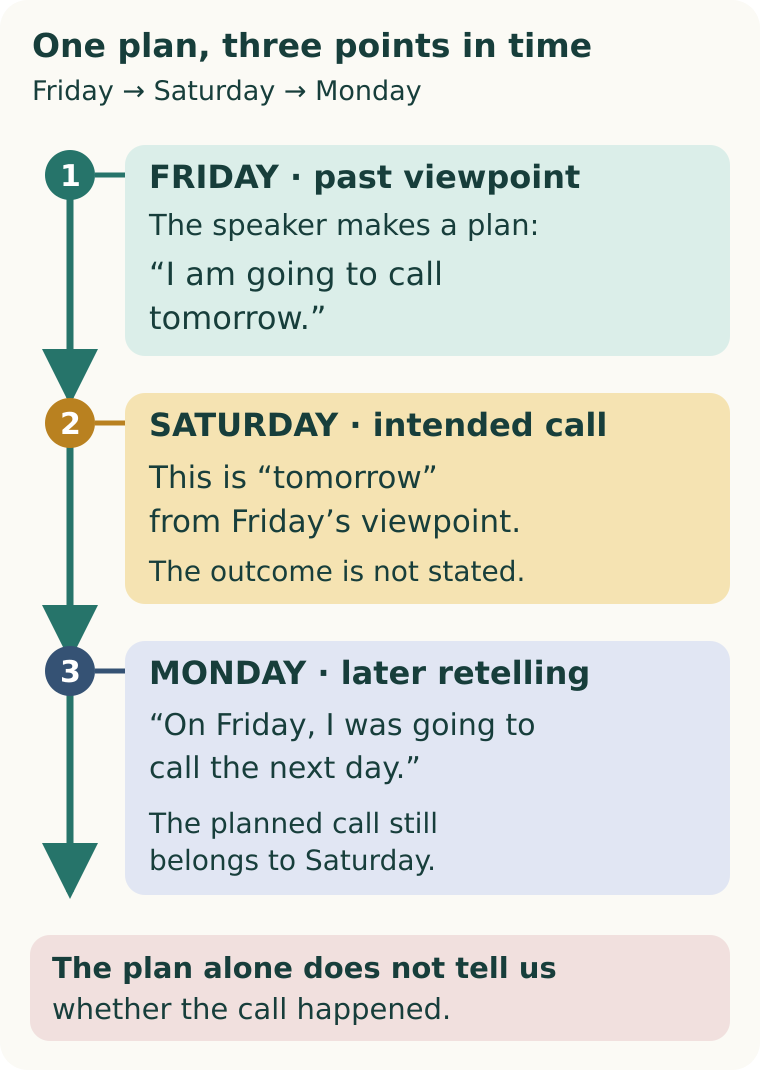
Future in the past describes an event that was still in the future at an earlier moment. On Friday, “I am going to call Nia tomorrow” points forward to Saturday. In a Monday recollection, “On Friday, I was going to call Nia the next day” looks forward from Friday. The call may now be in the speaker’s past, but it was later than the past viewpoint. Keep those two time relationships separate.
Build a timeline with three positions: past viewpoint → expected later event → present retelling. You do not need all three dates in every sentence, but the reader needs a recoverable anchor. “I thought the shop would be open” uses thought as the past anchor. The expected opening is later than, or viewed from, that earlier thought. The sentence does not by itself tell us the actual opening hours.
This is a viewpoint choice, not a special tense that proves a plan failed. Learn the form together with the continuation. Compare “We were going to meet at noon, and we did” with “We were going to meet at noon, but the train was delayed.” The same intention form introduces two different outcomes.
Plans and intentions: was or were going to
Use was/were going to + base verb to report a past intention: “I was going to print the tickets”; “They were going to bring lunch.” Was agrees with I/he/she/it; were agrees with you/we/they. Keep the main verb uninflected: was going to print, not was going to printed.
The outcome needs evidence. “I was going to print the tickets” leaves it unspecified. “I was going to print the tickets, and I printed them after lunch” confirms completion. “I was going to print the tickets, but the printer stopped working and I used the digital version instead” establishes a changed plan. A but-clause often signals an obstacle, but even an obstacle alone does not logically prove permanent cancellation.
Be precise about what was planned. A sentence may name a person’s intention without proving that everyone agreed. “Nia was going to book a table” does not mean “A table was booked.” If a diary records only intentions, mark outcomes as unknown instead of filling the gaps from what normally happens. This distinction is useful in project updates, travel stories and everyday recollections.
Predictions and reported future: would
“We thought the hall would be quiet” reports an earlier expectation. “Nia said she would call after lunch” reports her future-oriented words from a past viewpoint. Would is followed by the base form, including be: would call, would be quiet. It does not take an -s ending or a to-infinitive.
To connect this pattern with ordinary speech reports, review reporting statements. Here, keep the predicted event later than the past viewpoint.
Compare direct words and a later report. Friday: “The guide will arrive at ten.” Monday: “We were told that the guide would arrive at ten.” The report preserves the expected time; it does not assert actual arrival. Add “She arrived at ten fifteen” only if the source gives that outcome. Pronouns and time phrases also need to match the new speaker and retelling date.
Sometimes a narrator uses would for an event known from a later viewpoint: “That small choice would change the whole afternoon.” That storytelling use looks forward within a past narrative. This guide concentrates on stated expectations and reports, where checking the source makes the meaning easier to establish.
Schedules and imminence
Was/were due to and was/were scheduled to describe an expected or arranged time: “The coach was due to leave at nine”; “The exhibition was scheduled to open on Saturday.” Neither phrase guarantees that the event happened. “The coach was due to leave at nine but left at nine twenty” explicitly supplies the outcome.
Was/were about to means something was expected very soon: “We were about to leave when the organiser called.” The group had not necessarily left already. The sentence places the call at the edge of departure; whether departure followed is a separate question. About to is normally unsuitable for a distant plan such as a holiday next year.
Choose the phrase that tells the reader what matters. A timetable calls for due to or scheduled to. A personal plan calls for going to. A moment immediately before an action calls for about to. More than one form can sometimes fit, but they highlight different features rather than functioning as interchangeable decoration.
Would has several jobs
Context separates future expectation, repeated habit and hypothetical meaning. “On Friday, I thought we would visit the gallery on Saturday” is an expectation from a past viewpoint. “When we lived nearby, we would visit the gallery every month” describes a repeated past habit. “I would visit the gallery if I had more time” describes a hypothetical situation.
An isolated sentence such as “We would meet there” can support several readings. Add an anchor or continuation before deciding. A repeated-time phrase such as every summer supports a habitual reading; thought or said plus a later date supports future in the past; an if-clause can establish a hypothetical condition. Do not assign one label from would alone.
Would also appears in requests and preferences, but those uses are outside this timeline task. The useful habit is to ask what communicative job the whole sentence performs. A word-for-word substitution chart cannot replace that context check.
Repair viewpoint and outcome together
“On Friday we were going to leave on Saturday, so we definitely left” adds an unsupported conclusion. Repair it to “On Friday we planned to leave on Saturday; the note does not say whether we did.” If a later diary says they left, cite that evidence instead. The grammar of intention is not a record of completion.
“We were about to travel next year” normally creates a mismatch between imminence and a distant date. “We were planning to travel the following year” is clearer. “Nia said she would arrived” needs the base form arrive. “At ten we were about to leave, but we had already left at nine” contains incompatible viewpoints unless the story explicitly describes a second departure.
Finally, check words such as tomorrow, the next day and later. They depend on the reference time. A Monday report of Friday’s “tomorrow” normally means Saturday, not Tuesday. Naming the day can be the simplest solution when several messages from different dates are combined.
Eight checks: apply the rule
Answer before you check. For typed answers, use the requested wording; valid listed variants are accepted. Read the explanation even if your answer is right.
Match the timeline
Answer on paper, then open the explanations below. Enable JavaScript to check answers here.
Choose a precise form
Answer on paper, then open the explanations below. Enable JavaScript to check answers here.
Judge the outcome
Answer on paper, then open the explanations below. Enable JavaScript to check answers here.
Your decision card
Past anchor → intended later event → outcome evidence. Friday plan: call on Saturday. Monday report: was going to call the next day. Outcome: happened / changed / not stated. Keep these three fields separate.
Related learning
Companion resource: The Weekend We Had Planned: Future-in-the-Past Practice.
Related references for further study: Future Forms: Will, Going To and Present Continuous; Used To and Would: Talking About Past Habits; Reported Speech: Statements.
Related Guides






Continue learning this topic
Review an explanation, study examples or try a related practice test.
- Practice test Question words: who, what, where, when, why, how, how often, and how many — A1 English Grammar Practice Test
- Practice test Past simple verb forms: regular, irregular, and spelling exceptions — A1 English Grammar Practice Test
- Practice test Past simple: regular and irregular verbs — A1 English Grammar Practice Test
- Course lesson Present perfect or past simple – B1–B2: Grammar in Context
- Course lesson Past perfect and earlier events – B1–B2: Grammar in Context
- Course lesson Telling a story with past tenses – B1–B2: Grammar in Context