
Guide
A2 · Elementary
Reading
Laundry and Cleaning Vocabulary: Read Everyday Care Instructions
Understand everyday cleaning verbs and written care-label phrases. Eight explained checks distinguish actions, conditions and missing information using fictional labels.
9 min read
1,541 words
Updated Oct 23, 2026

On this page (7 sections)
Begin with the instruction, not the object
Care instructions use short phrases to tell a reader what action is needed. A shirt and a scarf may look similar but have different labels. Start with the written instruction instead of guessing from the object’s appearance.
The noun tells you the object or surface. The verb tells you the action. The words after the verb may add a method, condition or limit. Read the whole line, especially do not.
Cleaning actions that are not interchangeable
Wipe means move a cloth or similar material over a surface. Sweep means move loose dirt with a broom. Mop means clean a floor using a mop, usually with liquid. Vacuum means use a vacuum cleaner to remove dust or dirt. Dust means remove dust from a surface. These verbs name different actions, even when their general purpose is cleaning.
Verb | Typical object or surface | Meaning in this example |
|---|---|---|
wipe | a table | Move a cloth across the tabletop. |
sweep | a floor | Move loose dirt with a broom. |
mop | a floor | Use a mop on the floor. |
vacuum | a carpet | Use a vacuum cleaner on it. |
dust | a shelf | Remove the dust from its surface. |
wash | a garment | Clean it using water. |
rinse | a washed item | Use water to remove soap. |
Object pairs help you remember meanings. For example, wipe can go with table, shelf or worktop. The object changes, but the verb still describes moving a cloth across a surface.
Laundry from start to finish
Laundry can mean clothes that need washing or the activity of washing them. Useful action words are sort, wash, rinse, dry, fold and hang. Sort means put items into groups. Fold means bend one part over another to make the item smaller and neater. Hang means put an item on a support such as a hanger or line.
A classroom sequence is sort → wash → rinse → dry → fold. Hanging can be one way of drying, so hang and dry are not always two separate stages.
Tumble dry means dry in a machine that turns the clothes. Air dry means let an item dry without a tumble dryer. Dry flat tells you to keep the item laid out flat while it dries. Hang to dry tells you to support it on a line or hanger. Keep the exact wording rather than treating all drying phrases as identical.
Supplies and surfaces
A cloth is a piece of fabric used for tasks such as wiping. A brush has bristles. A bucket is a container, often used to carry water. Detergent is a cleaning product. A floor is the lower surface of a room; a shelf is a flat surface used to hold things. A surface is the outside or top layer you work on.
In “Wipe the table with a cloth”, table is the surface and cloth is the tool. In “Fold the towel”, the towel is the item being folded. The word with often introduces a tool, but you still need to read the whole instruction.
Look at each supply and name its role in the pictured task: a cloth for wiping, a broom for sweeping, and a basket for holding clothes.
For more practice, review do the laundry and other make/do combinations.
Read the key words on a care label
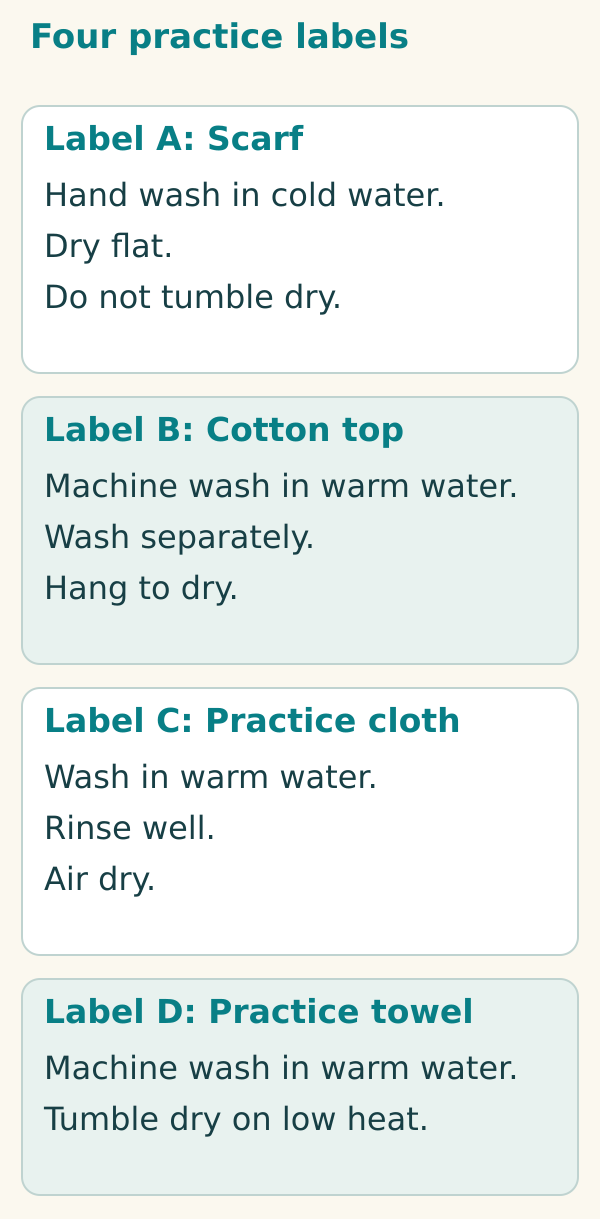
Hand wash means wash by hand; machine wash names a washing-machine method. Cold and warm describe water temperature in ordinary language here. No number is given, so do not invent a temperature setting. Separately means not together with the other items. In Label B it modifies wash.
Low heat names a low heat setting, but a real machine or manufacturer may give more specific information. Do not tumble dry is a negative instruction: the named action should not be used for that item. Missing instructions are different from negative instructions.
Label D names a wash method and drying method. It does not mention ironing, colour sorting or a detergent amount. Those details are not stated.
Spot a mismatch
Imagine a task card for Label A that says “Machine wash in cold water, then hang to dry.” Cold water matches one phrase, but machine wash conflicts with hand wash, and hang conflicts with dry flat. One matching word is not enough to make the whole card correct.
Correct classroom card: “Hand wash in cold water, then dry flat.” Keep the additional restriction “Do not tumble dry” in your notes. A useful check has three slots: action or method, temperature wording, drying instruction. Compare every supplied slot.
Now compare Label B with “Machine wash in warm water together with the other items, then hang.” The method and drying instruction match, but together conflicts with separately. Mark the exact conflict. Do not discard the whole source or change another detail unnecessarily.
Eight checks and a label-reading routine
Questions 1–4 match verbs to actions. Questions 5–6 check meanings. Questions 7–8 use the fictional labels above. Answer from the stated wording, not from your experience with a real garment.
Answer on paper, then open the explanations below. Enable JavaScript to check answers here.
Routine: read the whole label; identify the action and object; match method, temperature wording and drying instruction; check any negative or separate condition; mark missing information as not stated. Finally compare your task card with the source once more.
For more useful word groups after this routine, practise common everyday collocations.
Your turn · self-review
Transfer task: your turn
Self-check: machine wash, warm water, separately and hang to dry are all retained.
Practice only. Your writing stays on this page; it is not submitted or saved.
-
Model answer and explanation
Machine wash the cotton top in warm water, separately from the other items. Hang it to dry.
Next, apply the words to new fictional garments in Care for the Clothes: Match Labels, Tasks and Supplies. Optional related language work includes clear imperatives and everyday collocations; draft resources become available after release.
Related Guides





Continue learning this topic
Review an explanation, study examples or try a related practice test.
- Practice test Should “bird brain” be a compliment? New research examines how crows think fast — C2 English Reading Practice Test
- Practice test Airbnb Will Limit Chores Hosts Can Require of Guests — C1 English Reading Practice Test
- Practice test See how Big Tech is transforming Spain's landscape — B2 English Reading Practice Test