
Guide
B2 · Upper-intermediate
Reading
How to Improve Your English Reading Skills
Learn practical reading strategies for finding main ideas, locating details, making inferences, understanding vocabulary in context, and answering exam questions with confidence.
6 min read
1,032 words
Updated Aug 9, 2026
On this page (10 sections)
Reading well in English is not the same as translating every word. Strong readers preview the text, choose a strategy for the task, and return to the passage for evidence. This guide shows you how to read with more confidence in everyday English and in exams.
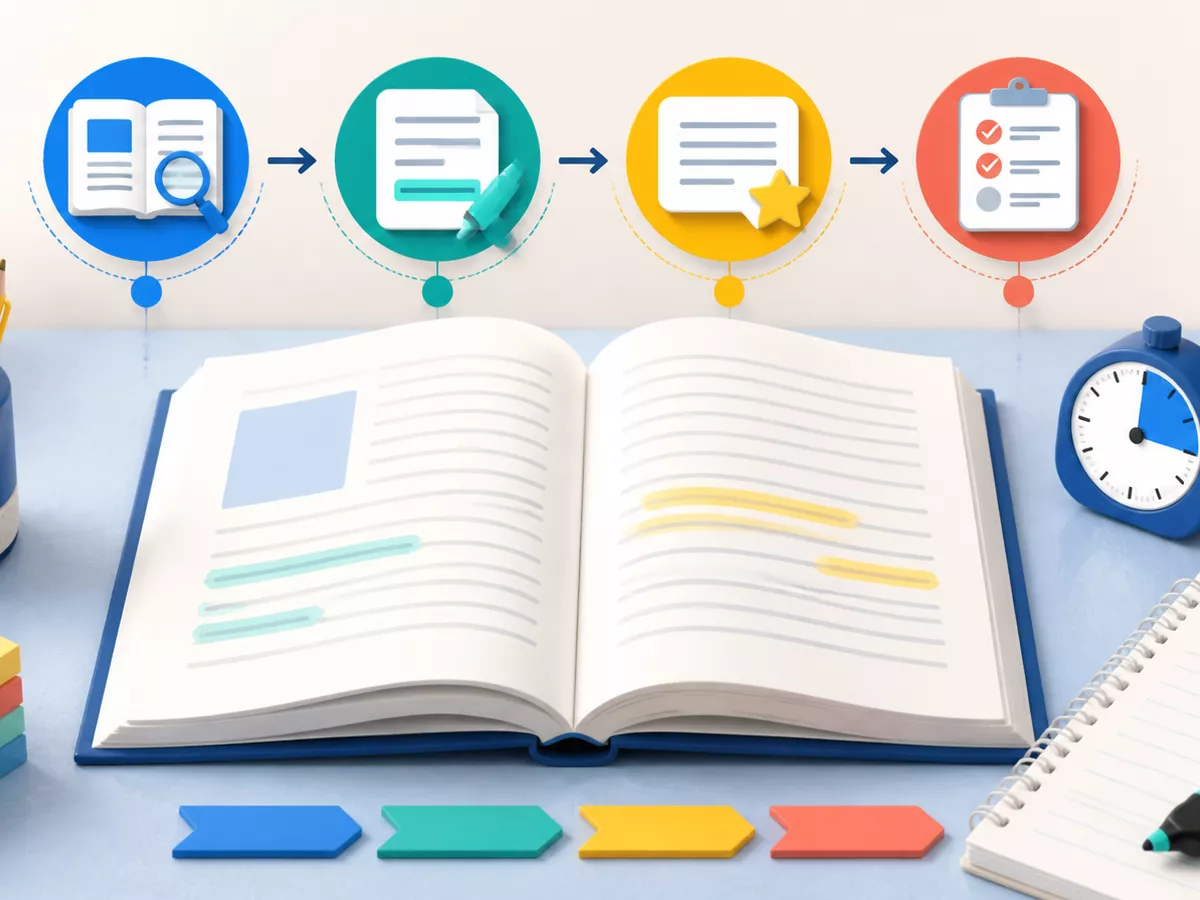
The three-step reading process
Step | What to do | Why it helps |
|---|---|---|
Preview | Read the title, headings, opening lines, and any questions before reading every detail. | You build a quick map of the text and predict its topic. |
Read with a purpose | Choose whether you need the main idea, a detail, an inference, or the meaning of a word. | A clear purpose tells you which information deserves your attention. |
Prove your answer | Return to the relevant sentence or paragraph and check what the text actually supports. | Evidence protects you from answers that only sound reasonable. |
Skim for the main idea
Skimming means reading quickly to understand the overall message. It is useful before a close read and whenever a question asks for the best title, purpose, or summary. Do not stop at every unfamiliar word. Notice the title, repeated ideas, contrast words such as “however”, and the first or last sentence of each paragraph.
Read the title and predict the topic in three or four words.
Read the first sentence of each paragraph and notice repeated nouns or ideas.
Ask, “What is the writer mainly trying to say?”
Summarise the text in one sentence before looking at the answer choices.
Skimming is a map, not a shortcut. It helps you know where to slow down later.
Scan for specific details
Scanning means moving through a text to locate one particular piece of information. It works well for names, dates, prices, places, reasons, and numbers. First underline the important words in the question, then look for the same idea or a natural paraphrase in the passage.
Question clue | Search for | Check before choosing |
|---|---|---|
Who? | a person, group, or job title | Make sure the person is connected to the action in the question. |
When? | a date, time, season, or time expression | Check whether it describes the event itself or a different event nearby. |
Why? | because, since, to, or a sentence showing a reason | Separate the writer’s reason from a result or example. |
How many / how much? | a number, amount, or comparison | Check the unit and whether the number is positive or negative. |
Read between the lines
An inference is a conclusion that the text supports without stating in exactly the same words. To answer an inference question, combine a clue from the passage with common sense. Do not choose an answer simply because it is possible; choose the answer that the evidence makes most likely.
Ask yourself | Look for | Avoid |
|---|---|---|
What does the writer suggest? | a detail plus the feeling or result it implies | an idea that is too strong or too broad |
How does the writer feel? | evaluative words, examples, and contrasts | your personal opinion about the topic |
What will probably happen next? | the direction of the final paragraph or an unfinished plan | a prediction with no clue in the text |
Unlock unfamiliar vocabulary from context
You can often understand an unfamiliar word without a dictionary. Read the sentence before and after it, then look for a definition, an example, a contrast, or a familiar word with a similar meaning. Decide what the word means in this text, not every meaning it can have.
Cover the unfamiliar word and read the sentence without it.
Identify whether the surrounding idea is positive, negative, a cause, or a result.
Replace the word with a simple guess and check whether the sentence still makes sense.
Continue reading. Return to the word only if it affects the question.
Match your strategy to the question
Question type | Best first move | Evidence check |
|---|---|---|
Main idea or title | Skim the whole text and compare repeated ideas. | The answer should cover the text without being too narrow. |
Specific detail | Scan for the key noun, number, or paraphrase. | The relevant sentence must directly answer the question. |
Inference | Find the clue and connect it to the implied conclusion. | The text should make the answer likely, not merely possible. |
Meaning in context | Read around the word and test a simple replacement. | The meaning must fit the sentence and topic. |
Writer’s attitude | Notice adjectives, examples, and contrast markers. | The tone should match the writer’s language, not your reaction. |
A reliable exam reading routine
Read the instructions carefully and identify the question type.
Preview the title, layout, and first lines before reading slowly.
Read the questions and underline the words that define the search.
Return to the passage in order. Mark evidence rather than relying on memory.
Eliminate answers that contradict the text or introduce information that is not there.
Use the final minute to check unanswered questions and confirm that each answer matches the question wording.
When one sentence is difficult
Do not allow one long sentence to stop the whole reading. Find the main verb, identify the subject, and separate extra phrases with commas or linking words. If the sentence is not essential to the current question, move on and return later. Progress is part of good exam technique.
If you see... | Try this |
|---|---|
a long sentence | Find the subject and main verb first. |
an unknown reference word | Look at the previous sentence for the noun it replaces. |
several unfamiliar words | Use the familiar words to identify the overall direction. |
two close answers | Find one sentence that supports one answer more clearly. |
A 15-minute practice routine
Minutes | Activity | Target |
|---|---|---|
2 | Preview a short article and predict its main idea. | Build a text map. |
5 | Read for the main idea, then write a one-sentence summary. | Practice skimming. |
5 | Answer two detail or inference questions and underline evidence. | Practice scanning and proof. |
3 | Choose one unfamiliar word and explain its meaning from context. | Build vocabulary independence. |
Final reading checklist
I know what the text is mainly about.
I chose a strategy that fits the question.
I can point to evidence for my answer.
I did not let one unknown word stop my reading.
I checked the exact wording before submitting.
The goal is not to read every text at the same speed. The goal is to slow down for meaning, speed up for searching, and always return to evidence.
Choose a short English article today and practice only one strategy. On your next reading, add a second strategy and compare how much more clearly you can explain the text.
You may also like
B2
Daily News
Archaeologists race to save artifacts in Alaska after storm damage
Archaeologists in Alaska are trying to protect as many objects as possible after remnants of a typhoon damaged an archaeological dig site last year.
Read resource
C2
Daily News
Five Years On, the NPR College Podcast Challenge’s First Winner Reflects on Journalism’s Lasting Reach
Five years after winning the inaugural NPR College Podcast Challenge, one journalist reflects on her early work and reconnects with fellow participants to consider where their stories have led.
Read resource
C2
Daily News
‘Fire amoeba’ sets a new thermal limit for complex life
Scientists have identified a species they have named the fire amoeba, establishing a record thermal limit for complex eukaryotic life.
Read resource