
Guide
B2 · Upper-intermediate
Grammar
Third Conditional: Imagining a Different Past
Separate past facts from imagined alternatives with had + participle and would, could or might have, plus six explained checks.
8 min read
1,353 words
Updated Nov 10, 2026

On this page (11 sections)
Look back without changing the facts
An event started late. The organiser did not test the projector cable the day before. Looking back, the team says, If we had tested the cable earlier, we would have discovered the fault. The real past remains the same: they did not test it earlier. The conditional describes an imagined alternative.
Third conditionals help us reflect on decisions, explain missed opportunities and consider improvements. They are not evidence that an imagined outcome certainly would have happened. When several causes affected an event, choose language that respects what you know and what you cannot know.
Build a past condition and past result
Use if + had + past participle for the condition. Use would have + past participle for the imagined result. If the driver had received the correct address, she would have gone to the right building. The first clause imagines a different earlier fact; the second gives the result the speaker predicts within that imagined past.
The structure does not change with the subject: if I had checked, if she had checked, if they had checked. Would have also stays the same. The past participle is essential: had seen, not had saw; would have gone, not would have went. With regular verbs, it often ends in -ed: checked, arrived, tested.
Reverse the clauses if it helps the flow: We would have discovered the fault if we had tested the cable. Normally use a comma when the if-clause comes first. In the standard pattern here, do not put would have in both clauses.
Use negatives to match the alternative
Actual fact: We sent the old address. Imagined alternative: If we hadn’t sent the old address, the driver might have found us sooner. Actual fact: We did not allow extra travel time. Alternative: If we had allowed extra travel time, the delivery might not have delayed the setup.
A negative in the real fact often leads to a positive alternative, or the reverse. But do not simply reverse every verb mechanically. Decide exactly what you are imagining. The result can be positive or negative: If the hall had been locked, we wouldn’t have been able to enter.
Read contractions carefully
Had not becomes hadn’t; would not have becomes wouldn’t have. In speech, I’d can mean I had or I would. The words after it help: If I’d checked means If I had checked. I’d have noticed means I would have noticed. Writing the full forms is useful while you are learning.
Would have often sounds reduced in conversation, but write have, not of. If we had left earlier, we would of arrived sooner is not standard written English. The correct written form is would have arrived. This guide uses full forms in most examples to keep the structure visible.
Choose would, could or might
Would have presents a result the speaker expects in the imagined situation: If we had saved the file, we would have had a copy. Could have often describes an opportunity or ability: If the room had been unlocked, we could have set up earlier. The opportunity does not prove that we would have used it.
Might have presents a possible, uncertain result: If we had advertised earlier, more people might have attended. Many other factors affect attendance. Could have can also express possibility, so context matters. Do not treat would, could and might as interchangeable decorations: they communicate different degrees or kinds of commitment.
Separate evidence from hindsight
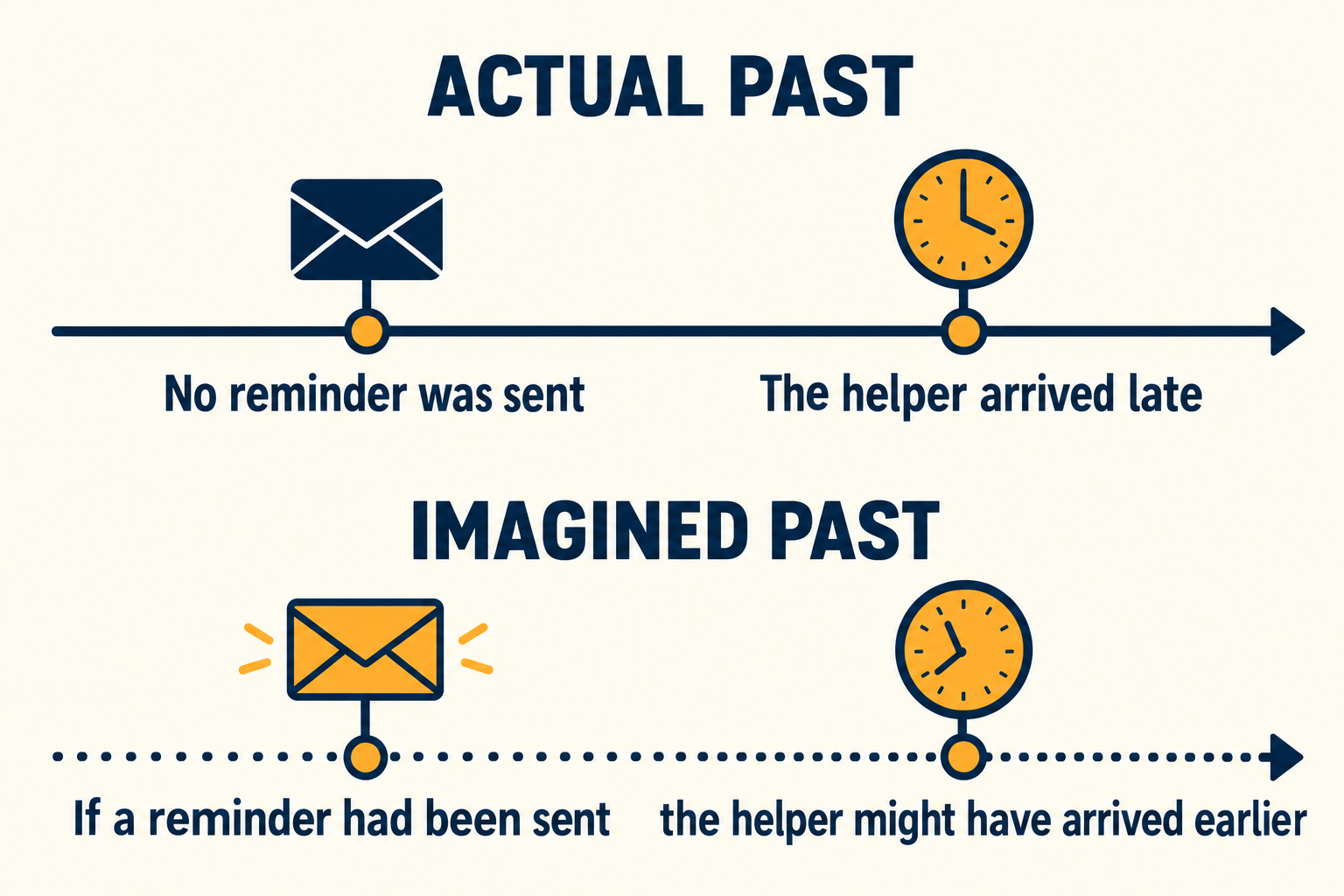
Write down the actual facts before creating alternatives. A late email, heavy rain and a faulty cable may all have contributed to a delay. If we had sent a reminder, everything would have been perfect is a much stronger claim than the evidence supports. If we had sent a reminder, some helpers might have arrived earlier is more careful.
Use reflection to identify practical changes rather than blame one person for every problem. State the fact, choose a plausible alternative and acknowledge uncertainty. Keep both clauses about the past for this lesson. Mixed conditionals, which connect a past condition to a present result, are a separate topic.
A short worked example
Facts: The team did not check the updated room number. Several guests went to the wrong door. Alternative: If the team had checked the updated room number, it would have sent a more accurate invitation. Possible further result: More guests might have arrived at the correct room on time.
The first result follows directly from correcting the information. The second is less certain because travel, weather or other factors could still have delayed guests. This distinction makes a retrospective fairer and more useful.
Check your understanding
Choose or type your answers. Then read every explanation. The short checks give feedback on these answers only.
Answer on paper, then open the explanations below. Enable JavaScript to check answers here.
Answer key and explanations
1. We did not check it in the situation being imagined differently. — The third conditional imagines a past alternative to the stated situation.
2. If the driver had received the correct address… — Had received places the alternative condition in the past.
3. seen — The past perfect uses had plus the past participle seen, not saw.
4. left — Would have needs the past participle left.
5. More people might have attended. — Might have marks the outcome as possible rather than guaranteed.
6. An available opportunity or ability — Could have describes what would have been possible, not what actually happened.
Your turn · self-review
Use the language yourself
Write or speak first, then compare these possible models. Your wording may be different. This is self-check practice; it does not automatically score your writing or pronunciation.
Practice only. Your writing stays on this page; it is not submitted or saved.
-
Model answer and explanation
If the organiser had sent a reminder, some helpers might have remembered the time.
-
Model answer and explanation
If the team had saved the final file, it would have had a final copy.
Self-check and next step
Check the meaning first, then the form. Read your answer aloud at a comfortable speed. Correct one feature, try again, and compare with the examples. Ask a teacher or partner for feedback if you are unsure.
Useful reference
Related Guides






Continue learning this topic
Review an explanation, study examples or try a related practice test.
- Practice test Nvidia shares fall as company investigates alleged link involving CEO Jensen Huang — C2 English Listening Practice Test
- Practice test Nvidia shares fall as company investigates alleged link involving CEO Jensen Huang — C2 English Grammar Practice Test
- Practice test Nvidia shares fall as company investigates alleged link involving CEO Jensen Huang — C2 English Vocabulary Practice Test
- Course lesson Present perfect or past simple: Choosing the right tense – B1–B2: Grammar in Context
- Course lesson Past perfect: What had happened before? – B1–B2: Grammar in Context
- Course lesson Narrative tenses: Telling a story in the past – B1–B2: Grammar in Context