
Guide
B1 · Intermediate
Grammar
Gerunds and Infinitives: Common Verb Patterns
Learn common -ing and to-infinitive patterns, verbs after prepositions and purpose with to. Compare stop doing with stop to do in six explained checks.
6 min read
920 words
Updated Nov 8, 2026

On this page (9 sections)
Learn the pattern with the verb
Some verbs need another verb to complete their meaning: I enjoy cooking. I hope to learn. The second verb can have an -ing form or a to-infinitive. This choice often depends on the first word or phrase. Learn useful combinations as whole patterns, rather than guessing from the meaning of one verb.
An -ing form used this way is often called a gerund. A to-infinitive is to + the base form: to cook, to learn, to go. This guide covers a useful beginner set; it is not a rule for every English verb.
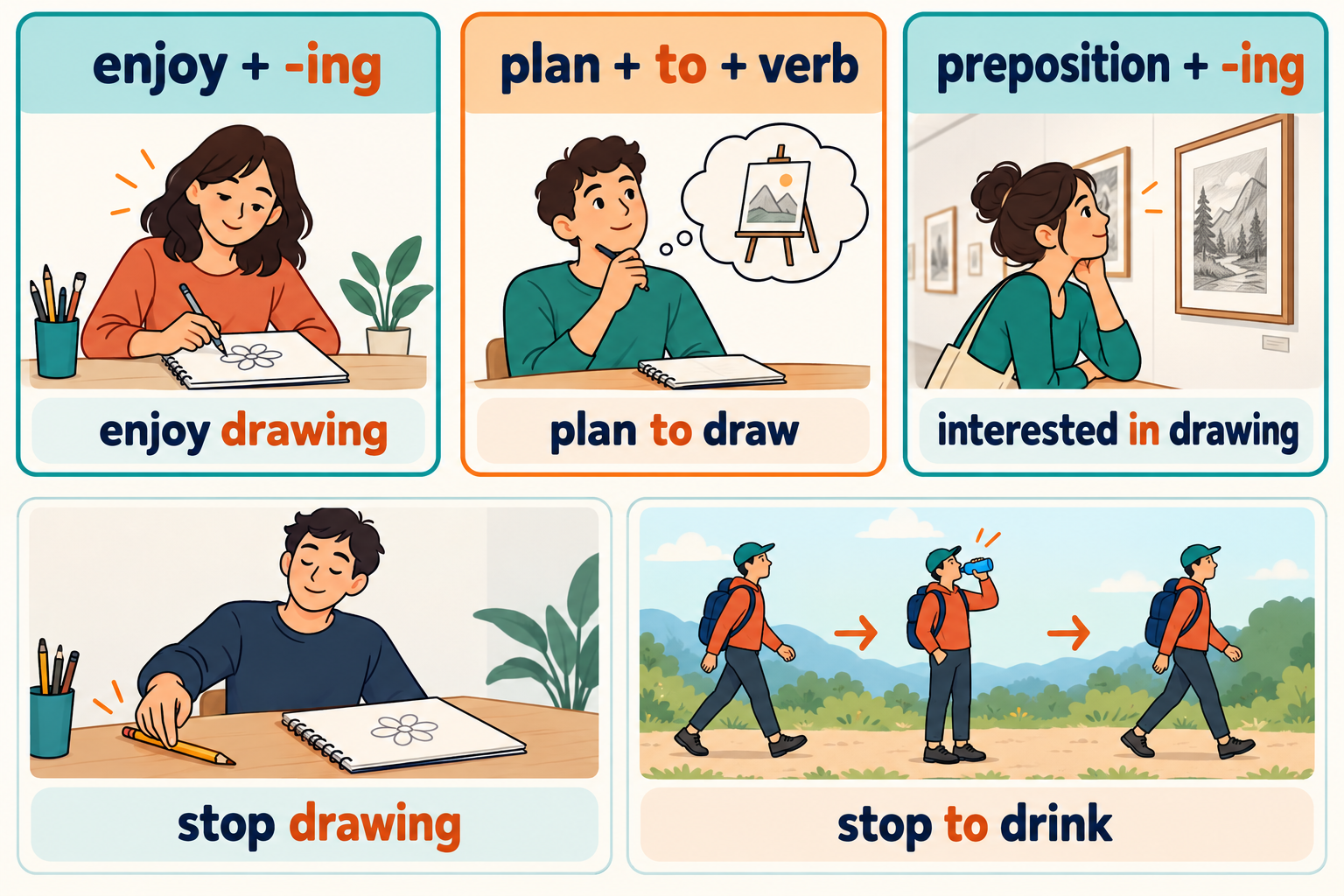
Enjoy, avoid and finish + -ing
enjoy doing: I enjoy making things with my hands.
avoid doing: We avoid travelling at busy times.
finish doing: She finished painting the chair.
Keep the first verb in the tense you need: I enjoyed cooking yesterday. I have finished cleaning. The following pattern stays -ing. Do not write “enjoy to cook” or “finish to clean” in these meanings.
Decide, hope and plan + to-infinitive
decide to do: We decided to join a drawing group.
hope to do: I hope to meet new people.
plan to do: She plans to practise twice a week.
The first verb changes with the subject and time: He plans to go; they planned to go. To is followed by the base verb, not an -ing form or a past form. To make the infinitive negative, usually put not before it: I decided not to buy new equipment.
A verb after a preposition takes -ing
Compare a noun and a verb after in: I am interested in photography. I am interested in taking photographs. Use -ing after other prepositions too: good at drawing, worried about spending money, before leaving, without asking.
Do not assume that every to introduces an infinitive. In “I look forward to meeting you”, to belongs to the phrase look forward to and acts as a preposition. Learn that whole phrase. In “I hope to meet you”, to introduces the infinitive.
To + verb can explain a purpose
I joined the club to make friends answers Why did you join? The infinitive describes the purpose of joining. She went outside to take a photo. We met early to plan the trip. This purpose pattern is different from a fixed complement such as hope to learn, although both contain to + verb.
Avoid “I joined for meet people”. Say I joined to meet people. For can introduce a noun: I joined for the company. Some for + -ing phrases describe what something is used for: a tool for cutting paper.
Stop doing and stop to do change the meaning
I stopped drawing means that drawing ended. I stopped to answer the phone means I paused another activity in order to answer it. The action after to is the reason for the pause; it is not the action that stopped.
Context makes the sequence clear: I was drawing. I stopped drawing at six and went home. In a different story: I was drawing when my phone rang. I stopped to answer it, then continued the picture. Neither sentence means the person can never draw again.
Six quick checks
Choose or type the form that fits the stated meaning. Then read the explanation.
Answer on paper, then open the explanations below. Enable JavaScript to check answers here.
Use the patterns together
Your turn · self-review
Explain a plan
Write two sentences about an activity you want to try. Compare this model.
Practice only. Your writing stays on this page; it is not submitted or saved.
-
Model answer and explanation
I enjoy taking photos, so I plan to join a weekend group. I am interested in learning how to use natural light.
Self-check
I learnt the first verb and its following pattern together.
I used -ing after a preposition.
I used to + base verb to state a purpose.
I checked whether stop means ending an activity or pausing for another one.
Related Guides






Continue learning this topic
Review an explanation, study examples or try a related practice test.
- Practice test Places Around Town Words — A1 English Vocabulary Practice Test
- Practice test Clothes and Weather Words — A1 English Vocabulary Practice Test
- Practice test Finding the Library on Green Street — A1 English Listening Practice Test
- Course lesson The verb be: Am, is and are – A1–A2: Grammar Foundations
- Course lesson Adverbs of frequency: Always, sometimes and never – A1–A2: Grammar Foundations
- Course lesson Gerund or infinitive: Choosing the form after a verb – B1–B2: Grammar in Context