
Guide
B1 · Intermediate
Grammar
Second Conditional: Imagining Different Situations
Use if + past form and would + base verb to imagine present or future alternatives, offer advice, and complete six explained checks.
8 min read
1,285 words
Updated Nov 8, 2026

On this page (10 sections)
Imagine a different situation
Suppose your town has a busy car park but little green space. You might say, If we had more space, we would plant a community garden. You are imagining a situation that is different from the present. You are not reporting that the town had more space in the past.
The second conditional is useful for ideas, dreams, hypothetical choices and advice. The situation may be impossible now, unlikely, or simply presented as more remote. The speaker’s view matters. A form alone cannot tell us the precise probability that an idea will happen.
Make the two parts
Use if + a past form for the imagined condition, followed by would + the base form for its result. If the council owned this land, it would build a small park. Owned is the past form in the if-clause. Would build has a base verb after would, without -s or to.
You can reverse the clauses: The council would build a small park if it owned this land. When the if-clause comes first, normally use a comma after it. When the result comes first, a comma is normally unnecessary. Reversing the order does not change the basic meaning.
For a negative condition, use didn’t + base verb: If cars didn’t use the square, people would have more space. For a negative result, use wouldn’t + base verb: If there were a bike lane, I wouldn’t drive to work. Do not write didn’t used or wouldn’t drove.
Past form does not always mean past time
Compare these two sentences: When we had a garden, we grew herbs. If we had a garden, we would grow herbs. The first describes a past situation. The second imagines a present or future alternative. Would grow and the wider context help you understand the meaning.
For ordinary second-conditional sentences, put would in the result clause, not in both clauses. If we would have more room, we would add benches is not the standard pattern being practised here. Use If we had more room, we would add benches. There are other specialised uses of would in if-clauses, but they are outside this guide.
Use were and give advice
For clearly hypothetical situations, were can be used with I, he, she and it: If I were the organiser, I would ask residents first. The fixed advice expression If I were you is widely useful. If I were you, I would check the cost before choosing a design.
You may hear was in informal hypothetical sentences, especially with he, she or it. Were is a safe choice in formal writing and in If I were you. This does not mean every if + was sentence is wrong: If she was at the meeting, she heard the news can be a real past possibility. Meaning and context determine the construction.
Compare first and second conditionals
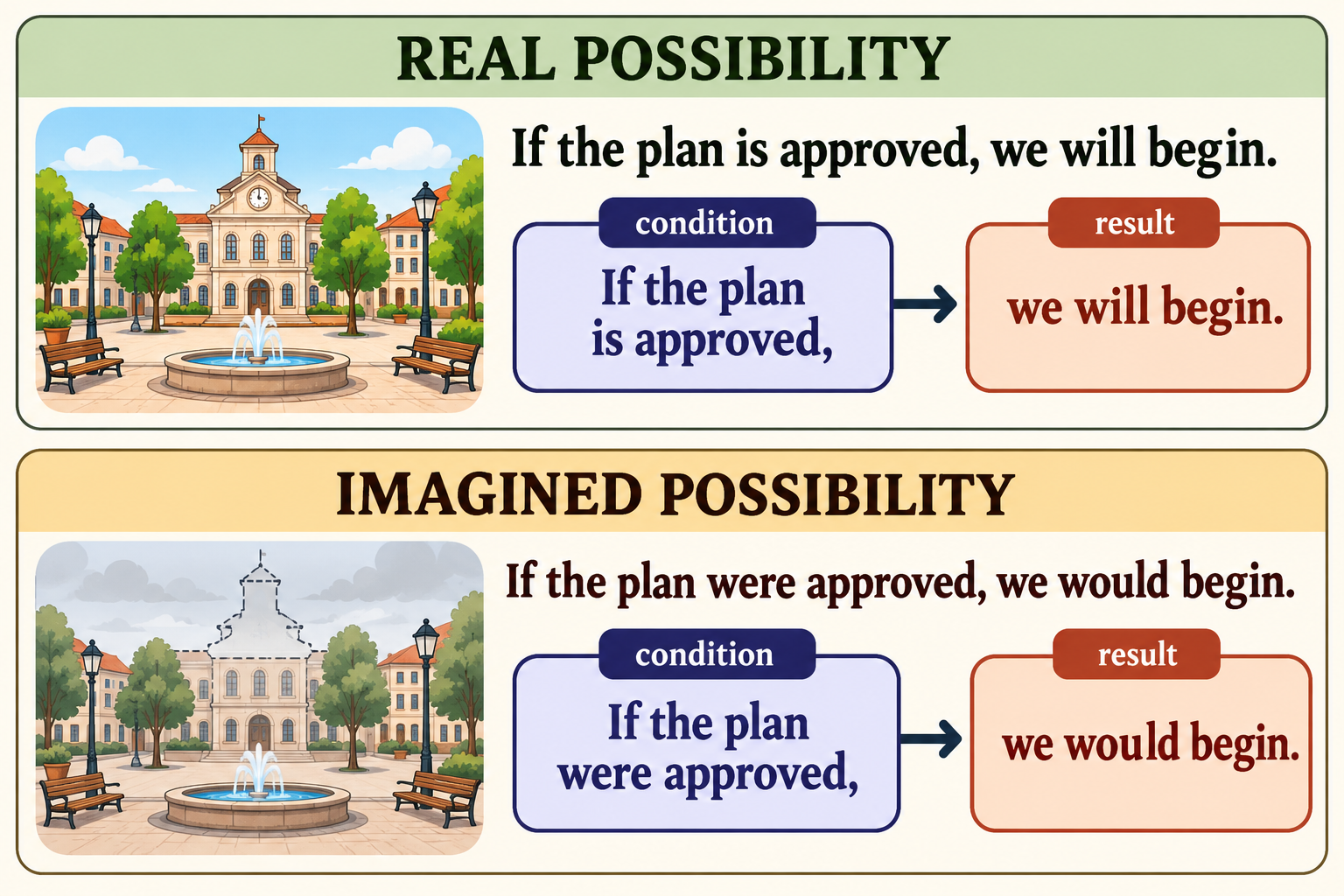
If the council approves the plan, we will start in May presents approval as a real future possibility. If the council approved the plan, we would start in May presents it more hypothetically or remotely. Neither sentence tells you a numerical chance of approval.
Choose the form that matches your message. A confirmed project with a decision expected tomorrow may naturally use the first conditional. An imagined redesign with no funding may naturally use the second. Do not change every future idea to would simply because the result has not happened yet.
Add possibility without promising a result
Would describes the result you imagine. Could can describe an opportunity or ability: If we had a larger room, we could run evening classes. Might makes the result less certain: If we added lights, more people might visit after work. A new light does not guarantee that everyone will visit.
For a clear proposal, give one condition, one likely benefit and a realistic limit. If the empty shop were available, we would create a reading room. Residents could borrow books there. We would still need volunteers to open it. Before the checks, underline the condition and circle the result in two examples.
Check your understanding
Choose or type your answers. Then read every explanation. The short checks give feedback on these answers only.
Answer on paper, then open the explanations below. Enable JavaScript to check answers here.
Answer key and explanations
1. An imagined present situation — Lived marks a hypothetical situation here; it does not report past time.
2. If the council approved it, we would begin. — Past approved with would begin presents the possibility as hypothetical or more remote.
3. more people would sit there. — The result uses would plus the base verb sit.
4. if I were the organiser. — Were supplies the imagined condition that matches would ask.
5. If we had more money, we would buy trees. — Use the past form had in the standard second-conditional if-clause.
6. If I were you, I would compare the prices. — Would is followed by a base verb without to.
Your turn · self-review
Use the language yourself
Write or speak first, then compare these possible models. Your wording may be different. This is self-check practice; it does not automatically score your writing or pronunciation.
Practice only. Your writing stays on this page; it is not submitted or saved.
-
Model answer and explanation
If the old garage were available, we would create a repair room. Neighbours could share tools there. We would still need money for safe equipment.
-
Model answer and explanation
If I were you, I would ask the neighbours what they need before choosing a design.
Self-check and next step
Check the meaning first, then the form. Read your answer aloud at a comfortable speed. Correct one feature, try again, and compare with the examples. Ask a teacher or partner for feedback if you are unsure.
Useful reference
Related Guides






Continue learning this topic
Review an explanation, study examples or try a related practice test.
- Practice test At the University of Maryland, a historic campus farm remains a classroom — C2 English Listening Practice Test
- Practice test At the University of Maryland, a historic campus farm remains a classroom — C2 English Grammar Practice Test
- Practice test At the University of Maryland, a historic campus farm remains a classroom — C2 English Vocabulary Practice Test
- Course lesson Conditional inversion: Had I, were I and should you – C1: Precision and Expression
- Course lesson First conditional: If, unless and as long as – B1–B2: Grammar in Context
- Course lesson Second conditional: Imagining a different situation – B1–B2: Grammar in Context