
Guide
A2 · Elementary
Grammar
Past Simple vs Past Continuous
Understand past events and background actions, when and while, and was/were + -ing with timelines and six explained checks.
7 min read
1,195 words
Updated Nov 7, 2026

On this page (10 sections)
Choose the view of a past event
Both tenses talk about the past, but they show different views. The past simple presents an event as a complete part of the story: Mia opened the door. The past continuous shows an action in progress around a past moment: Mia was cooking at six. It does not tell us by itself when she started or finished cooking. Think of a completed event as a whole picture and an action in progress as looking inside that event. A long action can still use the past simple: She worked all day. Length alone does not decide the tense.
Build the past continuous
Use subject + was or were + verb-ing. I/he/she/it was waiting; you/we/they were waiting. In negatives, use wasn’t or weren’t: We weren’t sleeping. In questions, move was or were: Were you sleeping? What was she doing? Do not combine did with this pattern. Did she was waiting? is incorrect; write Was she waiting? The main verb needs -ing: They were playing, not They were play. Common spelling changes include make → making, run → running and lie → lying. The verb be agrees with the subject, while the -ing form stays the same.
Put a background behind an event
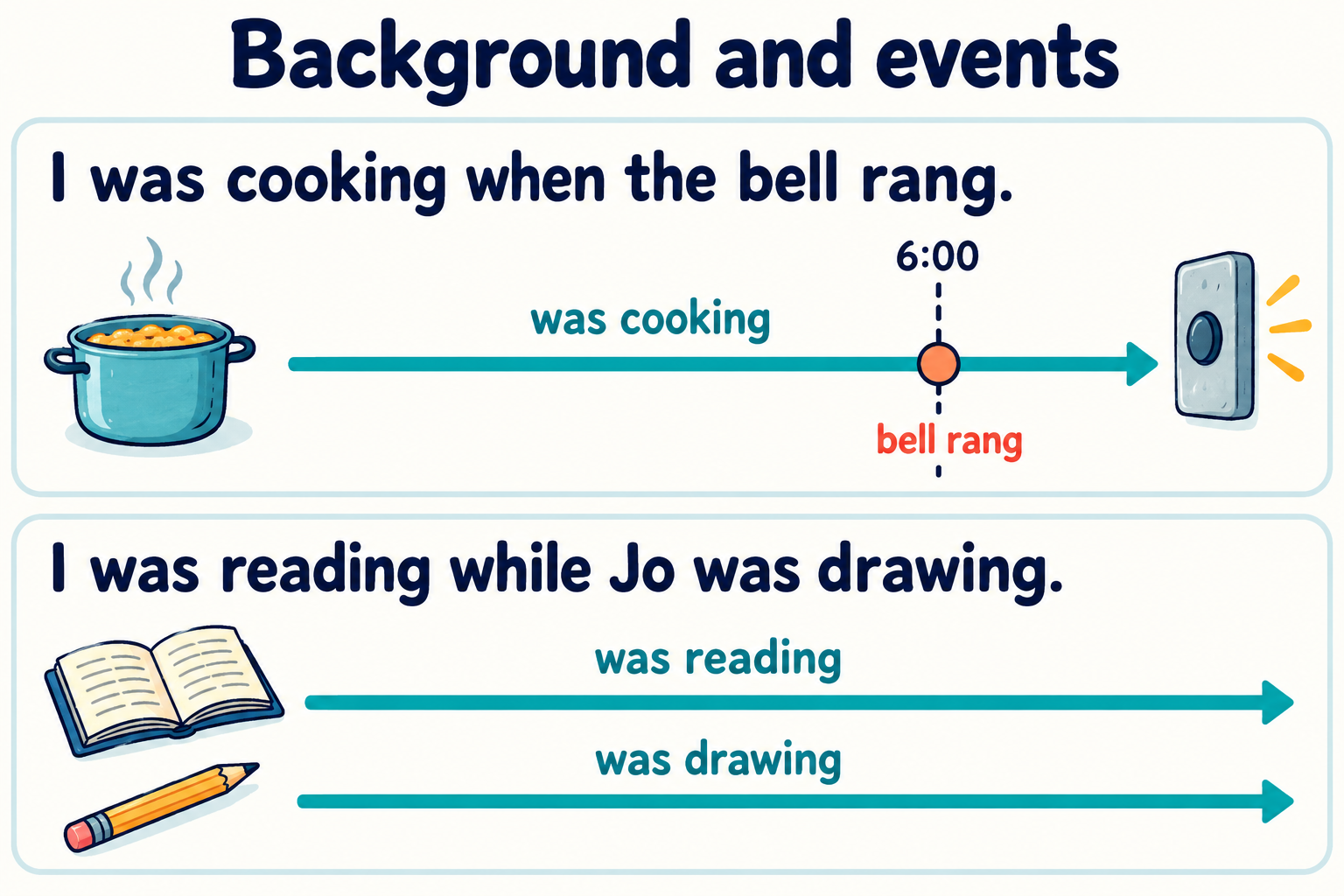
Use the continuous to establish a scene, then the simple to move the story forward: I was washing a cup when the doorbell rang. Washing was already in progress. The ringing happened during it. The sentence does not say I finished washing the cup. Another example is We were walking home when we saw a fox. Seeing the fox is the event that enters the scene. Some books call this an interruption, but it does not always stop the background action. You can continue walking while you see something. Explain the time relationship instead of assuming every event makes the first action end.
Describe two actions in progress
Two continuous forms can show activities happening at the same time: I was chopping vegetables while Dan was setting the table. Both activities form the background. In contrast, I chopped the vegetables and Dan set the table reports completed tasks; it does not necessarily give their exact overlap. At eight, I was reading and Jo was drawing tells us what was in progress at eight. At eight, I opened my book describes an event at that time. Draw two lines through the same time marker to represent simultaneous background actions; use a point to represent an event introduced into that scene.
Use when and while for meaning
When often introduces an event: I was talking when my phone rang. It can also introduce a background time: When I was living in Rome, I walked to work. While often emphasises the time during an activity: While we were waiting, we talked. These are useful tendencies, not a rule that every when needs past simple or every while needs past continuous. Compare When I arrived, she was leaving with When I arrived, she left. In the first, leaving was already in progress. In the second, her departure is presented as an event after or around my arrival. The intended story controls your choice.
Notice verbs and avoid common errors
For ordinary states, use a simple form: I knew the answer; she wanted a drink; we were tired. I was knowing the answer is not the usual way to express that state. Some verbs have action meanings that allow continuous forms, so do not memorise a ban without context. Keep be plus -ing together, and keep did plus base verb together. She didn’t hear the bell is correct. She wasn’t hearing the bell is not the ordinary choice for one missed sound. Before correcting a tense, ask whether the writer means a completed event, an action in progress or a state.
Plan a clear mini-story
Start with a place and a past time. Add one or two background actions. Introduce the important event with a past-simple verb, then explain the result. At seven, I was preparing dinner. My flatmate was reading. Suddenly, someone knocked. We opened the door and saw our neighbour. This pattern gives the reader a scene and a sequence. The visual below shows the same relationship through lines and event markers; the text above supplies all the meaning. In your own account, use tense changes to make the time relationships clear, not just to include a grammar form. Read the complete account aloud to check that the sequence is easy to follow.
Quick check
Choose an answer, then check the explanation. If you prefer, note your answers before revealing the key.
Answer on paper, then open the explanations below. Enable JavaScript to check answers here.
Answer key and explanations
1. She was cooking when the bell rang. — Cooking is the background in progress; rang introduces the event.
2. At eight, I was reading while Jo was drawing. — Both continuous forms show activities in progress at the same time.
3. was taking — Was taking shows the activity already in progress when the phone rang.
4. arrived — Arrived presents the event that happened during the waiting.
5. Were they playing cards? — Use were + subject + verb-ing in this question.
6. I knew the address. — Knew is the usual simple form for the state of knowing something.
Related learning
Related Guides





Continue learning this topic
Review an explanation, study examples or try a related practice test.
- Practice test How Hydroxyapatite Toothpaste Compares With Fluoride for Oral Health — C1 English Listening Practice Test
- Practice test How Hydroxyapatite Toothpaste Compares With Fluoride for Oral Health — C1 English Grammar Practice Test
- Practice test How Hydroxyapatite Toothpaste Compares With Fluoride for Oral Health — C1 English Vocabulary Practice Test
- Course lesson Present perfect or past simple: Choosing the right tense – B1–B2: Grammar in Context
- Course lesson Present perfect simple or continuous: Result or duration? – B1–B2: Grammar in Context
- Course lesson Past perfect: What had happened before? – B1–B2: Grammar in Context