
Guide
A1 · Beginner
Grammar
Time Prepositions: In, On and At
Choose in for months and years, on for days and dates, and at for clock times. Includes exceptions, a visual reference and six checks.
6 min read
911 words
Updated Nov 9, 2026

On this page (8 sections)
Add a clear time
The class starts at nine. It is on Monday. It starts in October. Small words connect an event to its time. This guide helps you choose in, on and at, and recognise common phrases that use no preposition. Read the time expression before you choose the word.
1. At: a clock time
Use at before a clock time: at 8:00, at half past two, at six thirty. The meeting starts at 9:00. We finish at five. A digital time or a time written in words follows the same pattern. Do not add o'clock after a time with minutes: at nine thirty is enough.
Useful fixed phrases include at noon, at midnight and at night. Noon means twelve in the middle of the day; midnight means twelve at night. Say I read at night for a general night-time habit. For a beginner, learn these as complete phrases.
2. On: days and dates
Use on with a day: on Monday, on Friday, on Sunday. Use it with a date too: on 12 October, on October 12, on the first of May. A named day and date can come together: on Monday, 12 October. The date styles differ, but the preposition is still on.
Use on when a day is followed by a part of that day: on Monday morning, on Tuesday evening, on Friday night. Compare in the morning with on Monday morning. Adding Monday makes it a named day-part, so the usual choice changes to on.
For repeated days, use a plural day name: We meet on Mondays. This means Monday is our usual meeting day. On Monday can mean one particular Monday, depending on the surrounding conversation.
3. In: longer periods and broad day-parts
Use in with months, years and seasons: in October, in 2026, in spring. Our course starts in October. They moved here in 2020. We often travel in summer. Capitalise names of months and days; season names normally use a small letter.
Use in the morning, in the afternoon and in the evening. These expressions name broad parts of a day. The article the is part of the phrase. I study in the evening is natural; I study in evening is missing the article.
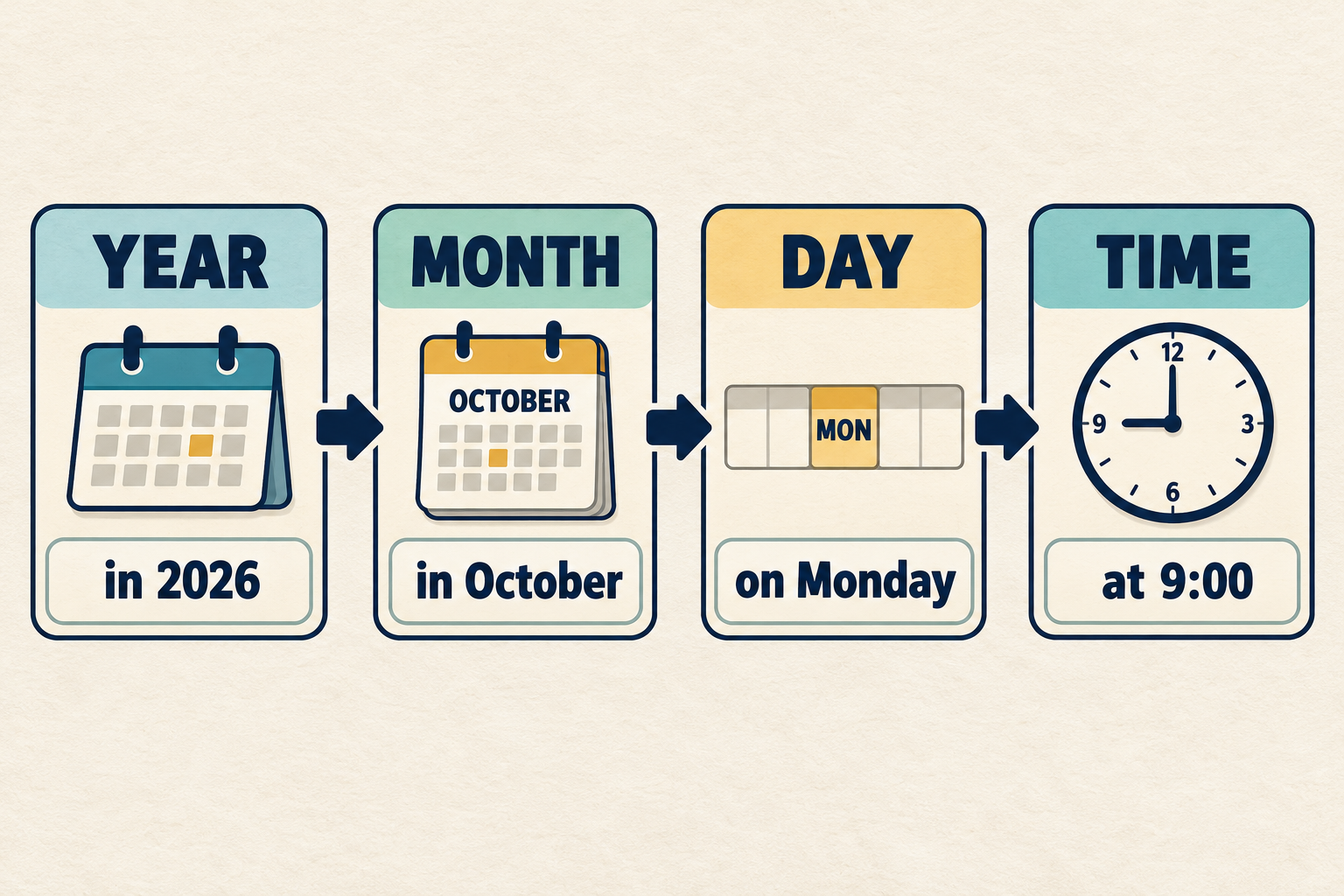
The visual reference moves from broad to specific: in 2026 → in October → on Monday → at 9:00. You do not have to include every detail. Choose only the information the listener needs: The class is on Monday at nine.
4. No preposition with this, next, last or every
Do not normally add in, on or at before time phrases beginning with this, next, last or every. Say next Monday, this evening, last year and every morning. We meet next Tuesday. She works every Friday. The meeting is this afternoon.
Compare
on Monday / next Monday
On is used with the plain day name, but not before next.
We meet on Monday. We meet next Monday.
in the evening / this evening
This already introduces the time phrase.
I study in the evening. I am free this evening.
in October / every October
Every introduces a repeating time.
The course starts in October. It starts every October.
Today, tomorrow and yesterday also normally have no preposition: Come tomorrow. We met yesterday. This is different from on Tuesday or in October. Read the whole expression rather than automatically putting on before any word about a day.
5. Weekends and useful differences
At the weekend is common in British English. On the weekend is common in American English. At weekends and on weekends are also used for repeated weekends. These are variety differences, not a reason to mark one speaker wrong. Keep a consistent style when practising.
Some holidays have useful phrase differences: at Christmas refers to the holiday period; on Christmas Day refers to a particular day. You do not need every exception at once. Build a small list of whole expressions from reliable examples.
Quick check: six questions
Answer on paper, then open the explanations below. Enable JavaScript to check answers here.
Make your own reminder
Write an event, a day and a time: My class is on Thursday at 18:00. Then write a month: The course starts in November. Finally, write a reminder with next: Bring your book next Thursday. Underline the full time expression and check its pattern.
Related Guides






Continue learning this topic
Review an explanation, study examples or try a related practice test.
- Practice test First-Time Homebuyers Are Scarce, but More Are Paying Cash — B1 English Listening Practice Test
- Practice test First-Time Homebuyers Are Scarce, but More Are Paying Cash — B1 English Grammar Practice Test
- Practice test First-Time Homebuyers Are Scarce, but More Are Paying Cash — B1 English Vocabulary Practice Test
- Course lesson Future time clauses: When, until and as soon as – B1–B2: Grammar in Context
- Course lesson Participle clauses: Clear subjects and time relationships – C1: Precision and Expression
- Course lesson B1 review: Tenses, time clauses and conditionals – B1–B2: Grammar in Context