
Guide
A1 · Beginner
Grammar
Imperatives: Clear Instructions with Verb, Don't and Let's
Give clear instructions, say what not to do and make shared suggestions. Includes a four-step visual and six explained checks.
6 min read
963 words
Updated Nov 7, 2026

On this page (8 sections)
Tell someone what to do
Open your book. Put the paper here. Please wait. These sentences are imperatives. We use them for instructions, directions, signs, advice and simple requests. They are common in classes, recipes, games and everyday tasks. In this guide, learn a useful pattern, make it negative and put several instructions in order.
1. Start with the base verb
The base verb is the short form you find in a dictionary: open, take, put, check, read. Begin a normal positive imperative with this form: Open the door. Take a seat. Read the message. The listener understands you as the subject, so you do not normally write it.
The pattern is the same for one person and several people: Anna, open your book. Everyone, open your books. We do not add -s to the verb. Opens your book is not an imperative. To open your book is not a complete instruction in this pattern either.
Make the action clear
Put the paper on the table.
Action + object + place
Put the paper on the table.
Not this: Are careful.
Be careful.
Use base form be before an adjective
Be careful with the hot cup.
Add the information the listener needs. Put it there works only when both people know what it and there mean. Put the notebook on the desk is clearer in written instructions. Give one main action at a time when the task is new.
2. Don't + base verb
To tell someone not to do something, use don't before the base verb: Don't touch the screen. Don't close the window. Don't forget your keys. Do not is the full form; it is common on formal notices and signs.
Keep the verb in its base form after don't. Say Don't run, not Don't running or Don't runs. Use Don't be with an adjective: Don't be late. A negative imperative is about an action to avoid; it is not a sentence about what a person usually does.
3. Please and a friendly tone
Please makes many simple instructions sound more polite: Please sit here. Sit here, please. A comma is common before please at the end. A calm voice and the situation matter too. Please does not make every command appropriate. With an unfamiliar adult, a question such as Could you help me, please? can be a softer request.
Use short imperatives when the purpose is clear: a teacher explaining an activity, a friend giving directions, or a written craft guide. Thank you can follow a completed action. You can also give a reason: Please close the door. It is cold.
4. First, then, next, finally
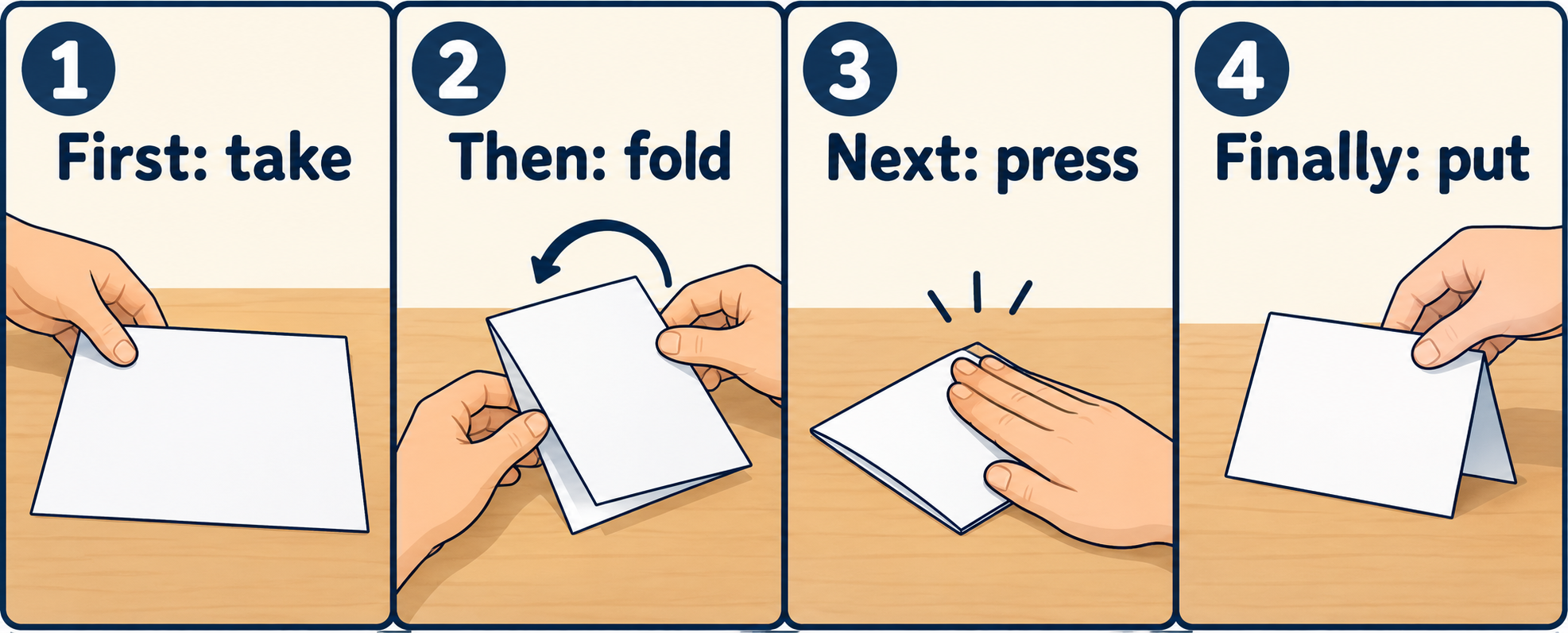
Sequence words help the listener follow the order. First introduces the start. Then and next introduce later steps. Finally introduces the last step. The words do not replace the verb: First, take a sheet of paper. Then, fold it in half. Next, press the fold. Finally, put the card on the table.
The picture sequence shows these same four actions: 1 take; 2 fold; 3 press; 4 put. Read the whole sequence before beginning. If the order matters, put the instructions in a numbered list or use sequence words. Do not hide an important step inside a long sentence.
5. Let's includes the speaker
Let's means let us in a shared suggestion: Let's start. Let's make a card. The speaker invites another person to do something together. Compare Open the book, which tells the listener what to do, with Let's open the book, which suggests a shared action.
Use let's not for a shared negative suggestion: Let's not hurry. Let's not use glue. The verb stays in the base form. In standard writing, include the apostrophe in let's. Lets without an apostrophe has a different job: She lets me use her pen.
Quick check: six questions
Answer on paper, then open the explanations below. Enable JavaScript to check answers here.
Try a three-step instruction
Choose a simple everyday task, such as opening a book or making a paper card. Write three short instructions. Model: First, take a card. Then, write your name. Finally, put it on the desk. Check every verb is a base form and each detail is clear. Add a useful don't instruction only if the reader needs it.
Related Guides






Continue learning this topic
Review an explanation, study examples or try a related practice test.
- Practice test Places Around Town Words — A1 English Vocabulary Practice Test
- Practice test Clothes and Weather Words — A1 English Vocabulary Practice Test
- Practice test Instructions for a Saturday Bookshop Shift — A2 English Listening Practice Test
- Course lesson The verb be: Am, is and are – A1–A2: Grammar Foundations
- Course lesson Participle clauses: Clear subjects and time relationships – C1: Precision and Expression
- Course lesson Adverbs of frequency: Always, sometimes and never – A1–A2: Grammar Foundations