
Guide
B1 · Intermediate
Grammar
Future Forms: Will, Going To and Present Continuous
Choose future forms for decisions, intentions, evidence and arrangements, understand overlap, and try six checks with explained answers.
7 min read
1,218 words
Updated Nov 9, 2026

On this page (10 sections)
Start with the speaker’s meaning
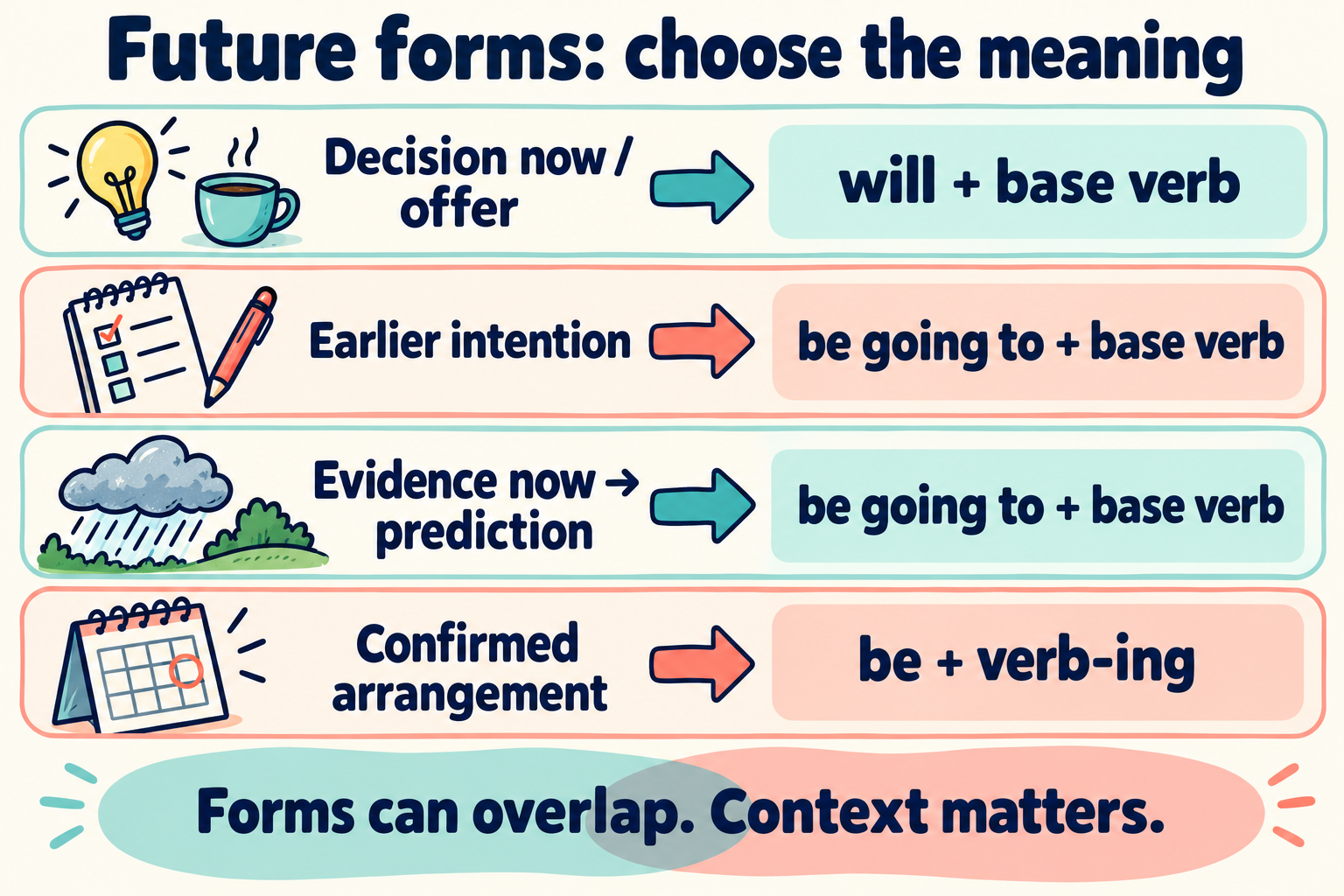
English has several ways to talk about the future. Choosing a form often tells the listener how the speaker views a situation: a decision made now, an earlier intention, evidence for a prediction, or an arrangement already agreed. Do not choose only because tomorrow appears. I’ll call tomorrow, I’m going to call tomorrow and I’m calling tomorrow can all be grammatical in suitable contexts. The difference is the meaning you want to highlight. This guide gives useful common patterns, then shows where they overlap. These are choices for communication, not a test of one form always being right.
Will: decide, offer and predict
Use will + base verb. The negative is will not or won’t; a question begins Will you...? When a problem appears, will often introduces an immediate decision or offer: The printer has stopped. I’ll send the file by email. Your bags look heavy. I’ll carry one. Will can also give a prediction or expectation: I think the repair will take an hour. It does not always mean an immediate decision: that depends on the surrounding sentence. Avoid I will to send and I will sending. In everyday speech, contractions such as I’ll and we’ll are common. Read the context before labelling the purpose.
Going to: an intention already in mind
Use am/is/are + going to + base verb: I’m going to replace the old printer. This often presents an intention made before the current moment. A speaker might show a prepared list or refer to an earlier decision: We discussed it yesterday. We’re going to buy a smaller model. The intention need not be booked or agreed with another person. In a negative, put not after be: She isn’t going to order it today. In a question, move be: Are you going to order it? Do not leave out be: I going to call is incomplete.
Going to: a prediction from present evidence
Going to can point to evidence visible or available now: Look at that loose shelf. Those boxes are going to fall. The speaker connects what they can see with an expected result. Will may still be possible in many prediction contexts, particularly when giving an opinion: I think those boxes will fall. Do not teach this as a ban on will whenever evidence exists. Ask what is foregrounded. A close look at an overheating machine can support It’s going to stop; a broad expectation about its reliability can support It will probably stop again. Neither form guarantees the future result.
Present continuous: an arrangement
Use am/is/are + verb-ing with a future context for an arrangement: I’m meeting the technician at ten tomorrow. A date, time, place, confirmation or another person often makes the arrangement clear. The form is the same as the continuous for an action happening now, so the time context matters. I’m meeting the technician now and I’m meeting her tomorrow do not describe the same time. An arrangement is often more concrete than a general intention, but it can change. Do not call the present continuous a promise that nothing can alter. For a simple prediction such as rain later, going to or will is the usual choice.
Allow overlap and explain the difference
A confirmed repair visit can be described as The technician is coming tomorrow or The technician is going to come tomorrow. The continuous highlights the arrangement; going to can highlight the planned action. I’ll see the technician tomorrow may be a neutral future statement in a suitable exchange. In a grammar task, added context may make one choice the best illustration of a target meaning without making every other form impossible. If an exercise asks for the arrangement form, choose the continuous. If someone asks what you really mean, explain the decision, evidence or agreement instead of only naming a tense.
Use the decision map carefully
First ask whether you are responding now with a decision or offer. Will is useful. If you are reporting an intention already made, consider going to. If present evidence leads to your prediction, going to often highlights that link. If a concrete agreement is in place, consider the present continuous. The map’s overlapping paths are intentional. Check the sentence’s form after choosing its meaning: will + base; be going to + base; be + -ing. Finally, add enough context for a listener to understand the time and purpose. Try five selected-response checks and one open explanation below.
Quick check
Choose an answer, then check the explanation. If you prefer, note your answers before revealing the key.
Answer on paper, then open the explanations below. Enable JavaScript to check answers here.
Your turn · self-review
Check 6: explain a choice
A colleague has booked a room for Friday. Explain why both “We’re meeting on Friday” and “We’re going to meet on Friday” can work.
Practice only. Your writing stays on this page; it is not submitted or saved.
-
Model answer and explanation
We’re meeting highlights the agreed arrangement. We’re going to meet presents the planned intention. The booking supports both meanings; the speaker chooses what to emphasise.
Answer key and explanations
1. A decision made now — The speaker responds to a new event with an immediate decision.
2. An earlier intention — The earlier decision supports going to for an intention.
3. An agreed arrangement — The confirmed person and time support an arrangement.
4. is going to — Is going to + base verb forms a prediction linked to the visible stack.
5. will send — Will is followed by the base verb send.
Related learning
Related Guides






Continue learning this topic
Review an explanation, study examples or try a related practice test.
- Practice test Southwest Floods Bring a Rare Boost to Reservoirs, Including Lake Powell — B2 English Listening Practice Test
- Practice test Southwest Floods Bring a Rare Boost to Reservoirs, Including Lake Powell — B2 English Grammar Practice Test
- Practice test Southwest Floods Bring a Rare Boost to Reservoirs, Including Lake Powell — B2 English Vocabulary Practice Test
- Course lesson Present perfect or past simple: Choosing the right tense – B1–B2: Grammar in Context
- Course lesson Present perfect: For, since, already, yet and just – B1–B2: Grammar in Context
- Course lesson Present perfect simple or continuous: Result or duration? – B1–B2: Grammar in Context