
Guide
B1 · Intermediate
Grammar
Collocations with Take, Have and Get: Examples and Practice
Learn collocations with take, have and get through everyday examples and 12 questions with explained answers. Compare meanings, forms and common mistakes.
12 min read
2,123 words
Updated Oct 12, 2026
On this page (17 sections)
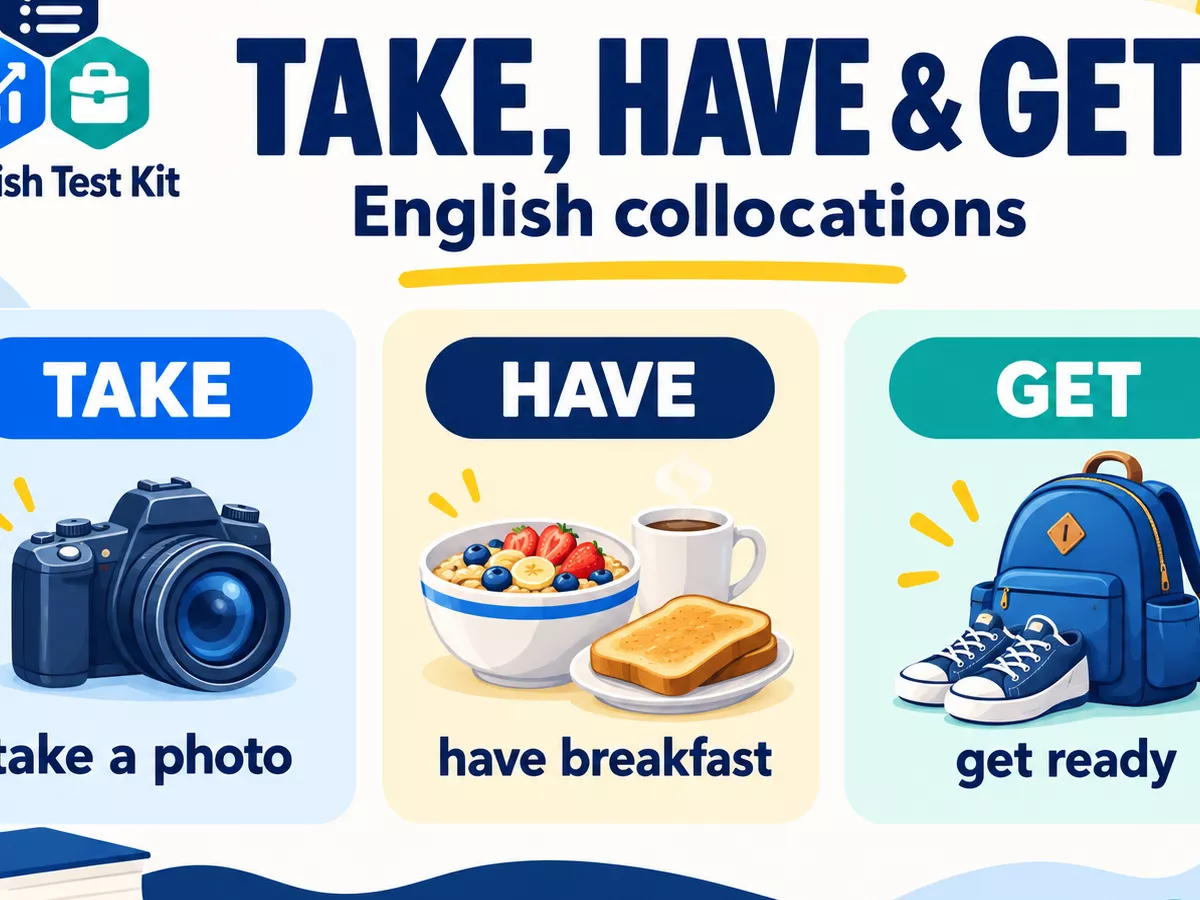
Take notes, have breakfast and get ready are useful English collocations: combinations that speakers normally use together. This B1 guide explains how take, have and get work in everyday phrases, compares meanings that are easy to confuse, and gives you 12 practice questions with explained answers. Learn the whole phrase and the situation, not a rule that says one verb always belongs to one kind of noun.
Start with the meaning of the whole phrase
A common verb can do different jobs. Take a photo means use a camera to create a picture; take notes means record information; take responsibility means accept a duty. The noun helps determine the meaning. A phrase can be natural even when a word-for-word translation from another language would choose a different verb. Notice what people are doing and why they use the expression.
Do not assume that every noun has only one possible partner. You can take a break or have a break, and you can have a shower or take a shower. Sometimes two verbs describe different stages: having a ticket means possessing one, while getting a ticket can mean obtaining it. A dictionary example and a clear context are more useful than a rigid colour-coded rule.
Useful collocations with take
Take a photo — capture a picture. Mina took a photo of the old station.
Take notes — write down useful points. We take notes during the weekly briefing.
Take a seat — sit down, often after an invitation. Please take a seat while I find the form.
Take responsibility for — accept a duty. Our team will take responsibility for checking the dates.
Take part in — participate. Dan takes part in the neighbourhood clean-up.
Take a risk — do something despite a possible unwanted result. Booking before the dates were confirmed was a risk. Keep for after responsibility and in after part.
Useful collocations with have
Have breakfast, lunch or dinner — eat a meal. We usually have breakfast in the kitchen.
Have a conversation or a chat — talk together. I had a conversation with the new assistant.
Have a good time — enjoy an experience. They had a good time at the concert.
Have a headache describes an experience or condition. Have a problem with something identifies a difficulty: I have a problem with this password. These expressions do not all refer to owning an object. Compare I have a bicycle with I have a headache; the same verb connects to different meanings. A meal name normally has no a in have breakfast, but we can say have a large breakfast.
Useful collocations with get
Get ready — become prepared. We need to get ready before the taxi arrives.
Get better — improve. My listening is getting better with regular practice.
Get hungry — become hungry. Get lost — become unable to find your location or route. These phrases focus on a change.
Get permission means obtain someone's agreement to do something. Ask the coordinator before using the room. Get a message usually means receive one. Get a job means obtain employment, while have a job describes being employed. When you learn a new get phrase, write a short note explaining whether it means receive, obtain or become in that context.
Compare experiences, changes and alternatives
I have a headache describes my condition now; I am getting a headache focuses on its beginning. I have a job describes my employment; I got a job last month describes obtaining it. I have a photo means the picture is available to me; I took a photo means I created it with a camera. Get a photo can mean obtain one, so it is not a general substitute for take a photo.
Both have a shower and take a shower are natural, with regional preferences. Likewise, have a break and take a break are common. Do not mark a valid alternative wrong simply because your notebook contains only one version. In practice below, the choices and the context identify the intended meaning; where two usual alternatives are wanted, the question says so.
Keep the verb form, article and preposition
The key forms are take–took–taken and have–had–had. The past of get is got; its past participle is usually got in British English and often gotten in American English. Get becomes getting in the -ing form. With he or she, use takes, has or gets in the present simple. After did, return to the base form: Did she take notes?
Learn articles and prepositions as part of the unit: take a photo, have a conversation, get permission, take part in and take responsibility for. Permission is usually uncountable in this sense, so get a permission is not the pattern taught here. A useful notebook entry has the full phrase, one original sentence and the context in which you would actually use it.
Exercise 1: choose the phrase (1–6)
Choose the phrase that matches the action in each sentence. Use the whole phrase, not just the verb.
Answer on paper, then open the explanations below. Enable JavaScript to check answers here.
Exercise 2: forms, corrections and meaning (7–12)
Type the missing verb in questions 7–10, choose the meaning in question 11, and give both normal alternatives in question 12.
Answer on paper, then open the explanations below. Enable JavaScript to check answers here.
Answers and explanations
Check each question using its Answer and explanation panel, or open the complete answer key below. Try the exercises before revealing the answers.
Show the complete answer key (1–12)
1. take notes — Take notes means record useful information in writing while you listen or read.
2. get ready — Get ready describes preparation: you change from not prepared to prepared.
3. have a good time — Have a good time means enjoy an experience, not obtain time as an object.
4. take responsibility for — Take responsibility for means accept a duty or obligation; keep for before the task.
5. have a conversation — Have a conversation describes a shared exchange of ideas or information.
6. get lost — Get lost describes a change to being unable to find your location or route.
7. get — Get hungry describes a change of state. Have hungry is not the usual pattern; hungry is an adjective.
8. took — Take has the irregular past simple form took. Yesterday fixes the time as past.
9. has — With he, the present simple form is has. The usual phrase is have breakfast.
10. getting — Is getting better uses the present continuous to describe an ongoing improvement. Double the final t in getting.
11. I have a headache describes the current condition; I am getting a headache describes its beginning or development. — Have presents the experience as existing now; getting focuses on a change. The second sentence does not mean you are receiving a headache as a physical object.
12. have / take — Have a shower and take a shower are both normal English. Have is common in British English; take is especially common in American English. Neither alternative should be treated as an error. Also accepted: take / have; have and take; take and have.
Check your learning
Choose Check my answers at the end of each exercise to see your score and feedback. Each exercise is worth 6 points, giving you up to 12 points in total. Read the explanations and use Try again to practise mistakes. This is a practice activity, not a CEFR level test.
If a phrase was wrong, return to the take, have or get examples and check the whole expression, including its article and preposition.
If a verb form was wrong, practise take–took–taken, have–had–had and get–got in a fresh sentence.
Choose three phrases you need this week and use each in a true sentence. Check your revised answers again another day.
Put three expressions into your own routine
Choose one take phrase, one have phrase and one get phrase. Write a true sentence for each, then change one sentence into a past event and one into a question. Read them aloud together. This checks meaning, word partnership and verb form without treating the guide as a test score or an official assessment.
Frequently asked questions
Can I say both have a shower and take a shower?
Yes. Both are normal English. Have a shower is common in British English, while take a shower is especially common in American English. Learn which version suits your context, but do not correct one simply because you prefer the other.
What is the difference between get a job and have a job?
Get a job focuses on obtaining employment, as in She got a job in May. Have a job describes the situation of being employed, as in She has a job at the museum. The phrases can describe different stages of the same experience.
Should I memorise lists of verbs or complete phrases?
Learn complete phrases with an example and any necessary article or preposition. Knowing take alone will not tell you to say take responsibility for a task. Review a few useful phrases, use them in your own context and check unfamiliar alternatives in a learner's dictionary.
Continue practising
Explore 50 Common Collocations in English
Build everyday English vocabulary
Language references
The examples and practice in this guide are original. The following primary learner references were used to check verb patterns and normal alternatives, not copied as exercise text.
Cambridge English Grammar Today: Take
Cambridge English Grammar Today: Have
Related Guides





Continue learning this topic
Review an explanation, study examples or try a related practice test.
- Practice test Pope Leo XIV to Have Surgery for Small Lung Nodule — B1 English Listening Practice Test
- Practice test Pope Leo XIV to Have Surgery for Small Lung Nodule — B1 English Grammar Practice Test
- Practice test Pope Leo XIV to Have Surgery for Small Lung Nodule — B1 English Vocabulary Practice Test