
Guide
A2 · Elementary
Grammar
Possessive Apostrophes: A Person’s, People’s and Friends’
Choose apostrophe placement by finding the owner. Practise singular and plural owners, shared ownership, its/it’s and ten explained checks.
8 min read
1,333 words
Updated Oct 17, 2026
On this page (7 sections)
1. Who owns what?
A possessive noun phrase tells us who owns, uses or is connected with something. Mira has a desk. It is Mira’s desk. Two teachers use a room. It is the teachers’ room. Find the owner first. The number of desks or rooms does not decide where the apostrophe goes.
Compare the teacher’s two keys with the teachers’ key. In the first phrase, one teacher owns two keys. In the second, two or more teachers share one key. The owner is the noun before the apostrophe: teacher or teachers. Ask “Whose?” before changing the spelling.
2. One owner
For one owner, add apostrophe + s: Mira’s desk; the teacher’s key; my neighbour’s bicycle. Keep the whole owner phrase together: my new neighbour’s bicycle. The bicycle belongs to my new neighbour. Do not put the apostrophe after the name of the owned thing.
For a singular name ending in s, this guide uses apostrophe + s: James’s notebook. Some house styles use James’ notebook. Both styles occur, so follow your course or workplace style consistently. The apostrophe does not make the name plural. James is still one person.
A possessive can show a useful connection rather than legal ownership: today’s meeting, the doctor’s advice or the children’s lesson. You do not need to prove that someone owns an event. Think about the relationship expressed by the whole phrase.
3. More than one owner
If the owner is a regular plural already ending in s, add only an apostrophe: the teachers’ room, the volunteers’ coats, my friends’ keys. First make the plural: friend → friends. Then show the relationship: friends → friends’. Do not add a second s.
If the plural does not end in s, add apostrophe + s: the children’s books, the women’s team, the people’s choice. Children is plural even without final s. Childrens is not a standard plural. A possessive ending cannot repair the wrong owner noun.
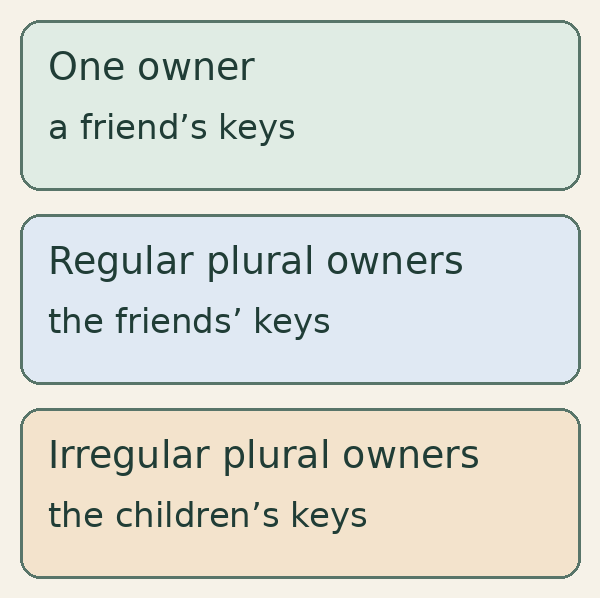
Owner first, ending second
one friend → a friend’s keys
One owner
A friend owns these keys.
two friends → the friends’ keys
Plural owner ending in s
The keys belong to two friends.
children → the children’s keys
Plural owner not ending in s
Several children use these keys.
4. Shared or separate
Sam and Jo share one room. Write Sam and Jo’s room. Only the last name takes the possessive ending because the phrase names the shared owners. Sam has one room and Jo has a different room. To make separate ownership clear, write Sam’s and Jo’s rooms.
The facts must come first. Sam and Jo’s desks could be understood in different ways if nobody explains the arrangement. Do not guess ownership from punctuation alone when the source is unclear. Ask “Do they share the desks, or does each person have a separate desk?” A longer phrase can be clearer: the desk that Sam and Jo share.
Two named owners do not automatically require two apostrophes. One shared cupboard can belong to two people. Equally, one person can own several cupboards. Check owner number and shared/separate meaning before you look at the owned noun.
5. Apostrophe traps
Its is an ownership word with no apostrophe: The cupboard has a door. Its door is blue. It’s means it is or it has: It’s blue. Try the full words. If “it is door” makes no sense, use its door.
An ordinary plural sign does not need an apostrophe: books, desks, keys. Write New desks, not New desk’s, when you simply mean more than one desk. A possessive needs a relationship, not just a plural meaning.
An of phrase is often natural for a part of a thing: the door of the cupboard. The cupboard’s door is also possible. Do not force every noun phrase into an ownership pattern: a coffee cup describes a kind of cup; it does not mean that coffee owns a cup. Choose the clearest natural phrase.
6. Choose and correct
Answer ten checks. Use the ownership facts in each question. Straight and curly apostrophes are both acceptable in typed answers.
Answer on paper, then open the explanations below. Enable JavaScript to check answers here.
7. Reference and practice route
Use the owner-first checklist: identify the owner; decide whether it is singular or plural; check whether its form already ends in s; decide whether named owners share the thing; read the finished phrase aloud with “belongs to” or “used by”. Finally check that you have not added an apostrophe to an ordinary plural.
Try this short audit: “The volunteers’ coats are beside the children’s books.” Volunteers is a regular plural ending in s, so its apostrophe comes last. Children is a plural without s, so it takes ’s. Coats and books are ordinary plurals. No apostrophe belongs in those two words.
A natural alternative is sometimes longer: the coats belonging to the volunteers. Use it when it makes a label easier to understand. The paired workspace lesson gives you specific ownership facts and asks you to create labels a new caretaker can trust.
Related Guides



Continue learning this topic
Review an explanation, study examples or try a related practice test.
- Practice test Noah Adams, longtime host of NPR’s All Things Considered, dies at 84 — B1 English Listening Practice Test
- Practice test Noah Adams, longtime host of NPR’s All Things Considered, dies at 84 — B1 English Grammar Practice Test
- Practice test Noah Adams, longtime host of NPR’s All Things Considered, dies at 84 — B1 English Vocabulary Practice Test
- Course lesson Subject pronouns and possessive adjectives – A1–A2: Grammar Foundations
- Course lesson Checkpoint: people and daily life – A1–A2: Grammar Foundations