
Guide
B2 · Upper-intermediate
Grammar
How to Read Long English Sentences: Find the Main Clause
Break a long sentence into its main claim, modifiers and conditions without losing meaning.
9 min read
1,442 words
Updated Oct 19, 2026

On this page (9 sections)
B2 · 25 minutes · 8 explained checks. Work through the examples, try the questions, then use the final checklist. All people, venues and notices in this resource are fictional.
Do not translate one word at a time
A long sentence can be understood in stages. First locate its main statement, then attach the information that qualifies it. This does not mean ignoring difficult words forever or deleting every subordinate clause. It means building a map before trying to carry all the details in memory at once. If the basic pattern is unfamiliar, review the simple sentence spine before unpacking a longer one.
Read this fictional notice: “Visitors who have reserved a place on the workshop that begins at two may collect the materials prepared by our volunteers from the reception desk after one, provided they show their booking confirmation.” The main statement is about visitors collecting materials. The rest tells you which visitors, which materials, where, when and under what condition. Those restrictions are essential to a faithful reading.
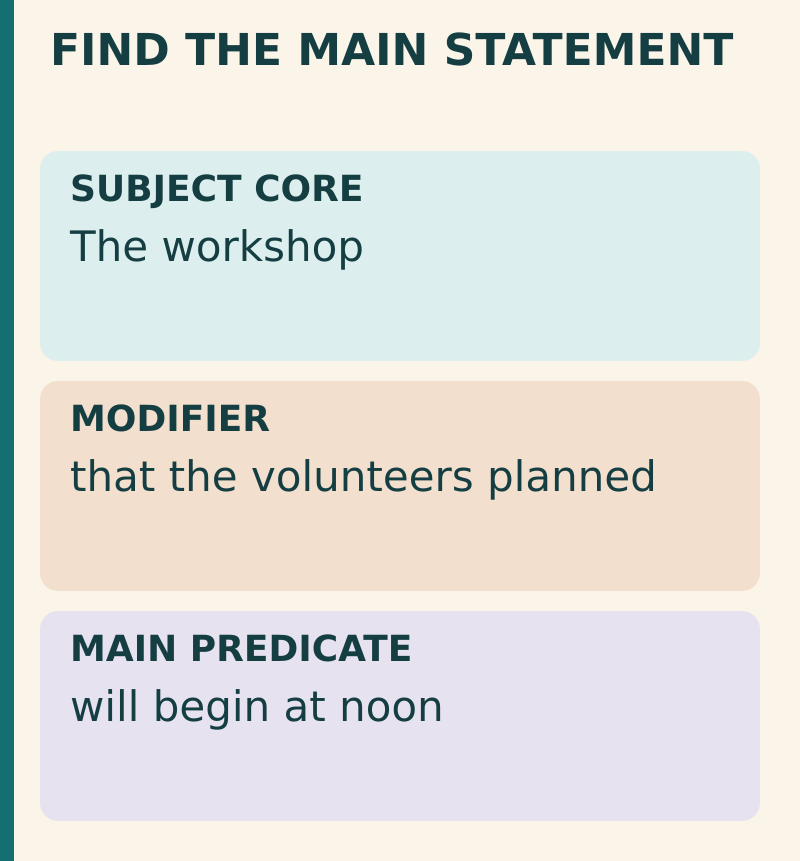
Find the main clause
Locate the subject and its main verb phrase. In “The workshop that the volunteers planned for visitors who had completed the induction will begin at noon,” the main subject is the workshop and the main verb phrase is will begin. Planned belongs to a clause describing workshop. Had completed belongs to a clause describing visitors. The first verb you see is not necessarily the main one.
Start with a temporary skeleton: “The workshop will begin at noon.” Then restore the modifiers: volunteers planned that workshop, and it is for visitors who completed the induction. A skeleton is a reading aid, not a complete summary. In more complex sentences there may be coordinated main clauses, so do not assume every sentence must reduce to one verb. This guide starts with one-main-clause examples to make the method manageable.
Unpack long noun groups
A noun group can contain several layers. “The display of photographs from the harbour archive” has display as its head. Of photographs tells us what is displayed, and from the harbour archive describes the photographs’ source. In “The guide who checks the tickets near the door,” who checks the tickets identifies the guide. Follow the meaning and grammar together rather than attaching every phrase mechanically to the nearest word.
Use brackets in your notes: [The guide [who checks the tickets near the door]] will answer questions. The entire bracketed noun group is the subject of will answer. If a modifier could attach in more than one way, acknowledge the ambiguity. “The visitor saw the guide with binoculars” may describe the guide’s equipment or the visitor’s viewing method. Structure helps, but context sometimes has to decide.
Separate conditions and asides
A condition limits when a statement applies: “Visitors may enter if a volunteer is present.” Unless introduces an exception: “The room remains closed unless a volunteer is present” means it is closed if no volunteer is present. Although adds a contrast rather than a condition: “Although the room is small, it holds the full display.” Notice the relationship before simplifying.
A restrictive relative clause identifies a group: “Visitors who booked may collect materials.” You cannot reduce that to “Visitors may collect materials” without widening eligibility. A comma-marked aside such as “the workshop, which starts at two” adds information, but the information can still matter to the reader. Grammatical removability and practical importance are different questions.
Track scope and negation
Ask exactly what a limiting word applies to. “Only visitors with tickets may enter” restricts the people. “Visitors may enter only after two” restricts the time. “Visitors may borrow maps but not photographs” negates permission for the second object, not the whole borrowing activity. “The room is open except on Mondays” keeps an exception that a short paraphrase must retain.
Until also needs care. “The display will not open until noon” tells us that opening cannot happen before noon; in context it may suggest noon is the expected start, but it does not grant access at eleven. Avoid replacing a negative time condition with a positive claim that is stronger than the source. Read the words around only, not, except and until before choosing an answer.
Rebuild meaning in short units
Use three passes. Pass one: identify the main subject and predicate. Pass two: connect modifiers to their targets and label conditions or exceptions. Pass three: restate the meaning in short units, then compare those units with the original. You may need a key vocabulary definition between passes; looking up a word is compatible with structural reading.
Worked parse: “Visitors who have booked the workshop, which starts at two, may collect their materials after one.” Core: eligible visitors may collect their materials. Restriction: they have booked the workshop. Aside: that workshop starts at two. Collection time: after one. Faithful short version: “If you have booked the workshop, you may collect materials after one. The workshop starts at two.” Neither all visitors nor collection at two is the intended message.
Eight checks and a worked-parse review
Use the questions to practise main-clause recognition, modifier attachment and faithful paraphrase. Read the complete sentence before typing a phrase. If asked for the verb phrase, include an auxiliary such as will or may when it belongs to the main verb. After choosing a paraphrase, identify a restriction that the incorrect option loses.
For independent reading, keep a small clause map: main subject / main predicate / noun modifiers / conditions / scope words. A long sentence is not necessarily badly written, and a short paraphrase is not automatically accurate. Your goal is to reconstruct the writer’s meaning with less processing effort while preserving the details that matter.
Check your understanding
Choose the best answer for the stated purpose. In short answers, type only the requested words. For open rewrites, compare meaning as well as form: other well-formed answers may be possible. Each submitted answer reveals an explanation.
Answer on paper, then open the explanations below. Enable JavaScript to check answers here.
Your final check
Read the complete sentence or source again. Check the actor, action, time, quantities, conditions and intended meaning. Explain why your version works rather than memorising its surface form. Revisit any question whose explanation differs from your reasoning. When you can reconstruct the structure reliably, move from structure to tone and implication with the optional C1 reading guide.
Related Guides




Continue learning this topic
Review an explanation, study examples or try a related practice test.
- Practice test UNLV Introduces a Minor in Teaching Mariachi as Demand for Instructors Grows — C2 English Reading Practice Test
- Practice test What Time Is It on the Moon? Scientists Consider How Lunar Clocks Could Work — C1 English Reading Practice Test
- Practice test Kalkan Keeps a Taste of Summer as Autumn Arrives — B2 English Reading Practice Test
- Course lesson Be and basic sentences – A1–A2: Grammar Foundations
- Course lesson For, since, already and yet – B1–B2: Grammar in Context
- Course lesson Cleft sentences and focus – C1: Precision and Expression