
Guide
B2 · Upper-intermediate
Grammar
Colons, Semicolons, Dashes and Parentheses in Clear Writing
Choose punctuation to introduce an explanation, connect full clauses or add an aside.
9 min read
1,510 words
Updated Oct 16, 2026
On this page (9 sections)
B2 · 22 minutes · 8 explained checks. Work through the examples, try the questions, then use the final checklist. All people, venues and notices in this resource are fictional.
Start with two complete sentences
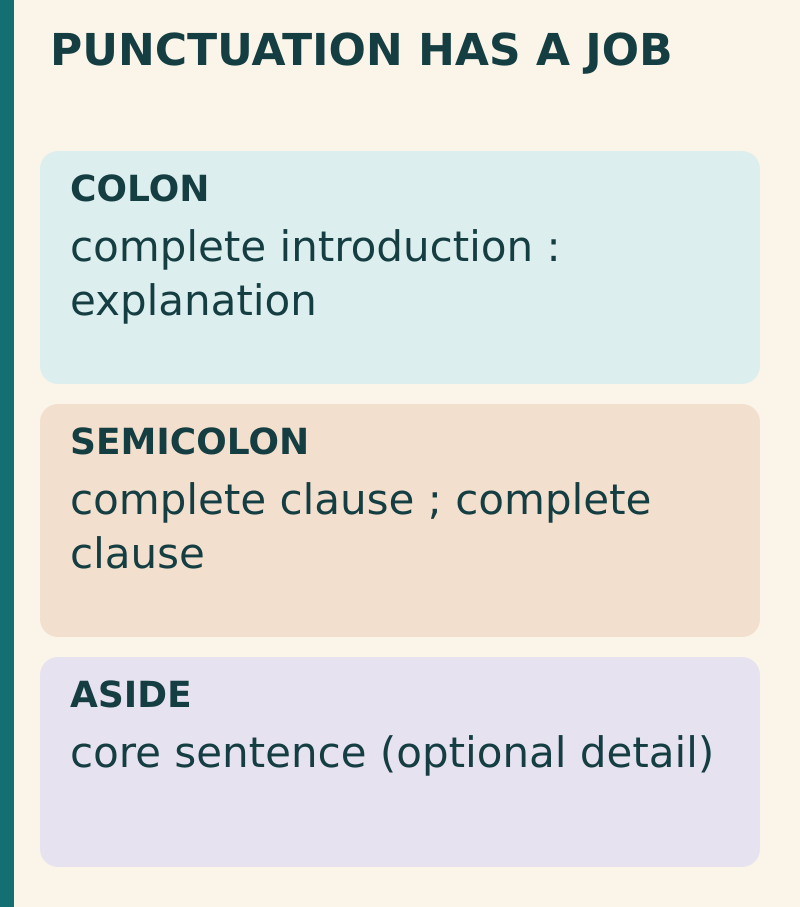
Punctuation helps a reader see how ideas belong together. Begin with the relationship you want to express, then choose a mark. A colon can announce an explanation; a semicolon can connect two closely related statements; dashes and parentheses can manage an aside. None is a badge of advanced writing. A full stop is often an excellent choice. Before choosing punctuation, use the sentence-spine guide to check that a clause is complete.
Test a possible independent clause by reading it on its own. “The walk starts at ten” has a subject and a complete verb phrase. “Because the walk starts at ten” leaves the reader expecting the main statement. “A bottle and a hat” is a noun phrase. Commands also count as complete clauses: “Bring a bottle” has an understood subject, you. This distinction will help you decide where a colon or semicolon can go.
Colons introduce what follows
A colon points forward: the next part supplies the promised detail. “Bring one essential item: a reusable water bottle.” The introduction is complete, and the noun phrase tells us which item. “We changed the route for one reason: the riverside path is flooded.” Here the explanation after the colon is itself a clause. Both patterns work.
Avoid inserting a colon between a verb and its object in ordinary continuous prose. “You will need: a bottle and a hat” cuts need off from what is needed. Write “You will need a bottle and a hat” or “You will need two things: a bottle and a hat.” Lists displayed under headings can follow different house conventions; these examples teach sentences. Capitalisation after a colon varies by style and context. Follow a consistent style rather than treating every capital as an error.
Semicolons connect equal clauses
A semicolon can connect two independent clauses whose relationship is clear: “The morning group is full; the afternoon group still has spaces.” Each side could stand as a sentence. The semicolon makes their contrast feel closely connected without adding a joining word. It does not mean “because” or “therefore” by itself; the reader must understand the relation from the words.
“The morning group is full; although the afternoon group has spaces” is unsuitable for this pattern because although makes the second part dependent. Write “The morning group is full, although the afternoon group has spaces” or remove although and keep the semicolon. Similarly, “The path is wet; slippery in places” leaves a phrase after the mark. A colon or dash could introduce that description after suitable wording, or you could write “The path is wet; it is slippery in places.”
Dashes add emphasis or an interruption
A single dash can introduce a punchy explanation: “There is one change—the start time.” A pair of dashes can set off an interruption: “Our leader—an experienced local walker—will meet you outside.” The main sentence remains “Our leader will meet you outside.” The paired marks make the optional description relatively noticeable.
Do not confuse a dash with the shorter hyphen in a compound such as “well-marked route.” Different publications use different dash characters and spacing. A spaced en dash or an unspaced em dash may be selected by a house style. The important learning point is the job of the punctuation and the complete sentence around it. Too many interruptions can make directions hard to follow. If an aside contains a crucial safety instruction, give it a full sentence instead of hiding it in a busy line.
Parentheses lower the prominence of an aside
Parentheses, also called round brackets, usually make an aside feel supplementary: “Our leader (an experienced local walker) will meet you outside.” Compare the same words in paired dashes. The facts stay the same, but the dashes draw more attention to the detail. Parentheses are useful when a brief optional fact should not interrupt the main route through the sentence too strongly.
Use the removal test. In “The club (founded in 1998) welcomes beginners,” removing the parenthetical words leaves “The club welcomes beginners.” In “The club (welcomes beginners),” the bracketed words are the main predicate, so the sentence collapses when they disappear. Information can be grammatically removable but still essential to the reader. A changed meeting place or a payment deadline should normally be prominent enough to notice.
A choice, not a punctuation hierarchy
Compare “The route has changed: the bridge is closed” with “The bridge is closed; the route has changed.” The first announces an explanation for the change. The second places two related statements side by side. “The bridge is closed. The route has changed” is also grammatical and may be easiest for a quick notice. Punctuation choices work together with sentence order and wording.
For a welcome pack, aim for clear reading rather than a quota of marks. Keep instructions short, place any important condition beside the action it limits, and use optional asides sparingly. When two versions are both well formed, explain their effect instead of declaring one universally correct. Before submitting a revision, read the text once without its asides and once with them. Check that neither version changes who must do what or when.
Eight checks and a read-without-aside test
The questions below ask about explanations, complete clauses and optional information. For revision questions, notice the requested mark: that restriction makes a short answer practical to check. In your own writing, a different mark or two separate sentences may work just as well. Keep these three questions beside your draft: Does the first part make sense? What does the next part do? Can an aside be removed without breaking the core sentence?
Check your understanding
Choose the best answer for the stated purpose. In short answers, type only the requested words. For open rewrites, compare meaning as well as form: other well-formed answers may be possible. Each submitted answer reveals an explanation.
Answer on paper, then open the explanations below. Enable JavaScript to check answers here.
Your final check
Read the complete sentence or source again. Check the actor, action, time, quantities, conditions and intended meaning. Explain why your version works rather than memorising its surface form. Revisit any question whose explanation differs from your reasoning.
Related Guides





Continue learning this topic
Review an explanation, study examples or try a related practice test.