
Guide
C1 · Advanced
Grammar
Negative Inversion: Never, Rarely, Not Until and Only
Learn when fronted negative or restrictive expressions require auxiliary–subject inversion.
10 min read
1,688 words
Updated Oct 16, 2026

On this page (12 sections)
C1 • About 25 minutes. Invert auxiliary and subject after selected initial negative/restrictive expressions. Add do/does/did when needed and keep the main verb in base form. Locate inversion in the main clause after not until and only when. Distinguish “Only Maya knew” from “Only then did Maya know”.
Before practising inversion, review ordinary English sentence order. For a structured course sequence, study Inversion after negative adverbials.
Ordinary order and marked order
“I had never seen the path so quiet” and “Never had I seen the path so quiet” describe the same experience. The second sentence moves never to the front and places had before I. This is negative inversion: a deliberately marked way to emphasise a negative or restrictive idea. It is common in formal writing, speeches and dramatic recollections. It is not the default order for every sentence containing never.
Begin with meaning, not a formula. Ask what the writer wants the reader to notice. “We rarely close early” is a neutral statement about frequency. “Rarely do we close early” makes that unusual frequency prominent. Neither wording provides stronger evidence. If the original says rarely, do not change it to never merely because never is easier to place first.
The negative or restrictive expression must be in the relevant initial position. “We have never lost a key” keeps ordinary subject–auxiliary order. Front it and the pattern changes: “Never have we lost a key.” A short everyday message such as “I rarely use that entrance” usually needs no special emphasis. Repeated inversion can make a straightforward update harder to follow.
Use the auxiliary you already have
In a perfect construction, move the first auxiliary before the subject: “I had never noticed the inscription” becomes “Never had I noticed the inscription.” Keep the past participle noticed. In a modal construction, use the modal: “We could rarely hear the announcement” becomes “Rarely could we hear the announcement.” Do not add did to a sentence that already has the auxiliary it needs.
With be, inversion works without do: “The hall was rarely empty” becomes “Rarely was the hall empty.” With a longer auxiliary chain, move only the first auxiliary: “Never had the gate been left open.” The subject remains the gate, and been left stays together after it. Read the neutral version again to check that tense, aspect and negation have survived.
Add do-support only when needed
Present and past simple lexical verbs have no auxiliary in an ordinary affirmative clause. Supply do, does or did for inversion. “She rarely misses a meeting” becomes “Rarely does she miss a meeting.” Does carries third-person present agreement, so miss is a base form. “They seldom complained” becomes “Seldom did they complain.” Did carries past time; complained must become complain.
The same principle explains “Never did we expect such a long queue.” It does not license “Never did we expected.” Separate two questions during editing: have I selected the correct auxiliary, and have I removed the tense ending from the lexical verb? This small two-step check catches many errors that are hidden inside longer sentences.
Not until and only when: find the clause boundary
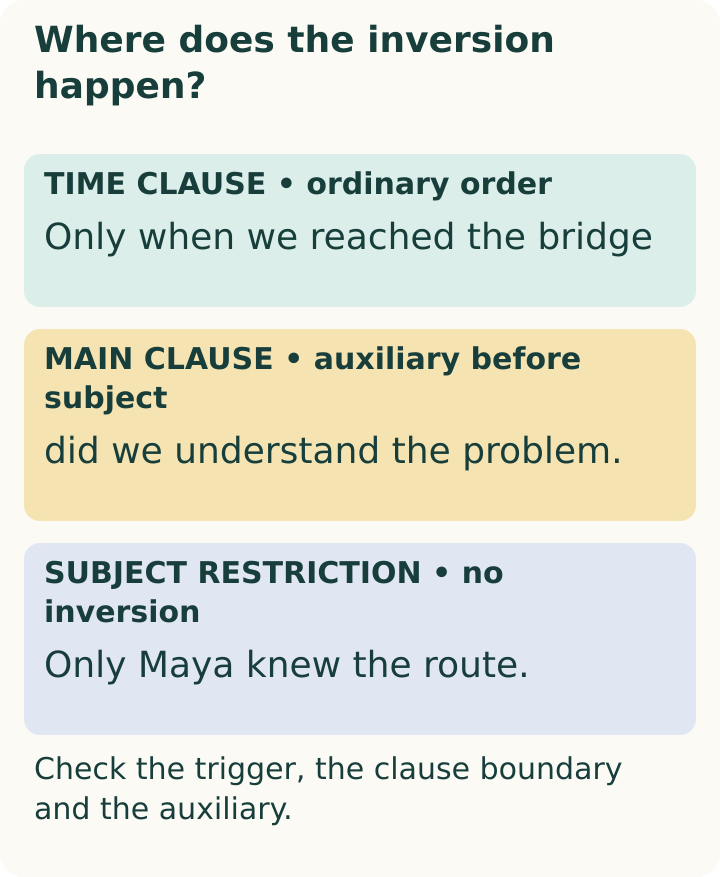
“We understood the problem only when we reached the bridge.” Fronting the time condition gives “Only when we reached the bridge did we understand the problem.” The time clause keeps reached after we. It is the following main clause that takes did we understand. Do not invert both clauses.
With not until, use the same boundary check: “Not until the caretaker arrived did we discover the missing key.” The opening part tells us when the discovery became possible. The main statement is we discovered the missing key. Bracket the sentence as [Not until the caretaker arrived] [did we discover the missing key]. Remove the brackets when the structure is secure.
An already present auxiliary stays appropriate: “Only after the notice had been checked could the group choose another route.” The first clause has ordinary order, the notice had been checked. The main clause inverts could and the group. Inversion does not change the order of the actual events.
Only is not a universal signal
When only directly modifies the subject, leave the subject before its verb: “Only Maya knew the route.” This means no other person knew it. “Only then did Maya know the route” restricts the time and triggers inversion. The position of only changes the meaning as well as the grammar.
An object in its ordinary place also does not trigger inversion: “Maya packed only a notebook.” A fronted restrictive object can: “Only a notebook did Maya pack.” That version is highly marked; the neutral version is normally clearer. Do not teach only as a mechanical instruction to swap the next two words.
“Only Maya did know” can be grammatical with emphatic did. It still has subject-before-auxiliary order. If an exercise asks for a neutral version, write “Only Maya knew”; do not claim that the emphatic version was an inversion error. Grammar, emphasis and preferred style are different judgements.
Boundaries and a small C1 extension
Hardly and no sooner can emphasise two closely connected past events: “Hardly had we sat down when the bell rang”; “No sooner had we sat down than the bell rang.” Keep the conventional when/than pairing in these practice patterns. The earlier action uses past perfect here; the following event uses past simple.
These constructions are optional expressive choices, not a requirement for accurate storytelling. Before using one, establish which event happened first and whether the close sequence matters. If you merely want to report two unrelated facts, two ordinary clauses are clearer. Choose one significant moment for emphasis and let surrounding neutral sentences carry the background.
Eight checks: apply the rule
Answer before you check. For typed answers, use the requested wording; valid listed variants are accepted. Read the explanation even if your answer is right.
Word order and clause boundaries
Answer on paper, then open the explanations below. Enable JavaScript to check answers here.
Controlled rewrites
Answer on paper, then open the explanations below. Enable JavaScript to check answers here.
Register decisions
Answer on paper, then open the explanations below. Enable JavaScript to check answers here.
Your decision card
Trigger → clause boundary → auxiliary → base form → meaning and register. [Only when we reached the bridge] [did we understand the problem]. The time clause keeps ordinary order; the main clause inverts. Only Maya knew restricts the subject and does not trigger inversion.
Related learning
Companion resource: A Walk That Went Wrong: Negative Inversion Practice.
Related references for further study: The Hidden Blueprint of a Clear English Sentence; Cohesive Paragraphs: Reference, Substitution and Linking Ideas; Hedging and Degrees of Certainty.
Related Guides






Continue learning this topic
Review an explanation, study examples or try a related practice test.
- Practice test “I’ve never seen anything like this” — A U.S. doctor treats Ebola’s youngest victims — C1 English Listening Practice Test
- Practice test “I’ve never seen anything like this” — A U.S. doctor treats Ebola’s youngest victims — C1 English Grammar Practice Test
- Practice test “I’ve never seen anything like this” — A U.S. doctor treats Ebola’s youngest victims — C1 English Vocabulary Practice Test
- Course lesson Inversion after negative adverbials – C1: Precision and Expression
- Course lesson Present simple questions and negatives – A1–A2: Grammar Foundations
- Course lesson Past questions and negatives – A1–A2: Grammar Foundations