
Guide
B1 · Intermediate
Grammar
Who Called You or Who Did You Call? Subject and Object Questions
Understand the difference between subject and object questions. Compare who called with who did you call, then practise 12 explained questions.
9 min read
1,512 words
Updated Oct 18, 2026

On this page (7 sections)
“Who called you?” and “Who did you call?” describe opposite directions. This B1 guide helps you identify the missing person before choosing a question form. Allow about 18 minutes. You will practise 12 questions. The examples use ordinary affirmative questions without special emphasis.
One event, two missing roles
Start with a complete event: Nina called Omar. Nina is the subject, the person making the call. Omar is the object, the person receiving it. The action runs from Nina to Omar. If you remove Nina, ask “Who called Omar?” If you remove Omar, ask “Who did Nina call?” The answer to either question restores the same fact, but the missing role is different.
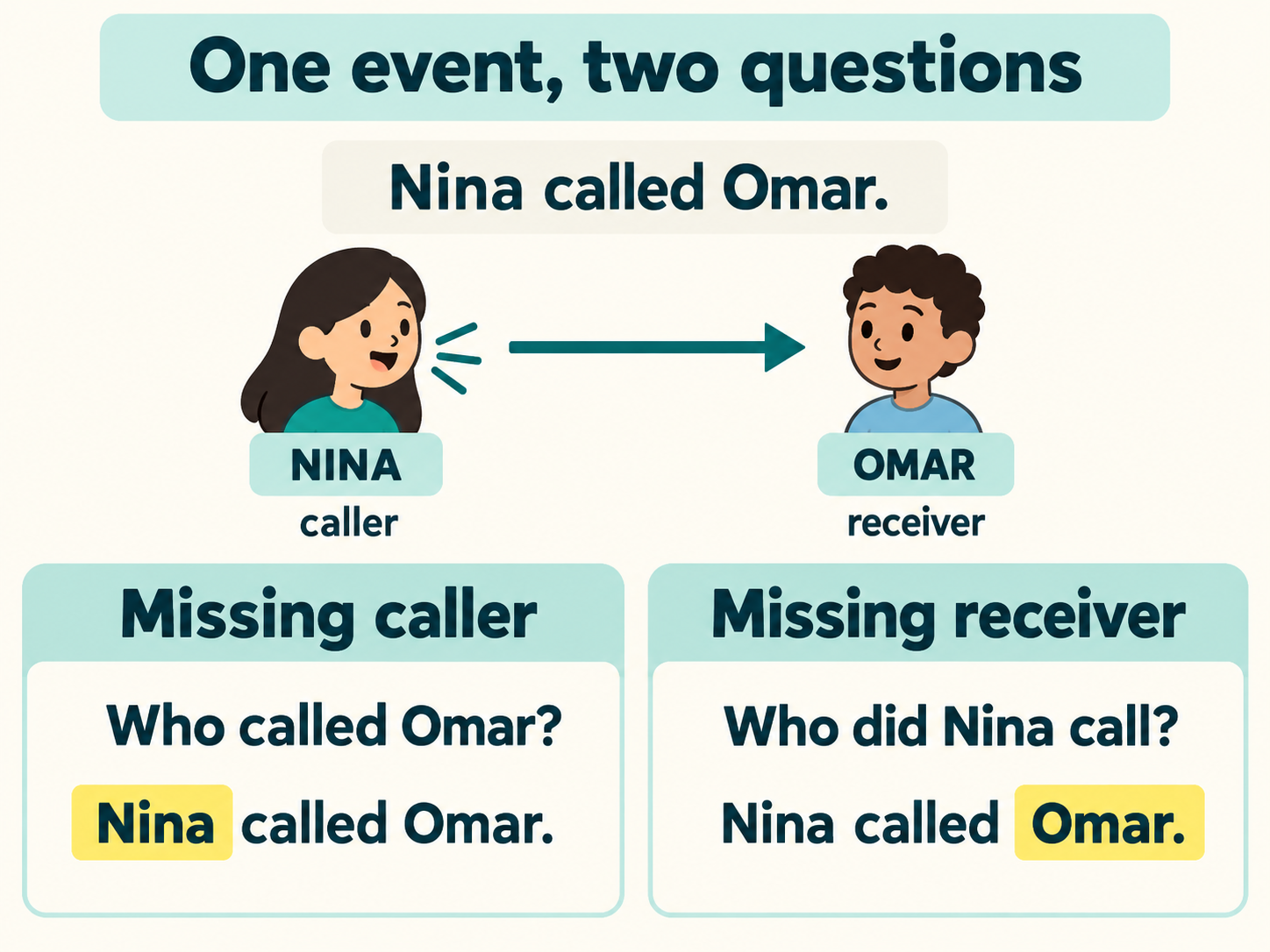
A quick way to check your meaning is to answer your own question with a complete sentence. “Who called Nina?” would produce a statement in which Nina received a call. That is a different event. Word order is useful only when it preserves the relationship between the people.
When the question word is the subject
In an ordinary affirmative subject question, who or what takes the subject’s place. Keep the verb after it: “Someone sent the message” becomes “Who sent the message?” “Something fell” becomes “What fell?” In the past simple, sent and fell remain past forms. You do not add did in this neutral pattern.
Use who for a person and what for a thing or event. A phrase such as which volunteer can also be the subject: “Which volunteer opened the door?” With an unknown singular subject, the present-simple pattern is normally “Who works here?” rather than “Who work here?” A question phrase can include a plural noun: “Which volunteers work here?” Match the verb to that plural phrase.
When the question word is the object
In an object question, the original subject stays visible. “Nina called someone” becomes “Who did Nina call?” Who replaces the receiver, while Nina remains the caller. In the past simple, add did and change the main verb to its base form. Compare called in “Who called Omar?” with call in “Who did Nina call?”
The same contrast works in the present: “Who helps Leo?” asks for the helper. “Who does Leo help?” asks for the person Leo helps. Does goes before Leo, and help has no -s because does carries that marking. Do not remove does just because the question starts with who.
Be and other auxiliaries
Do-support is not needed when an auxiliary is already present. “Who is waiting?” asks for the person doing the waiting; who is the subject. “Who are you waiting for?” asks for the person you expect to meet; you is the subject, and are precedes it. The preposition for naturally stays at the end in ordinary conversation.
Similarly, “Who has finished?” asks for the person who has completed the task. “What have you finished?” asks for the completed thing, with you still the subject. “Who can help?” asks for a helper, while “Who can you help?” asks for a recipient of your help. The position and presence of the other subject are important clues.
Optional recognition note: whom is a formal object form. “Whom did Nina call?” is possible, but who is normal in everyday questions. Do not use whom for the subject of “Who called Omar?” In these tasks, ordinary object who and formal whom are both accepted where the rest of the question is the same.
Read the meaning before changing the form
Never begin by deleting did from every who question. First ask: is there another subject? “Who did Sara thank?” contains Sara, so the missing person is the receiver of her thanks. “Who thanked Sara?” has no other subject before thanked, so who is the person giving thanks.
Context also matters. “Who is Alex?” normally asks about Alex’s identity rather than an action passing from one person to another. Use the actor–action–receiver method with simple active events such as inviting, calling, helping and thanking. Do not force every sentence with be into that action pattern.
Reconstruct and ask
For questions 1–4, identify the missing role. For 5–8, use who or what to ask about the named missing information. For 9–12, write an ordinary, neutral question with no special emphasis.
Answer on paper, then open the explanations below. Enable JavaScript to check answers here.
Use questions to rebuild an event
Use this role-first checklist: write the complete statement; mark the missing role; replace the gap with who or what; keep the ordinary subject pattern or build the object-question pattern; answer the question to confirm the original event has not changed.
Your turn · self-review
Use it yourself
Make your own answer before opening the model. Other accurate answers are possible. Use the checklist to review meaning and form.
Practice only. Your writing stays on this page; it is not submitted or saved.
-
Model answer and explanation
Who thanked Noor? Who did Lena thank? Answer: Lena thanked Noor. Check that Lena gives the thanks in both questions; the subject question keeps thanked, and the object question uses did + thank.
Next, use these question pairs to rebuild the fictional event record in “Who Helped Whom at the Open Day? Rebuild the Event Record”. The aim is to discover a missing fact while keeping every known person’s role unchanged.
Related Guides






Continue learning this topic
Review an explanation, study examples or try a related practice test.
- Practice test UNLV Introduces a Minor in Teaching Mariachi as Demand for Instructors Grows — C2 English Listening Practice Test
- Practice test UNLV Introduces a Minor in Teaching Mariachi as Demand for Instructors Grows — C2 English Grammar Practice Test
- Practice test UNLV Introduces a Minor in Teaching Mariachi as Demand for Instructors Grows — C2 English Vocabulary Practice Test
- Course lesson Subject pronouns and possessive adjectives – A1–A2: Grammar Foundations
- Course lesson Present simple questions and negatives – A1–A2: Grammar Foundations
- Course lesson Participle clauses and shared subjects – C1: Precision and Expression