
Guide
B2 · Upper-intermediate
Grammar
Parallel Structure: Balanced Lists, Comparisons and Paired Ideas
Recognise and build grammatically balanced lists, comparisons and paired structures.
9 min read
1,443 words
Updated Oct 18, 2026

On this page (9 sections)
B2 · 23 minutes · 8 explained checks. Work through the examples, try the questions, then use the final checklist. All people, venues and notices in this resource are fictional.
Hear and see the balance
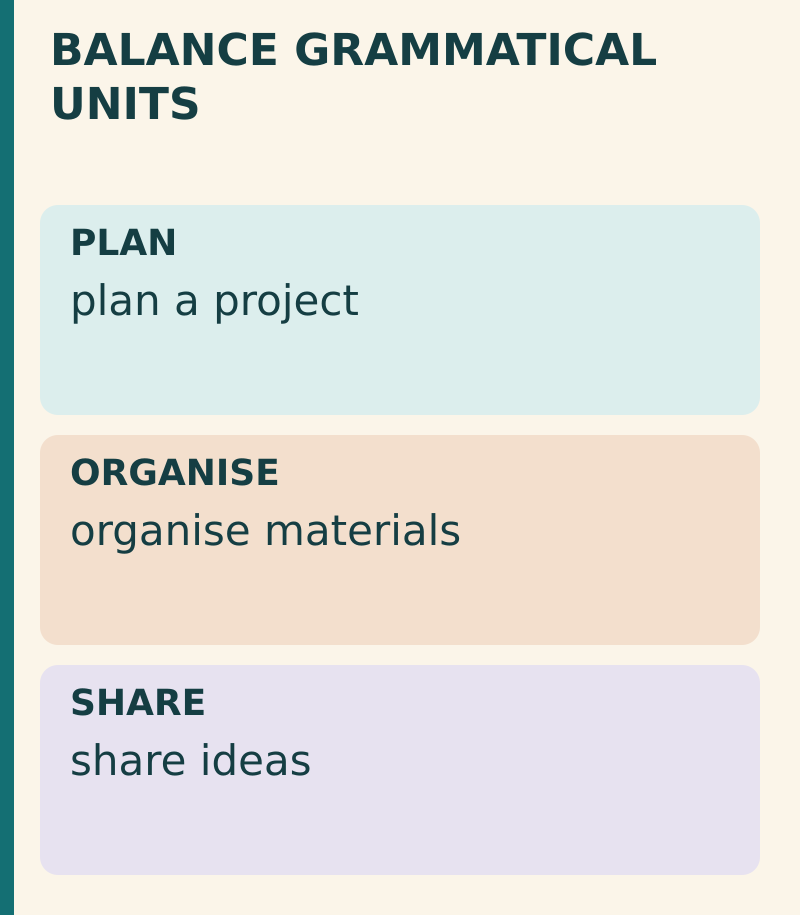
Parallel structure makes related units easy to compare. Read “The workshop helps you plan a project, organising materials and to share ideas.” The three activities have the same job, but their forms do not fit smoothly after helps you. “The workshop helps you plan a project, organise materials and share ideas” gives each item a compatible verb phrase.
Help permits both a bare infinitive and a to-infinitive: “helps you plan” and “helps you to plan” are standard. You can therefore write “helps you to plan, organise and share” or repeat to before each action. The problem is not the presence of to; it is the mixture of organising with the selected infinitive pattern. Parallelism is about grammatical relationships, not equal word counts or identical-looking words.
Words, phrases and clauses
Start by identifying what you are coordinating. Nouns: “We need tables, chairs and lamps.” -ing clauses: “The role involves greeting visitors, answering questions and recording bookings.” Infinitives: “We aim to reduce waste, save money and share equipment.” Full clauses: “Maya prepares the room, Leo checks the list and Noor welcomes visitors.” Each series uses comparable grammatical units.
Repeated words can often be shared. In “We want to plan, to practise and to present,” each verb has to. In “We want to plan, practise and present,” the first to applies across the coordinated verbs. Both are natural. Repeating to can make the parts more explicit or rhythmic. Do not remove a needed preposition merely for visual symmetry: “interested in design and proud of our work” uses two adjective phrases, each with its own required preposition.
Pair the same kind of unit
Place both and and before equivalent units: “The course teaches both planning and presentation.” The paired units are two nouns. “The course both teaches planning and provides practice” pairs two verb phrases. “Both Maya and Noor teach” pairs subjects. Moving both changes what is being grouped, so first decide whether you mean people, activities or objects.
The same principle helps with either...or: “You can either join the morning group or attend the afternoon session.” Each choice is a verb phrase after can. “You can join either the morning group or the afternoon session” pairs objects after join. Not only...but also can pair units too: “The session develops not only confidence but also practical skills.” This guide keeps these phrases inside ordinary sentences; fronted not only introduces a separate inversion pattern.
Compare like with like
A comparison needs a clear base. “The centre’s opening hours are longer than the library” appears to compare hours with a building or institution. Write “The centre’s opening hours are longer than the library’s” or “longer than those of the library.” The possessive or those refers to the missing hours. “The centre stays open longer than the library does” is another clear version.
A compact comparison is not automatically wrong merely because words have been omitted. “Our room is bigger than theirs” is perfectly clear when theirs means their room. Repair genuine ambiguity rather than expanding every sentence. Keep the measured property intact: changing longer opening hours into more convenient opening hours adds a judgement that the original fact did not support.
Avoid mechanical overcorrection
Parallelism cannot override meaning. “She works carefully and with great patience” coordinates two compatible manner expressions; one is an adverb and one a prepositional phrase. A strict classroom pattern may prefer “carefully and patiently,” but the original is natural. Similarly, a list of actions may contain phrases of very different lengths while keeping their grammatical role clear.
Ask whether a proposed correction changes scope. “Both Maya and Noor can teach either drawing or plant care” says two teachers each have a choice of activity. Rewriting it as “Maya can teach drawing and Noor can teach plant care” assigns different roles that the source did not assign. Balanced wording can still be inaccurate. Never sacrifice the original choices, participants or degree of certainty just to produce a neat row of forms.
Edit in two passes
First map the meaning: who acts, what units are joined, and whether the relation is addition, alternative or comparison. In “We plan to repair chairs, painting shelves and to share tools,” the intended three activities are repair, paint and share. Second choose a frame and make all three fit it: “We plan to repair chairs, paint shelves and share tools.” Repeat to if useful.
Now check time and scope. If the source says the group plans these actions, do not change it to a claim that the work is already finished. If it offers either a morning or afternoon session, do not turn that into a requirement to attend both. For comparisons, name the property and both comparable things. Read the result once for grammar and once as a factual statement.
Eight checks and a balancing card
For each question, identify the shared frame before choosing a form. In a short answer, supply only the requested phrase; the rest of the sentence stays fixed. The balancing card is: find the units; select a compatible frame; place paired markers before equivalent parts; compare like with like; check meaning again. This workflow is useful in proposals, instructions and reports without making every sentence sound identical.
Check your understanding
Choose the best answer for the stated purpose. In short answers, type only the requested words. For open rewrites, compare meaning as well as form: other well-formed answers may be possible. Each submitted answer reveals an explanation.
Answer on paper, then open the explanations below. Enable JavaScript to check answers here.
Your final check
Read the complete sentence or source again. Check the actor, action, time, quantities, conditions and intended meaning. Explain why your version works rather than memorising its surface form. Revisit any question whose explanation differs from your reasoning.
Related Guides




Continue learning this topic
Review an explanation, study examples or try a related practice test.