
Guide
B1 · Intermediate
Grammar
Adjective + Preposition: Good At, Interested In and Worried About
Learn 18 adjective–preposition combinations for skills, interests, feelings and relationships. Practise noun, pronoun and -ing complements in 12 checks.
8 min read
1,284 words
Updated Oct 27, 2026

On this page (7 sections)
Learn an adjective together with its preposition: interested in, good at, worried about. These small words are part of useful patterns. This B1 guide teaches 18 common combinations, followed by 12 checks. Allow about 20 minutes. If you need more words for personality, review useful adjectives for people before practising these patterns.
Learn a complete pattern
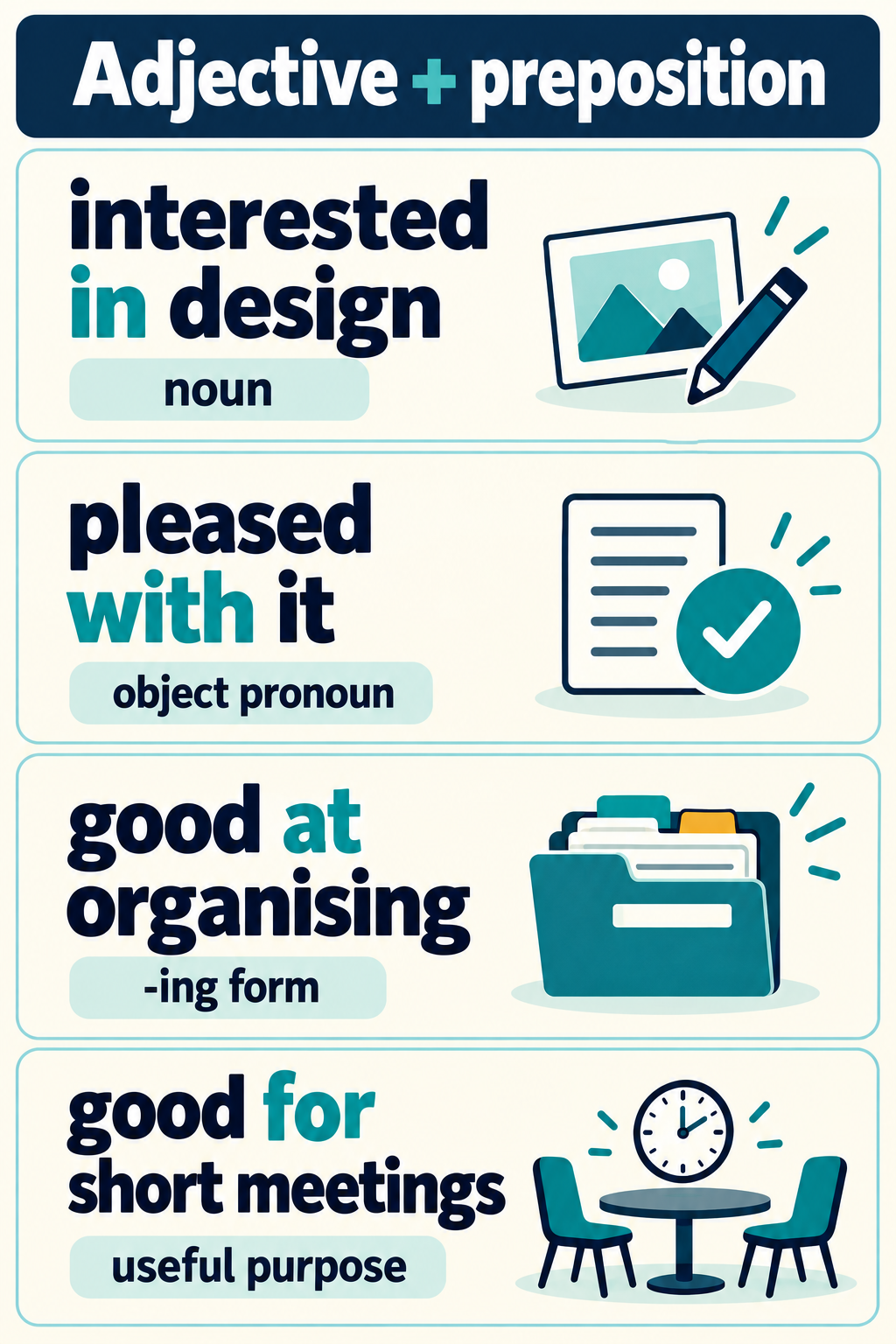
A useful phrasebook entry includes the adjective, preposition and an example: interested in + noun or -ing; “I’m interested in photography”; “I’m interested in learning photography”. Learning interested alone does not show what comes next. The same habit helps you learn common word partnerships in other parts of English.
Prepositions do not translate neatly from one language to another. Learn the whole chunk. For an unfamiliar adjective, check a learner’s dictionary example and its grammar pattern. A different preposition may express a different meaning rather than simply be an error.
Abilities and interests
Good at: skilled in an activity. “Leah is good at drawing.” Bad at: not skilled in an activity. “I’m bad at remembering names.” These describe a skill, not a person’s general worth.
Interested in: wanting to know or do more. “I’m interested in local history.” Keen on: enthusiastic about something. “They’re keen on cycling.” Keen on is especially common in British English.
Familiar with: knowing something through experience. “Are you familiar with this program?” Capable of: having the ability to do something. “The team is capable of solving the problem.” After of, solving uses -ing.
Feelings and reactions
Worried about: concerned about a possible problem. “Mina is worried about the deadline.” Excited about: looking forward with enthusiasm. “We’re excited about the trip.” Afraid of: feeling fear. “I’m afraid of heights.”
Proud of: pleased by someone’s achievement or qualities. “They’re proud of their work.” Tired of: having had too much of something. “I’m tired of waiting.” Pleased with: satisfied with a person, thing or result. “We’re pleased with the new layout.” Tired of waiting expresses frustration; tired after working describes physical fatigue.
People and practical relationships
Kind to: treating someone considerately. “The guide was kind to us.” Angry with: feeling anger towards a person. “She was angry with me.” Angry at is also possible; angry about often introduces the situation causing the anger. Context chooses the meaning.
Different from: not the same as. “This room is different from the old one.” Similar to: alike in some ways. “The design is similar to ours.” Different to is also common in British English, and different than in American English, especially before a clause. Do not treat every regional alternative as wrong.
Ready for: prepared for a thing or event. “We’re ready for the meeting.” Responsible for: having a duty or being the cause. “I’m responsible for the visitor list.” In that example it is a duty. In “The leak was responsible for the damage”, it means cause.
What follows the preposition?
A preposition can be followed by a noun (“interested in art”), an object pronoun (“kind to them”), or an -ing form (“good at explaining”). Do not use a bare verb after the preposition: “good at explain” needs explaining. Do not use a subject pronoun as its object: “kind to they” needs them.
Good at describes skill: “This person is good at planning.” Good for describes benefit or suitability: “This checklist is good for planning short meetings.” The checklist is useful; it does not possess a person’s skill. Also compare ready for the meeting with ready to start. The second pattern uses to + base verb, not a preposition followed by -ing.
Retrieve and apply
Answer on paper, then open the explanations below. Enable JavaScript to check answers here.
Build your own useful set
Make three cards, each with one complete chunk and a new example. On the front, write a meaningful gap such as “interested ___ learning”. On the back, write the whole phrase and one example. Review later today, tomorrow and next week. Mix examples rather than keeping them in the same order.
Your turn · self-review
Use it yourself
Make your own answer before opening the model. Other accurate answers are possible. Use the checklist to review meaning and form.
Practice only. Your writing stays on this page; it is not submitted or saved.
-
Model answer and explanation
Ravi is good at organising meetings. He is interested in learning design. He is worried about the new timetable. Check the whole chunk and the noun, pronoun or -ing form after each preposition. Other fictional details are welcome.
Use these patterns in “A New-Job Check-In: Talk About Strengths, Interests and Concerns”. You can use a fictional person; you do not need to share your own workplace feelings.
Related Guides






Continue learning this topic
Review an explanation, study examples or try a related practice test.
- Practice test Last Ditch, a Massachusetts Lesbian Bar Known for Its Mask Policy, Will Close — C1 English Listening Practice Test
- Practice test Last Ditch, a Massachusetts Lesbian Bar Known for Its Mask Policy, Will Close — C1 English Grammar Practice Test
- Practice test Last Ditch, a Massachusetts Lesbian Bar Known for Its Mask Policy, Will Close — C1 English Vocabulary Practice Test
- Course lesson Subject pronouns and possessive adjectives – A1–A2: Grammar Foundations
- Course lesson Time and place prepositions – A1–A2: Grammar Foundations