
Guide
A2 · Elementary
Grammar
Each, Every and All: Individuals, Groups and Word Order
Choose each, every and all with the right noun and verb. Compare group coverage, of phrases, every day and all day in ten explained checks.
7 min read
1,124 words
Updated Oct 26, 2026

On this page (7 sections)
1. Look at individuals and groups
Imagine a reading club with four volunteers. The organiser gives each volunteer a task card. Every volunteer needs a card before the session starts. All the volunteers then move the chairs together. The first sentence looks at people one by one. The second states a rule with no exceptions. The third refers to the whole group.
These meanings overlap. Each volunteer has a card and Every volunteer has a card can describe the same situation. Do not assume that only one is correct unless the sentence structure or the intended focus makes the difference clear.
2. The core patterns
Three useful patterns
each + singular noun
Look at members one by one
Each reader has a book.
every + singular noun
Include all members in a rule
Every reader has a book.
all + plural noun
Refer to the complete group
All readers have books.
all + uncountable noun
Refer to the complete amount
All the water is in the jug.
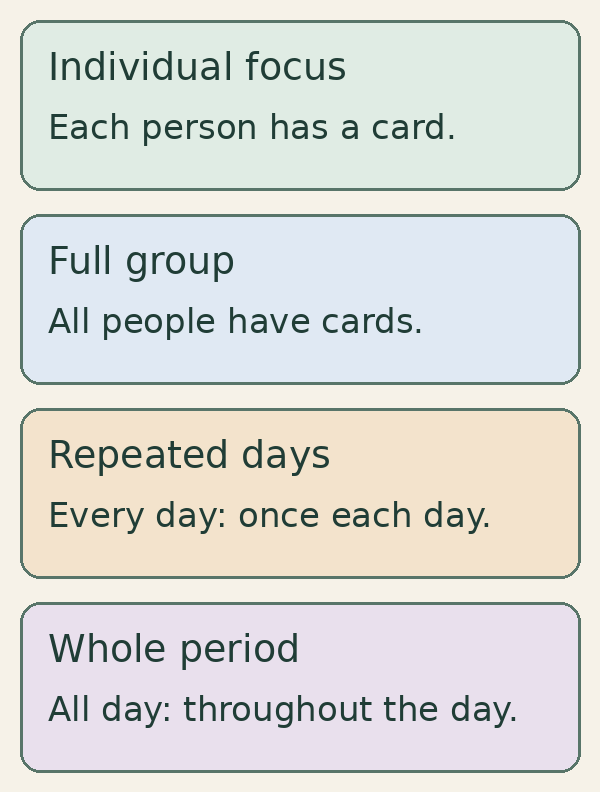
Use a singular noun and verb after each or every: each card is, every person has. Do not write every people or each books. All readers uses a plural noun and normally a plural verb. With an uncountable noun, use singular agreement: all the information is useful.
3. When both choices work
Each often highlights separate attention: “Check each page carefully.” Every often highlights complete coverage: “Every page needs a number.” But “Check every page carefully” and “Each page needs a number” are also grammatical. The difference is emphasis, not a ban on either word.
Each can refer to two members or more: each hand, each of the two bags. Every normally refers to a group of three or more. In everyday instructions for a larger group, both often work. When a task allows either, the answer key should accept both rather than make you guess the writer’s favourite word.
4. Each of and all of
Use each of with a plural group: each of the volunteers, each of these cards, each of them. In standard edited English, each is the singular head: Each of the volunteers has a card. Do not use every of them. Say every one of them or each of them.
All the books and all of the books are both possible. All my books and all of my books are also possible. With an object pronoun, use of: all of them, all of us. “They all have books” is another pattern, with all after the subject pronoun.
Compare “Each of us has a task” with “All of us have tasks.” The first treats each member separately; the second names the complete group. Use object forms after of: us and them, not we and they.
5. Time expressions
Every day means on each day: I read every day. All day means throughout the day: I read all day. These are different. Reading for ten minutes every day does not mean reading all day.
Every two days describes an interval: Monday, Wednesday, Friday, Sunday, Tuesday and so on. A routine on Monday, Wednesday and Friday each week has a three-day gap from Friday to Monday, so it is not a continuous every-two-days schedule. Everyday, written as one word, is an adjective meaning ordinary: everyday tasks.
6. Compare and repair
Answer ten checks. Where both each and every are possible, both are accepted.
Answer on paper, then open the explanations below. Enable JavaScript to check answers here.
7. Use the distribution checklist
Checklist: one member at a time → each; a rule for all members → every; the whole group or amount → all. Then check the structure. Each/every normally take a singular noun. Each of needs a plural group. Every of is not enough; use every one of. All can take a plural or uncountable noun.
For time, ask whether you mean repetition or duration. “We meet every day” answers how often. “We meet all day” describes how long the meeting lasts. For an interval, check every gap, including the weekend.
Try two accurate versions of one idea: Each volunteer has a book. All the volunteers have books. Both include the whole group, but the grammar changes. The paired reading-club lesson asks you to give individual jobs and shared jobs without leaving anyone out.
Related Guides






Continue learning this topic
Review an explanation, study examples or try a related practice test.
- Practice test Video of Long Beach Cyclist Encounter Prompts Call for Investigation — B2 English Listening Practice Test
- Practice test Video of Long Beach Cyclist Encounter Prompts Call for Investigation — B2 English Grammar Practice Test
- Practice test Video of Long Beach Cyclist Encounter Prompts Call for Investigation — B2 English Vocabulary Practice Test
- Course lesson Present simple for everyday routines – A1–A2: Grammar Foundations
- Course lesson Checkpoint: everyday grammar – A1–A2: Grammar Foundations