
Guide
B2 · Upper-intermediate
Grammar
Past Modals: Must Have, Might Have, Could Have and Should Have
Distinguish deduction, possibility, missed opportunity and retrospective advice about the past.
10 min read
1,690 words
Updated Oct 27, 2026

On this page (12 sections)
B2 • About 24 minutes. Build modal + have + past participle accurately. Distinguish must have/cannot have deductions from might/could have possibilities. Interpret should have as retrospective advice or expected outcome according to context. Recognise when could have means a possible explanation versus an unrealised opportunity.
One form, several communicative jobs
A modal perfect has a modal + have + past participle: must have left, might have forgotten, could have taken, should have checked. The form points back to a past event or a completed situation, but its communicative job depends on the modal and the surrounding context. It may express an inference, an uncertain explanation, an unused opportunity, criticism, advice in hindsight or an expected result.
Compare “She could have taken the bus; I do not know how she travelled” with “She could have taken the bus, but she chose to walk.” The words could have taken are identical. The first leaves the actual journey uncertain; the second says an available option was not used. Learn to ask what is known before deciding what the modal means.
This guide separates three questions: what happened, what evidence the speaker has, and what judgement the speaker makes. A well-formed modal perfect can still overstate the evidence. In a fair account of a missing object, cautious grammar and explicit facts are often more useful than an impressive-sounding deduction.
Strong deductions: must have and cannot have
“The floor is wet and there are muddy footprints from the open door. Someone must have come in.” Must have expresses a strong positive inference. The speaker treats that explanation as compelling on the available evidence; it is not the same as a direct eyewitness report. If a new fact offers another explanation, the inference may need revision.
“The only key was with me all morning, and the cupboard has no other entrance. They cannot have opened it with that key.” Cannot have, or can’t have, rejects a past possibility because it conflicts with the stated evidence. Could not have can serve a similar deductive function. Always specify what is ruled out: opening it with that key is narrower than claiming nobody could possibly have opened it by any means.
Must not have is also used for negative deductions, especially in some varieties and contexts: “She must not have received the message.” It is not automatically interchangeable with cannot have. The first infers that receiving did not happen; the second can mean that receiving was impossible or incompatible with the evidence. Context and dialect affect natural choices. Do not reduce the distinction to a universal one-word substitution.
Possible explanations: may, might and could have
“The envelope is not on the desk. Lina may have moved it”; “She might have put it in the drawer”; “It could have slipped behind the desk.” Each offers a possibility without claiming it is established. May, might and could can overlap here; there is no reliable numerical probability scale that applies to every speaker and context.
The strongest useful answer may be a cautious one. The lights being off does not prove everyone has gone home. “They might have left” leaves room for a meeting elsewhere or a switched-off light. A reason for doubt should be stated when it matters: “The box could have stayed in the car; nobody has checked the boot yet.”
Do not turn a possible explanation into an accusation. “A volunteer might have moved the box” is different from “The volunteer must have taken it.” Name a person only when the source justifies it. If the evidence is about location rather than behaviour, focus the possibility on location.
Could have: opportunity or explanation?
An unrealised opportunity has an available option and a continuation showing it was not used: “We could have borrowed chairs, but we bought them instead.” The borrowing was possible; the actual choice was buying. “We could have asked earlier, but we waited” often adds hindsight about an available action.
An uncertain explanation leaves the outcome open: “They could have borrowed the chairs; I have not seen the receipt.” Here the speaker does not know whether borrowing occurred. A sentence such as “They could have borrowed chairs” is ambiguous without more context. The responsible answer is to request or inspect the continuation, not to force one interpretation.
Could have can also describe an unrealised risk: “The glass could have broken, but it did not.” This guide’s exercises mainly use opportunities and uncertain explanations. In both cases, the context determines whether the action is known not to have happened or remains merely possible.
Should have: hindsight and expectation
“We should have checked the room number” usually evaluates a past choice as unwise or incomplete. In a context where the group did not check, it offers advice in hindsight. “We should not have left the list at home” criticises a past action. To keep feedback constructive, name the missed action and the next improvement rather than making a broad judgement about a person.
Should have can also describe an expected result: “The parcel should have arrived by now; the tracking estimate was noon.” This expresses expectation, not necessarily criticism of the sender. It does not confirm delivery. Add a check or another source before reporting “The parcel has arrived”.
The time phrase and context help. “We should have checked before leaving, but we did not” clearly marks hindsight. “The café should have opened by now, according to the schedule” is an expectation. An isolated should have sentence may allow both readings. Ask what the speaker is doing with it.
Form and meaning repairs
Have stays unchanged after a modal: must have, not must had. The next verb is a past participle: might have gone, not might have went. In speech, should’ve can sound like should of, but the written form is should have or should’ve. Of is a preposition and does not build this verb phrase.
Negation needs attention: “They might not have seen the sign” means it is possible that they did not see it. “They cannot have seen the sign” is a stronger rejection of the possibility that they saw it. Neither automatically means they chose to ignore it. Keep lack of perception separate from intention.
Use this editing sequence: label the job, underline the evidence, choose the level of commitment, then check modal + have + participle. If two cautious forms communicate the same intended possibility, both can be acceptable. A test should provide a reason for a unique choice rather than pretending that might and may never overlap.
Eight checks: apply the rule
Answer before you check. For typed answers, use the requested wording; valid listed variants are accepted. Read the explanation even if your answer is right.
Match form and job
Answer on paper, then open the explanations below. Enable JavaScript to check answers here.
Choose for the stated evidence
Answer on paper, then open the explanations below. Enable JavaScript to check answers here.
Repair the verb phrase
Answer on paper, then open the explanations below. Enable JavaScript to check answers here.
Your decision card
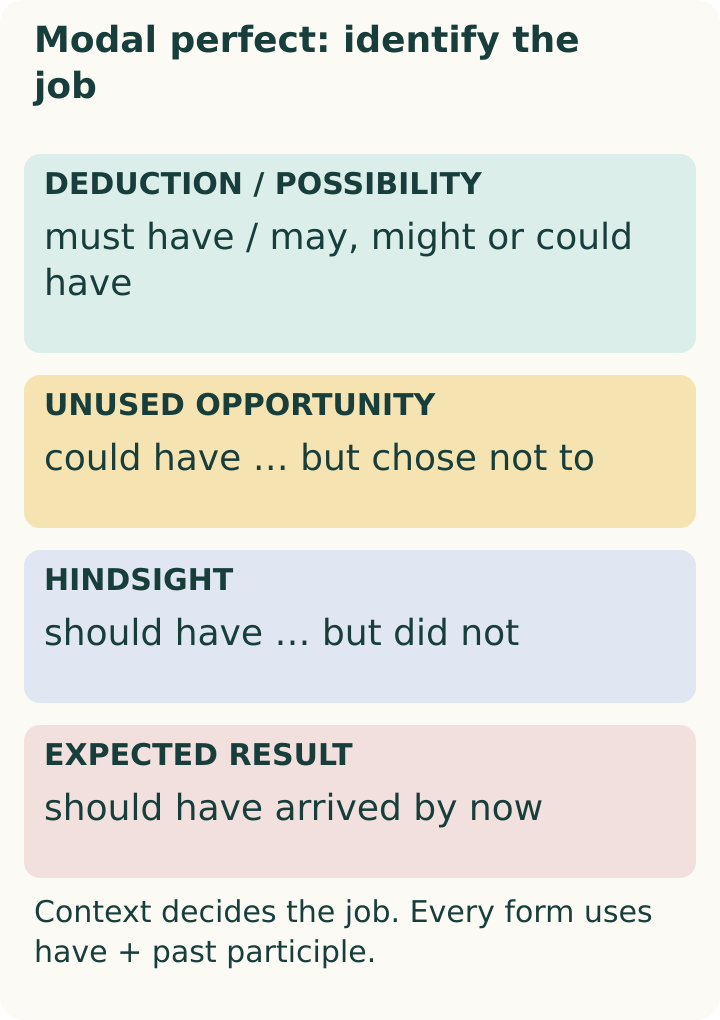
Job → evidence → strength → form. Deduction: must have. Possibility: may/might/could have. Unused option: could have … but did not. Hindsight: should have … but did not. Expectation: should have … by now. All use have + past participle.
Related learning
Companion resource: The Missing Picnic Box: Past Modal Practice.
Related references for further study: Must, Have To and Should: Rules and Advice; Hedging and Degrees of Certainty; Third Conditional: Imagining a Different Past.
Related Guides






Continue learning this topic
Review an explanation, study examples or try a related practice test.
- Practice test In Alaska, Some Early Voting Sites in Rural Villages Have Not Yet Opened — C1 English Listening Practice Test
- Practice test In Alaska, Some Early Voting Sites in Rural Villages Have Not Yet Opened — C1 English Grammar Practice Test
- Practice test In Alaska, Some Early Voting Sites in Rural Villages Have Not Yet Opened — C1 English Vocabulary Practice Test
- Course lesson Present perfect or past simple – B1–B2: Grammar in Context
- Course lesson Past perfect and earlier events – B1–B2: Grammar in Context
- Course lesson Telling a story with past tenses – B1–B2: Grammar in Context