
Lesson
B1 · Intermediate
Grammar
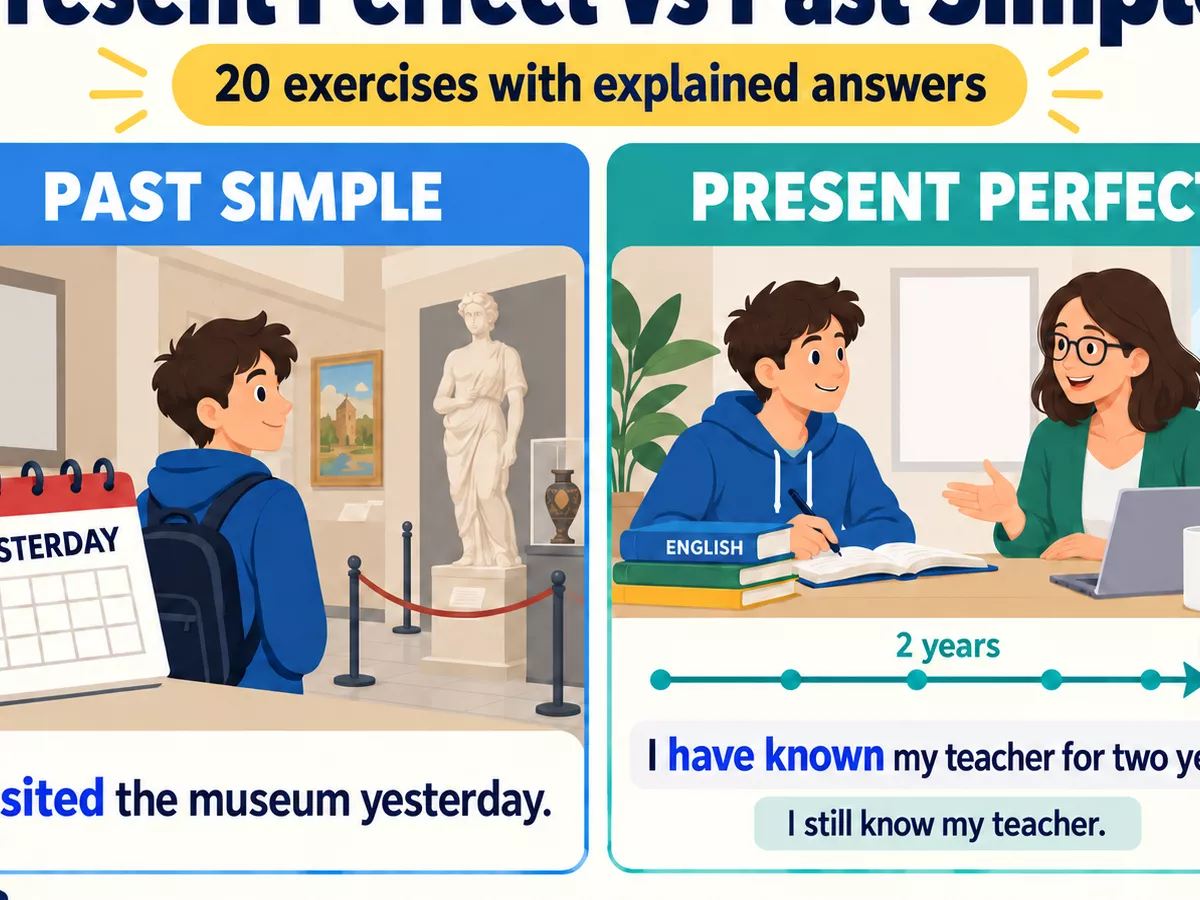
Present Perfect vs Past Simple: 20 Exercises With Answers
Try 20 B1 present perfect vs past simple exercises with explained answers. Compare finished time, continuing states, verb forms and British–American usage.
15 min read
2,540 words
Updated Oct 13, 2026
On this page (21 sections)
These 20 B1 exercises compare the present perfect simple with the past simple. The questions include clear time references and short situations, so you practise meaning rather than guessing from one word. Complete the four sets in the exercise cards and choose Check my answers to see your score and explanations. You can also work in a notebook. This is a self-study lesson, not an official level test.
What you will practise
First, distinguish a completed past period from a state that still continues. Then check the verb form: did plus a base verb for past questions, and have or has plus a past participle for the present perfect. Finally, read short exchanges to see why a speaker switches from experience to a specific occasion.
A starting point: finished events and continuing states
A finished date such as yesterday or in 2020 normally calls for the past simple when it tells us when an event happened. A state that began earlier and still holds now can use the present perfect: Nina has owned that bicycle since 2021. The present perfect does not mean every action is still happening.
Compare two original examples: I owned a blue bicycle at school, but I sold it years ago. I have owned this red bicycle for three years, and it is still mine. The verb describes possession in both sentences; the difference is whether that possession belongs to a closed period or continues to now.
Read the reference: Present Perfect Explained
Check the form before you choose the tense
Past simple: visited in a statement; did not visit in a negative; Did you visit? in a question. After did, use the base verb.
Present perfect: have visited or has visited; have not visited; Has she visited? Use have/has plus the past participle.
Check irregular forms carefully: go–went–gone; see–saw–seen; know–knew–known.
For gives a length of time, such as four months. Since gives a starting point, such as April. Neither word is an automatic tense switch: I lived there for four months can describe a finished stay. I have known the coach since April describes a relationship that continues now.
Do not let a time word choose for you
Today and this morning need context. At ten in the morning, a speaker may count calls made so far using the present perfect. Later, the same speaker may describe one completed call with the past simple. The way the speaker frames the situation matters. This lesson makes the intended frame clear rather than pretending that today allows only one tense.
British and American English also differ in some recent-event situations. American speakers commonly say I already ate where a British practice exercise may expect I have already eaten. The answer key labels that difference rather than calling natural American English incorrect. The words ever, already and yet are clues to meaning, not rules that forbid all other tenses.
Compare tense forms: English Tenses Chart With Examples
Practice: 20 questions
Exercise 1: choose the contextually appropriate form (1–5)
Choose one option. The context explicitly tells you whether the time or state is finished or continues to now.
Answer on paper, then open the explanations below. Enable JavaScript to check answers here.
Exercise 2: complete the verb forms (6–10)
Write the past simple or present perfect simple of the verb in brackets. Use full forms or standard contractions; do not use the present perfect continuous in this task.
Answer on paper, then open the explanations below. Enable JavaScript to check answers here.
Exercise 3: correct one tense, verb-form or time-expression error (11–15)
Rewrite the whole sentence. Keep the stated time and meaning. Each item has one tense, verb-form or time-expression error.
Answer on paper, then open the explanations below. Enable JavaScript to check answers here.
Exercise 4: choose the form in a short exchange (16–20)
Choose from the two options. Notice whether the speaker discusses a continuing state, a present result or a dated event. Item 18 specifies a British-English practice target.
Answer on paper, then open the explanations below. Enable JavaScript to check answers here.
Answers and explanations
Complete each exercise and choose Check my answers to reveal its answers and explanations. You can also open the complete answer key below for self-study.
Show the complete answer key (1–20)
Exercise 1: choose the contextually appropriate form (1–5)
met — Yesterday afternoon is a finished past time. Use the past simple met, not have met with yesterday.
have known — The friendship and knowledge continue now. Have known connects the earlier starting point with the present.
painted — Last Saturday places the action in a finished period. Painted is the past simple; have painted does not fit this finished-time reference.
have owned — The ownership continues to now, so use have owned for the ongoing state. Owned alone would present it as a finished past state.
lived — The school period and residence are finished. Lived describes that past state without saying it continues now.
Exercise 2: complete the verb forms (6–10)
bought — Last month is finished, so use the irregular past simple bought.
has known — Sara is singular, so use has plus the past participle known. The relationship continues from 2022 to now.
did not see — The sentence refers to yesterday's finished match. Use did not plus the base verb see, not did not saw. Also accepted or noted: didn't see
have had — Possession continues now. Have is the auxiliary; had is the past participle of the main verb have.
did / arrive — A question about a finished past arrival uses did plus the base form arrive. The word yesterday makes the time reference clear.
Exercise 3: correct one tense, verb-form or time-expression error (11–15)
We visited the aquarium in 2020. — In 2020 is a finished past time, so change have visited to visited.
She has known Omar for six years, and they are still friends. — The present perfect needs the past participle known, not the past simple knew. The friendship continues now.
Did you go to the meeting last Tuesday? — After did, use the base verb go. Went is the past form used without did in an affirmative statement.
I have never tried skiing in my life so far. — Have needs a past participle. Tried is the regular participle of try; the sentence considers experience up to now.
They have owned this shop for five years, and they still run it. — For introduces a duration such as five years. Since needs a starting point, such as 2021 or the day they moved here.
Exercise 4: choose the form in a short exchange (16–20)
have you had — The question asks about possession continuing to now. Have you had uses the present perfect simple of have.
did you take — When and last Friday identify a finished occasion. Did you take asks for that past time.
have already eaten — The target is the usual British-English present-perfect form for a present result. Already ate is also natural in American English and is not universally an error. Also accepted or noted: already ate (natural American-English usage; not the specified British-English practice target)
has been — The state of being director continues from 2017 to now. Has been presents that ongoing state, while was would frame the job as a finished past state.
did you write — The previous job is a finished period. Did you write asks about the total within that completed period, not your work up to now.
Check your learning
Choose Check my answers at the end of each exercise to see your score and explanations, up to 20 points in total. Accepted alternatives also count. Record your first attempt, then use Try again to practise mistakes. This is practice, not a CEFR level test, and your answers are not saved.
For a tense-choice mistake, underline the finished time or the evidence that the state continues now.
For a form mistake, check the auxiliary and whether the next verb should be a base form or a past participle.
Write one dated past event and one continuing state about your own life, then revisit any missed questions.
Make the contrast personal
Write two true sentences about something you still have: when you got it, and how long you have had it. For example, I bought my camera last March. I have had it for several months. Then ask a partner one experience question and one specific follow-up question. The second question should request a date or occasion.
When reviewing mistakes, underline the time or context first. Circle the auxiliary next. Ask whether the state continues, whether the event is dated, and whether the participle is correct. Do not simply copy the answer: explain which part of the situation supports it. If another form could express a different viewpoint, describe that viewpoint rather than treating English as a list of trigger words.
Frequently asked questions
Does a finished action always need the past simple?
No. The present perfect can describe an action completed before now when the speaker connects it to the present. The choice is about the time frame and viewpoint as well as whether the physical action ended. A stated finished event time, such as yesterday at four, normally leads to the past simple.
Do 'for' and 'since' always go with the present perfect?
No. For names a duration and can accompany a finished past state: I worked there for six months before I changed jobs. Since names a starting point. In this lesson, since is used with states that still continue, which makes the present perfect the appropriate choice.
Can 'already ate' be correct?
Yes. It is a normal choice in American English for many recent-event situations. British-English teaching materials often practise have already eaten instead. Read the context and the variety specified by an exercise. Do not assume a sentence is wrong just because a different variety uses another preferred form.
Grammar references
British Council: present perfect uses and time frames
Cambridge Grammar: present perfect forms and British–American differences
Related Lessons






Continue learning this topic
Review an explanation, study examples or try a related practice test.
- Practice test Yes/No questions, short answers, and simple conversation responses — A1 English Grammar Practice Test
- Practice test Question words: who, what, where, when, why, how, how often, and how many — A1 English Grammar Practice Test
- Practice test Past simple verb forms: regular, irregular, and spelling exceptions — A1 English Grammar Practice Test
- Course lesson Present perfect or past simple – B1–B2: Grammar in Context
- Course lesson Present perfect simple and continuous – B1–B2: Grammar in Context
- Course lesson Past perfect and earlier events – B1–B2: Grammar in Context