
Lesson
C1 · Advanced
Grammar
A Walk That Went Wrong: Negative Inversion Practice
Apply restrictive inversion accurately and judge its effect in a short recount.
9 min read
1,580 words
Updated Oct 16, 2026
On this page (8 sections)
C1 • About 32 minutes. Recover the sequence from a factual recount. Rewrite selected key moments with correct inversion. Repair false triggers and misplaced inversion. Use marked sentences sparingly in an engaging but accurate recount.
Read the route log
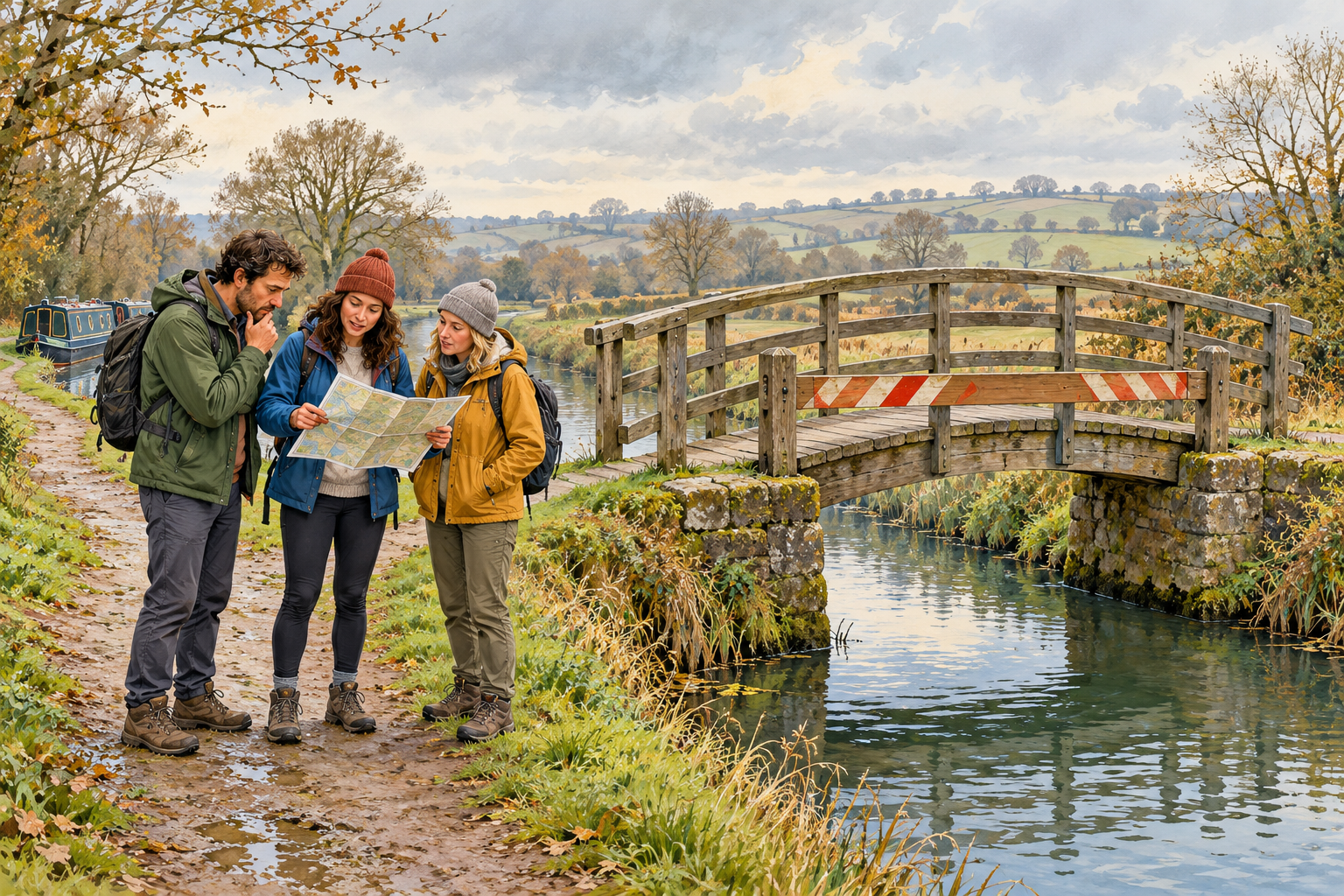
All people and places in this exercise are fictional. On Saturday morning, a small walking group left Brook Hall at nine. The sky was clear, and the organiser, Lena, carried a printed map from the previous year. No one had checked the path notice online. The first part of the walk followed a canal. They rarely met anyone there before ten, so the quiet path did not surprise them. At 9:40 they reached the footbridge. A temporary barrier covered the entrance, and a notice said that repairs would continue that weekend. Only the group leader knew that the bridge had been closed earlier in the month; she had expected it to reopen by Saturday. The group could not cross. They examined the map, but it did not show the temporary closure. At 9:50 they chose to return by the same canal path. Nobody suggested climbing over the barrier. The group reached Brook Hall at 10:30 and made tea. Later, Lena added a reminder to check current notices before another walk. The outing had been shorter than planned, but everyone returned together. The log records these events; it does not describe an accident or an argument.
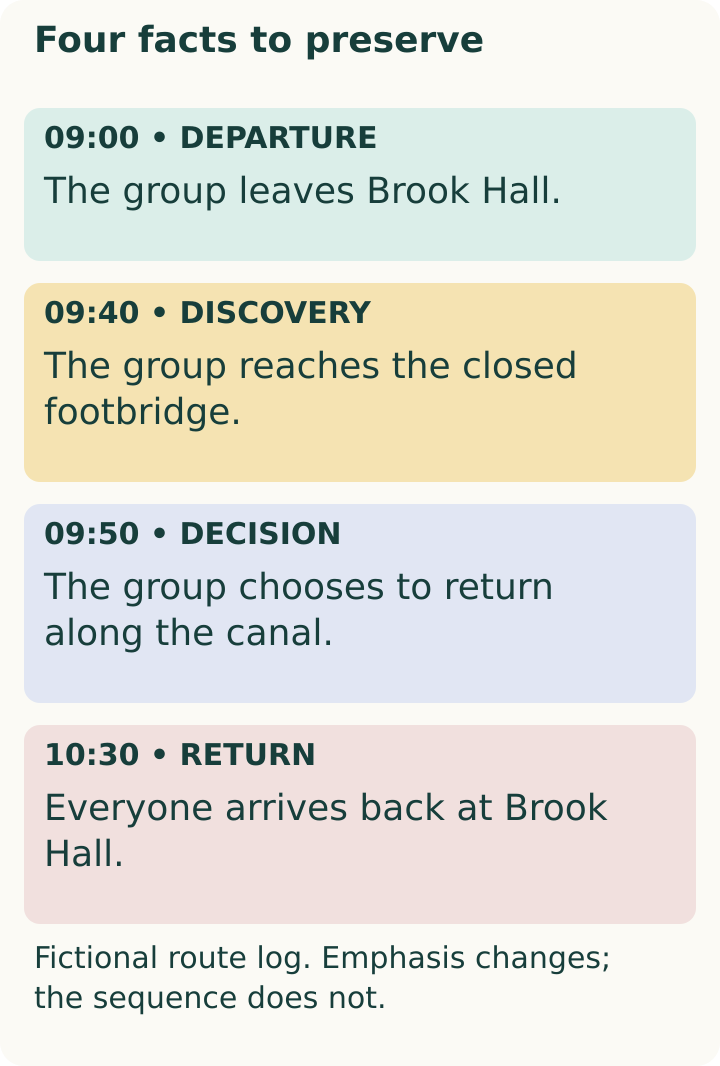
Four fixed facts: 09:00 — leave Brook Hall. 09:40 — reach the closed footbridge. 09:50 — choose to return along the canal. 10:30 — arrive back at Brook Hall. The decision follows the discovery, and the whole group returns together. Do not invent a different route, an injury or an earlier warning to the group.
Choose moments worth emphasising
Three possible turning points are the unexpected barrier, the realisation that the map was outdated, and the decision to turn back. Compare “We realised the map was out of date only at the bridge” with “Only at the bridge did we realise the map was out of date.” The marked version highlights delayed discovery. “We returned at 10:30” needs no inversion merely to report a time.
Keep the truth conditions fixed. Inversion cannot turn rarely into never, uncertainty into certainty, or the leader’s private knowledge into a warning she gave everyone. For each rewrite, locate the log fact first, identify the fronted expression second, and select the auxiliary last. The exercises below use a mixture of exact log details and clearly stated language-practice sentences based on that outing.
Auxiliary workshop
Choose or supply the requested form. Each answer has an explanation about both grammar and meaning.
Answer on paper, then open the explanations below. Enable JavaScript to check answers here.
Clause-boundary workshop
Keep the opening clause in ordinary statement order. The main clause contains the inversion.
Answer on paper, then open the explanations below. Enable JavaScript to check answers here.
Spot false inversion
Read whether the instruction asks for a grammatical repair or a neutral style. Those are different tasks.
Answer on paper, then open the explanations below. Enable JavaScript to check answers here.
Write, compare and revise
Your turn · self-review
Independent writing
Write your own response first, then compare the model and use the fact and grammar checklist below.
Practice only. Your writing stays on this page; it is not submitted or saved.
-
Model answer and explanation
We left Brook Hall at 9:00 on Saturday with Lena’s printed map. The first part of the walk was quiet, and we followed the canal without difficulty. At 9:40 we reached the footbridge and found a barrier across its entrance. Not until we read the notice did we understand that repairs were continuing that weekend. The map was from the previous year and did not show the temporary closure. Only after we had discussed the situation could we agree on our next step. At 9:50 we decided to return along the same path. We stayed together and arrived back at Brook Hall at 10:30. Over tea, Lena added a reminder to check current notices before our next outing. The walk was short, but the log gave us something useful to learn from.
Self-review and transfer
The model uses two inversions: Not until … did we understand and Only after … could we agree. Neutral alternatives are “We understood only after reading the notice” and “We could agree only after discussing the situation.” Check the four times, the return path and the absence of invented events. Then underline each subject and first auxiliary. Does the opening time clause keep statement order? Does every did have a base-form verb? Finally ask whether each marked sentence highlights an actual turning point.
Related learning
Companion resource: Negative Inversion: Never, Rarely, Not Until and Only.
Related references for further study: Why the Event Started Late: Third Conditional Practice; From Scattered Notes to a Clear Community Update; How Sure Can We Be About This Claim?.
Related Lessons






Continue learning this topic
Review an explanation, study examples or try a related practice test.
- Practice test Families sleep on Delhi sidewalks while children receive hospital treatment — B1 English Listening Practice Test
- Practice test Families sleep on Delhi sidewalks while children receive hospital treatment — B1 English Grammar Practice Test
- Practice test Families sleep on Delhi sidewalks while children receive hospital treatment — B1 English Vocabulary Practice Test
- Course lesson Inversion after negative adverbials – C1: Precision and Expression
- Course lesson Present simple questions and negatives – A1–A2: Grammar Foundations
- Course lesson Past questions and negatives – A1–A2: Grammar Foundations