
Lesson
B2 · Upper-intermediate
Grammar
Decode the Visitor Information: Long-Sentence Reading Practice
Parse complex visitor information and recover who can do what, when and under which conditions.
10 min read
1,770 words
Updated Oct 19, 2026

On this page (8 sections)
B2 · 32 minutes · 14 explained checks. Work through the examples, try the questions, then use the final checklist. All people, venues and notices in this resource are fictional.
Read the visitor context
You are helping a friend read information from the fictional Mill Court Local-History Centre. These are language examples, not a real venue’s access rules. Your friend has a workshop booking and wants to know what to collect, where to go and when. Use the exact sentence supplied in each question rather than assuming every rule applies to every activity.
Vocabulary: an archive is a collection of historical records; an induction is an introductory session; a display is an arrangement of objects for visitors to see; a confirmation is a message showing that a booking was accepted; a volunteer is someone helping without payment. These definitions support the reading task, but the sentences provide the actual conditions.
Reading protocol: find the main subject and verb; attach each description or clause to its target; retain conditions, exceptions and negative words. Write a temporary skeleton if useful, then put every meaning-critical detail back. Do not confuse the time of collecting materials with the later workshop start.
Find the main statement
Questions 1–4 gradually separate the subject from the main verb. A relative clause can contain its own finite verb, and a long noun phrase can contain several nouns. Ask which thing the whole sentence makes a statement about. Include the auxiliary when the prompt asks for a verb phrase.
Example: “The display that the volunteers assembled last week opens tomorrow.” The volunteers assembled is inside the description of display. The main statement is The display opens tomorrow. It is the display, not the volunteers, that opens.
Answer on paper, then open the explanations below. Enable JavaScript to check answers here.
Attach the extra information
Questions 5–8 connect a modifier to the noun it describes. In “The box of maps that are printed in large type is on the desk,” the plural are helps you see that the maps are printed in large type. The main verb is still is, agreeing with the singular box.
A relative clause beginning who normally refers to people. Which often introduces information about a thing, but a reader must still find its actual referent. Do not pick a noun merely because it is familiar. Read the entire phrase and test whether your interpretation makes sense.
Answer on paper, then open the explanations below. Enable JavaScript to check answers here.
Keep the conditions
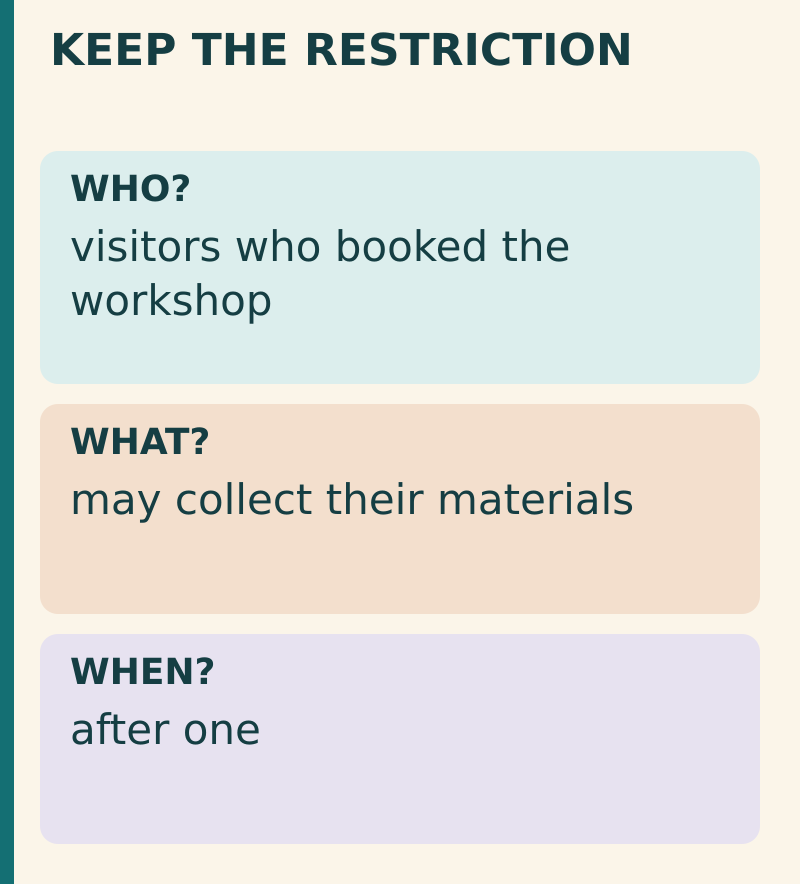
Questions 9–12 test eligibility, timing and exceptions. A person who booked a workshop may have a permission that ordinary visitors do not. A display can be open on most days but closed on one named day. A room can remain unavailable unless a volunteer is present. Each small marker limits the main statement.
As you simplify, keep words such as only, after and unless visible in your notes. A note saying “collect materials” is useful as a temporary skeleton, but it is not a final instruction if booking and time restrictions have disappeared.
Answer on paper, then open the explanations below. Enable JavaScript to check answers here.
Compare short paraphrases
Questions 13–14 ask which short version preserves the complete meaning. A paraphrase can use more than one sentence. That is often easier than trying to squeeze every condition into a single short line. Repeating workshop or visitors is acceptable when a pronoun would be unclear.
Check both sides: does the paraphrase add a claim, and does it lose a restriction? A version can be grammatically smooth while implying that everyone qualifies. Prefer accurate repeated words to a clever synonym that changes the relationship.
Answer on paper, then open the explanations below. Enable JavaScript to check answers here.
Use the reading protocol independently
Unseen paragraph: Visitors who have reserved a place on the afternoon workshop may collect the folder prepared by the archive volunteers from reception after one. The workshop, which begins at two in the upstairs room, includes a short demonstration of the large-print map collection. People who have not booked may still visit the ground-floor display, except on Mondays, when that area is closed for maintenance. The reading room remains unavailable unless a volunteer is present, and the notice does not guarantee that a volunteer will be there every afternoon. Anyone who needs step-free access should ask reception for the ground-floor alternative before the workshop starts. The centre lends display guides for use inside the building only; visitors must return them before leaving.
Write three plain-English information points for your friend. Point one should cover workshop collection and timing. Point two should explain access for unbooked visitors and the reading-room condition. Point three should cover the access request and guide-return restriction. Your points may contain two or three short sentences each. This is a meaning task, not a requirement to produce exactly three clauses.
Answer key and transfer
There are fourteen explained checks: four main-clause questions, four attachment questions, four condition/scope decisions and two paraphrase comparisons. Review the model only after making your own clause map. For a different long notice, keep the same protocol and add vocabulary help only where it is genuinely needed. The aim is accurate reconstruction, not deletion of everything that makes the sentence long.
Your turn · self-review
Three accurate information points
Compare your own three points with these models. Different wording is welcome when every required condition remains.
Practice only. Your writing stays on this page; it is not submitted or saved.
-
Model answer and explanation
1. Workshop collection and timing If you reserved a workshop place, collect the folder from reception after one. The workshop starts at two in the upstairs room and includes a demonstration of large-print maps. The booking restriction applies to workshop collection. 2. Other access Unbooked visitors can visit the ground-floor display, except on Mondays. The reading room is unavailable unless a volunteer is present. A volunteer is not guaranteed to be there every afternoon. 3. Access request and lending restriction For step-free access, ask reception about the ground-floor alternative before the workshop begins. Use borrowed display guides only inside the building and return them before leaving.
Your final check
Read the complete sentence or source again. Check the actor, action, time, quantities, conditions and intended meaning. Explain why your version works rather than memorising its surface form. Revisit any question whose explanation differs from your reasoning.
Related Lessons




Continue learning this topic
Review an explanation, study examples or try a related practice test.
- Practice test Noah Adams, longtime host of NPR’s All Things Considered, dies at 84 — B1 English Listening Practice Test
- Practice test Noah Adams, longtime host of NPR’s All Things Considered, dies at 84 — B1 English Grammar Practice Test
- Practice test Noah Adams, longtime host of NPR’s All Things Considered, dies at 84 — B1 English Vocabulary Practice Test
- Course lesson Be and basic sentences – A1–A2: Grammar Foundations
- Course lesson Cleft sentences and focus – C1: Precision and Expression
- Course lesson Possession and belonging – A1–A2: Grammar Foundations