
Lesson
B2 · Upper-intermediate
Grammar
Edit the Club Welcome Pack: Punctuation Practice
Edit a short welcome pack using punctuation that preserves meaning and improves readability.
11 min read
1,932 words
Updated Oct 16, 2026

On this page (8 sections)
B2 · 30 minutes · 14 explained checks. Work through the examples, try the questions, then use the final checklist. All people, venues and notices in this resource are fictional.
Read the welcome-pack extracts
You are editing a fictional walking club’s welcome pack for new adult members. Keep every practical detail accurate. The extracts are already readable, but some sentences offer choices about punctuation. Do not add instructions or facts just to make a favourite mark fit.
Essentials: Our Saturday walk starts at ten outside the west gate. Bring three useful items: a reusable water bottle, a sun hat and comfortable shoes. The route is mostly level, but one short section can be muddy after rain. Please arrive ten minutes early so that the leader can check the group. There is no charge for this introductory walk. If you decide not to come, tell the organiser before Friday evening.
Meeting arrangements: The morning group has twelve places; the afternoon group has eight. Both groups follow the same route and meet at the same gate. The afternoon walk starts at two. A volunteer will wait beside the map board, which stands immediately inside the gate. Please check the group named in your confirmation before travelling. The café has indoor seating (subject to availability), but refreshments are not included.
Optional history: The club began with six neighbours in 1998. It now welcomes people from across the town. Our oldest member—who helped organise the first walk—still joins some short routes. This history can appear in a separate box, leaving the main arrival instructions easy to scan.
Explain or connect?
For questions 1–4, inspect both sides of the gap. An explanation or a named list can follow a colon after a complete introduction. A semicolon in these questions joins two independent clauses. Do not choose merely because the pause “sounds longer.” Silent readers need a clear structural relationship too.
Try one together: “There is one meeting point: the west gate.” The second part is a noun phrase that specifies one meeting point. A semicolon would be unsuitable there. By contrast, “The gate opens at nine; the walk starts at ten” has two complete statements. Check that the welcome pack still gives the actual ten o’clock start, rather than the earlier arrival time.
Answer on paper, then open the explanations below. Enable JavaScript to check answers here.
Test the clauses
Questions 5–8 distinguish a complete introduction from a fragment. “You need” is not a useful complete introduction to its own object in these list sentences. You can remove an intrusive colon or add a label such as “three things.” When a dependent clause begins with although, because or if, it normally needs to be linked to a main clause rather than being stranded after a semicolon.
A punctuation repair should not quietly remove a condition. “If you cancel, tell the organiser” is not equivalent to “You cancel; tell the organiser.” The second version changes a possible event into a statement. Keep the original relationship even when a different structure would be easier to punctuate.
Answer on paper, then open the explanations below. Enable JavaScript to check answers here.
Manage optional details
Questions 9–12 use the removal test. Identify the exact start and end of the aside. If the main sentence continues after it, paired dashes or two parentheses are normally needed. The final full stop usually belongs to the whole sentence when the aside is only part of it.
The history of the club is optional background. The meeting gate is essential for a new member. Both details could be placed inside parentheses grammatically, but a good editor asks whether the reader might miss something important. If the core message disappears when you remove the bracketed words, you have probably enclosed too much.
Answer on paper, then open the explanations below. Enable JavaScript to check answers here.
Compare editor choices
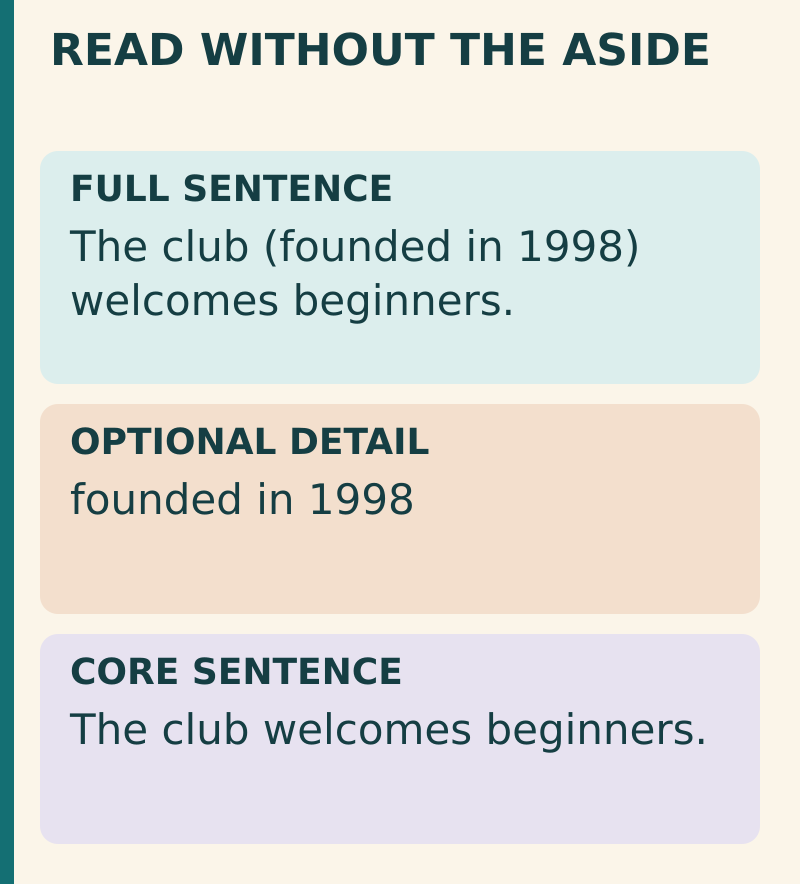
Questions 13–14 compare valid versions for a stated reader. Use context: a quick arrival notice benefits from short, prominent instructions, while a history box can contain a light aside. There is no rule that longer sentences or more specialised marks make writing better.
House styles differ about spaces around dashes and capital letters after colons. This lesson scores the relationship between sentence parts, not a single publisher’s typography. When editing your own welcome pack, choose one convention and use it consistently.
Answer on paper, then open the explanations below. Enable JavaScript to check answers here.
Edit a final extract
Write a 100–120-word welcome message using the facts in the source. Use at least two target marks only where they help. Include the Saturday morning start, gate, arrival lead time, items to bring, possible mud, cancellation deadline and refreshment limit. Keep the optional history brief or omit it. Check the model after making your attempt.
A simple-punctuation alternative is equally acceptable: split the model’s first two statements into separate sentences, replace the colon introduction with “Bring a bottle, a hat and comfortable shoes,” and turn the final parenthetical reminder into its own sentence. These changes simplify punctuation without changing the facts.
Answer key and read-aloud check
After submitting each question, explain the relationship before reading the feedback. Then read your final welcome message aloud at a comfortable speed. A place where you stumble is a reason to inspect the structure, not automatic proof that it needs a comma. Finally, imagine arriving with only your edited message: would you know the right place, time and required preparation?
Your turn · self-review
Model welcome message
Write 100–120 words first. Compare facts and punctuation choices; this open task is not automatically graded.
Practice only. Your writing stays on this page; it is not submitted or saved.
-
Model answer and explanation
Welcome to our Saturday walk. Meet outside the west gate at ten; please arrive ten minutes early so the leader can check the group. Bring three useful items: a reusable water bottle, a sun hat and comfortable shoes. Most of the route is level, but a short section can be muddy after rain. The introductory walk is free. If you decide not to come, tell the organiser before Friday evening. Please check that your confirmation names the morning group. The café has indoor seats (subject to availability), but refreshments are not included. We look forward to meeting you at the gate.
Why this model works: The semicolon joins two complete instructions; the colon introduces a list after a complete command; parentheses hold a short availability qualification. The gate, ten o’clock start, ten-minute lead time, items, mud warning, free walk and cancellation deadline remain accurate.
Your final check
Read the complete sentence or source again. Check the actor, action, time, quantities, conditions and intended meaning. Explain why your version works rather than memorising its surface form. Revisit any question whose explanation differs from your reasoning.
Related Lessons



Continue learning this topic
Review an explanation, study examples or try a related practice test.
- Practice test Origin Genomics Seeks to Show That Embryo Gene Editing’s Potential Benefits Outweigh Its Risks — C2 English Listening Practice Test
- Practice test Origin Genomics Seeks to Show That Embryo Gene Editing’s Potential Benefits Outweigh Its Risks — C2 English Grammar Practice Test
- Practice test Origin Genomics Seeks to Show That Embryo Gene Editing’s Potential Benefits Outweigh Its Risks — C2 English Vocabulary Practice Test