
Lesson
B2 · Upper-intermediate
Grammar
Make the Activity Proposal Balanced: Parallel Structure Practice
Repair unbalanced lists, paired ideas and comparisons in a practical proposal.
11 min read
1,862 words
Updated Oct 18, 2026

On this page (8 sections)
B2 · 30 minutes · 14 explained checks. Work through the examples, try the questions, then use the final checklist. All people, venues and notices in this resource are fictional.
Read the proposal and fact card
This fictional proposal contains a few deliberately awkward lists. Your editing job is to improve their structure while keeping the choices and facts. Do not silently choose a venue or assign a teacher to a subject that the proposal leaves open.
Proposal: We are planning a Saturday skill-sharing event for adults who want to learn something practical. The event should help people meet neighbours, learning a useful skill and to exchange ideas. Participants will choose one of three activities: drawing simple maps, caring for indoor plants or repairing a loose cupboard handle. No previous experience is required. Each activity will last forty minutes, with a short break before the final discussion.
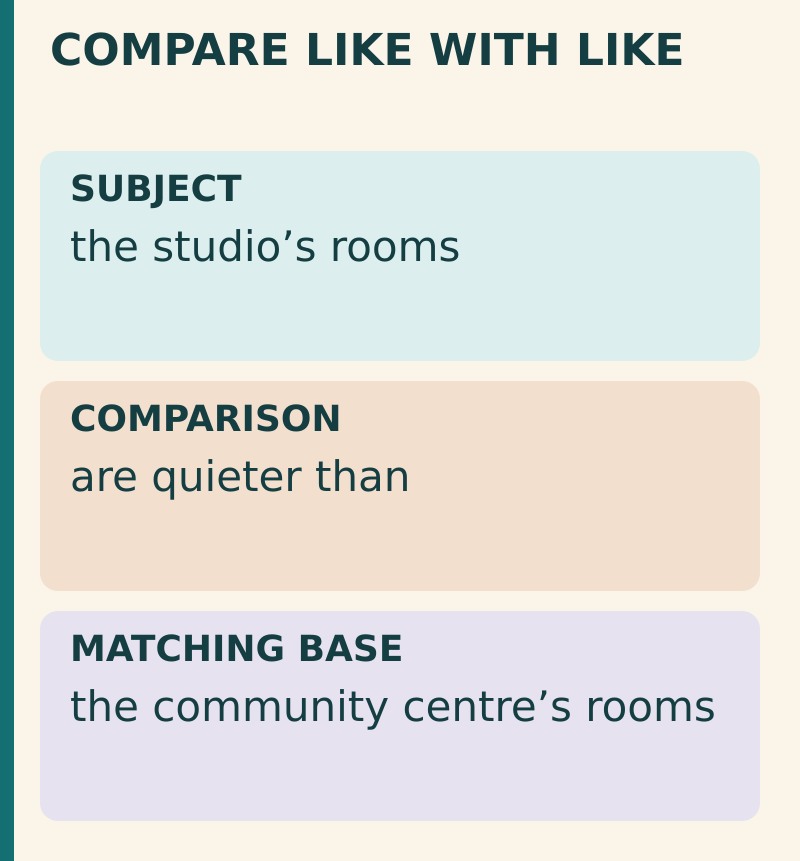
We are considering the studio and the community centre. The studio’s rooms are quieter than the community centre, but the centre’s opening hours are longer than the studio. Both Maya and Noor can teach either drawing or plant care. A separate volunteer will demonstrate the handle repair. We have not yet decided which venue to book or which teacher will lead each activity.
The proposal aims to offer a friendly welcome, keeping the instructions clear and to leave time for questions. We want participants to bring a notebook, a pencil and enthusiasm rather than expensive equipment. Please send comments by Wednesday. The organisers will compare the suggestions on Thursday before confirming a venue and sending the final invitation to interested neighbours.
Fact card: Saturday event; three activity options; one chosen activity per participant; forty minutes per activity; studio rooms are quieter; community-centre hours are longer; Maya and Noor can each teach either drawing or plant care; venue undecided; comments due Wednesday; organisers review Thursday.
Find the units
Questions 1–3 ask you to identify the units being joined. A shared introductory frame is a useful clue: after helps people, expect compatible infinitive verb phrases; after choose one of, expect a set of alternatives; after both, locate the matching and. Do not start editing before you know the level of the structure.
Write the intended list vertically if that helps: meet neighbours / learn a skill / exchange ideas. Each item now names an action. The vertical layout reveals the mismatch in the proposal without requiring equal word lengths.
Answer on paper, then open the explanations below. Enable JavaScript to check answers here.
Repair the activity lists
Questions 4–8 keep a frame fixed and ask for one matching form. Both “help people learn” and “help people to learn” are acceptable. A shared to can apply across a coordinated sequence; repeated to is also possible. Where the prompt supplies involves or enjoys, use a matching -ing pattern rather than extending a rule about help to every verb.
After a repair, read the complete proposal sentence. An editor can make every list an -ing list by changing the introductory frame, but that is not always the smallest or clearest revision. Choose a natural pattern and preserve the original intention, including the fact that the event is planned rather than already held.
Answer on paper, then open the explanations below. Enable JavaScript to check answers here.
Balance paired ideas
Questions 9–12 examine both, either and not only. “Both Maya and Noor can teach either drawing or plant care” gives each person the same two possible subjects. It does not assign drawing only to Maya. The paired markers carry scope, which means the part of the sentence they apply to.
A tidy but inaccurate allocation of subjects would fail this editing task. Mark the corresponding units before moving a paired word. If both applies to the two teachers, place it before Maya; if it applies to two activities after teach, place it before the first activity.
Answer on paper, then open the explanations below. Enable JavaScript to check answers here.
Compare the right things
Questions 13–14 restore a like-for-like comparison. The source’s intended facts are made explicit in the fact card, so you can repair the awkward sentences confidently. A possessive can stand for a repeated noun phrase: “the studio’s” can mean “the studio’s opening hours.” Alternatively, repeat the noun or use those.
Do not transform quiet into cheap, long hours into comfortable rooms, or an undecided venue into a confirmed booking. Parallel form is one layer of successful editing; faithful meaning is another.
Answer on paper, then open the explanations below. Enable JavaScript to check answers here.
Edit a final proposal
Write 110–130 words for the organising group. Include a balanced activity list, one paired structure, one like-for-like comparison and the two decision dates. Make it clear that no venue has been chosen. You may omit background about equipment if space is tight, but preserve the choice of one activity, not all three.
Use the model as a comparison, not a script to memorise. Underline the three activities, circle both...and and identify the nouns on each side of the room comparison. Then check whether a new reader could recover the same practical plan from your version.
Answers and meaning check
There are fourteen checks: three recognition, five list repairs, four paired-structure decisions and two comparison repairs. Explanations identify the units as well as the correct words. For transfer, take a short list from your own writing, map its shared frame and make the smallest useful repair. If the original is natural and unambiguous, leave it alone.
Your turn · self-review
Model edited proposal
Write 110–130 words first. The model is one acceptable version; compare its facts and grammatical units.
Practice only. Your writing stays on this page; it is not submitted or saved.
-
Model answer and explanation
We propose a Saturday skill-sharing event where adults choose one forty-minute activity: drawing maps, caring for plants or repairing a cupboard handle. The event will help people meet neighbours, learn a skill and exchange ideas. Both Maya and Noor can teach either drawing or plant care; a separate volunteer will demonstrate the repair. We are considering two venues. The studio’s rooms are quieter than those at the community centre, but the centre stays open longer than the studio does. No venue or teaching allocation has been confirmed. Please send comments by Wednesday. The organisers will review them on Thursday before booking a venue and issuing the final invitation.
Structure and fidelity audit: The three -ing activities are parallel. Meet, learn and exchange share help people. Both pairs the two teachers; either pairs their possible subjects. Rooms are compared with rooms, and opening duration with opening duration. The Saturday plan, forty-minute duration, one-activity choice and Wednesday/Thursday sequence remain unchanged.
Your final check
Read the complete sentence or source again. Check the actor, action, time, quantities, conditions and intended meaning. Explain why your version works rather than memorising its surface form. Revisit any question whose explanation differs from your reasoning.
Related Lessons




Continue learning this topic
Review an explanation, study examples or try a related practice test.
- Practice test Amazon feature shows shoppers personal insights based on their activity — B1 English Listening Practice Test
- Practice test Amazon feature shows shoppers personal insights based on their activity — B1 English Grammar Practice Test
- Practice test Amazon feature shows shoppers personal insights based on their activity — B1 English Vocabulary Practice Test