
Lesson
A2 · Elementary
Grammar
Shared-Workspace Labels: Show Who Owns What
Use a clear ownership roster to repair workspace labels and write a caretaker handover. Includes 12 scored checks and two self-reviewed tasks.
8 min read
1,372 words
Updated Oct 17, 2026

On this page (7 sections)
1. Meet the shared workspace
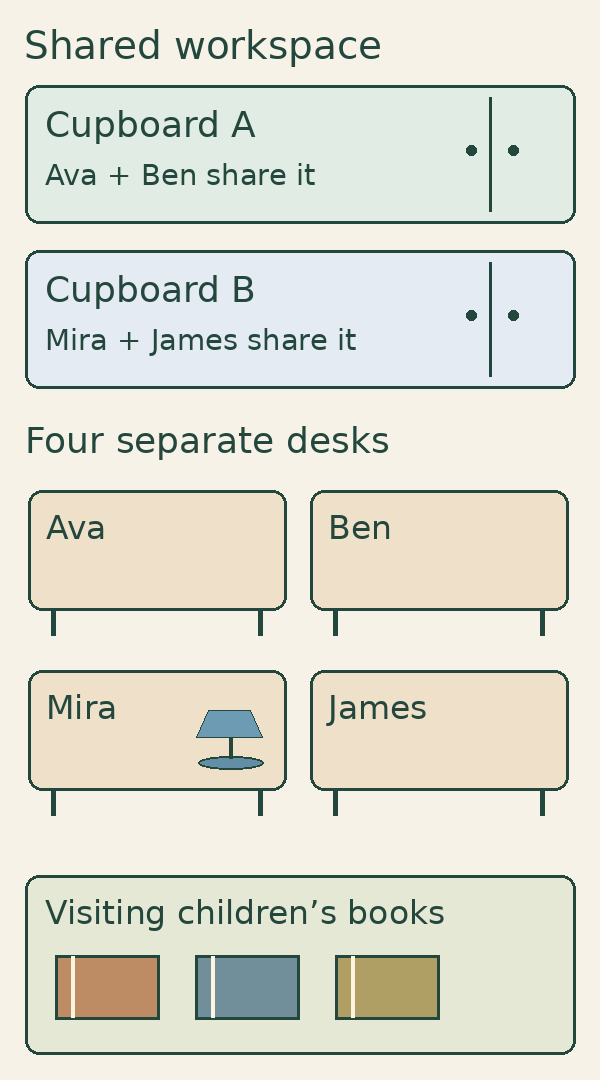
Four adults rent a fictional shared workspace: Ava, Ben, Mira and James. Ava and Ben are teachers. Mira and James are designers. Each person has a separate desk. There are two shared cupboards. Your task is to leave accurate labels for the next caretaker.
Ownership roster
Ava and Ben
Two teachers
They share cupboard A, but their desks are separate.
Mira and James
Two designers
They share cupboard B, but their desks are separate.
Mira
One owner
Mira owns the blue lamp.
Visiting children
An irregular plural owner
The activity books belong to the children.
2. Read the label brief
Caretaker’s note: Please label the workspace before tomorrow morning. Ava and Ben share cupboard A for teaching materials. Mira and James share cupboard B for design tools. All four tenants have separate desks. Mira’s blue lamp stays on her desk. James has one notebook on his own desk. The activity books on the low shelf belong to visiting children. Two old labels are unclear: “Ava and Ben’s desks” and “the teachers cupboard”. Use the facts above to make their meaning clear. Do not move anyone’s belongings. We also need a general sign for several spare chairs; that sign does not show ownership. The cupboard doors are white. One cupboard has a loose handle, so leave a separate maintenance note about its handle. Please keep the new labels short and easy to read.
Useful words: a tenant rents a space; belongings are the things a person owns; shared means used together; separate means not shared. The roster is the source of the ownership facts.
3. Match owners to labels
Match four descriptions to the correct label.
Answer on paper, then open the explanations below. Enable JavaScript to check answers here.
4. Audit the signs
Choose or repair six signs. Keep the ownership facts unchanged.
Answer on paper, then open the explanations below. Enable JavaScript to check answers here.
5. Prepare the handover
Answer on paper, then open the explanations below. Enable JavaScript to check answers here.
Your turn · self-review
Prepare the handover
Write your own answer first. Then compare it with the model and checklist. Natural alternatives are welcome when they preserve the facts.
Practice only. Your writing stays on this page; it is not submitted or saved.
-
Model answer and explanation
Ava and Ben’s cupboard; Mira and James’s cupboard; Mira’s lamp; the children’s books. The teachers’ cupboard and the designers’ cupboard also fit the two cupboards.
-
Model answer and explanation
Ava and Ben have separate desks, so I labelled them Ava’s and Ben’s desks. They share cupboard A, while Mira and James share cupboard B. I used one possessive ending for each shared cupboard. The spare chairs sign has no apostrophe because chairs is an ordinary plural. The children’s books stay on the low shelf.
Check: four labels match four facts; shared cupboards remain shared; separate desks remain separate; the plural chairs has no apostrophe; your note gives a reason, not only a corrected spelling. Straight apostrophes are fine. A longer natural phrase such as the cupboard shared by Ava and Ben is acceptable.
6. Compare with the model
Key 1–4: Mira’s lamp; the teachers’ cupboard; the children’s books; Mira and James’s cupboard. The owner patterns are singular, regular plural, irregular plural and shared named owners. A label can be grammatically formed but factually wrong: Mira’s and James’s separate cupboards would describe two cupboards, which the source does not give them.
Key 5–8: Ava’s and Ben’s desks; Spare chairs; Its; James’s notebook. The source, rather than the plural noun desks alone, tells us the desks are separate. This lesson requests James’s consistently; the alternative style James’ is not a misunderstanding of ownership.
Key 9–12: children’s books; the teachers’ cupboard; teachers; separate. In the open tasks, equivalent descriptions are welcome. The cupboard used by the teachers is clear and natural. Do not use an of phrase mechanically: the lamp of Mira is usually less natural than Mira’s lamp in an everyday label.
7. Apply the owner-first check
Try a fictional book-club noticeboard. One organiser, Bea, owns a folder. Three readers share a table. Several children own some picture books. Write Bea’s folder, the readers’ table and the children’s picture books. Now explain why each apostrophe goes in a different place.
Final audit: Who is connected with the thing? Is the owner one person or more than one? Does the owner noun end in s? Is ownership shared? Is the sign only a plural? These questions help you edit meaning before punctuation.
Related Lessons



Continue learning this topic
Review an explanation, study examples or try a related practice test.
- Practice test Noah Adams, longtime host of NPR’s All Things Considered, dies at 84 — B1 English Listening Practice Test
- Practice test Noah Adams, longtime host of NPR’s All Things Considered, dies at 84 — B1 English Grammar Practice Test
- Practice test Noah Adams, longtime host of NPR’s All Things Considered, dies at 84 — B1 English Vocabulary Practice Test
- Course lesson Participle clauses and shared subjects – C1: Precision and Expression