
Lesson
B1 · Intermediate
Vocabulary
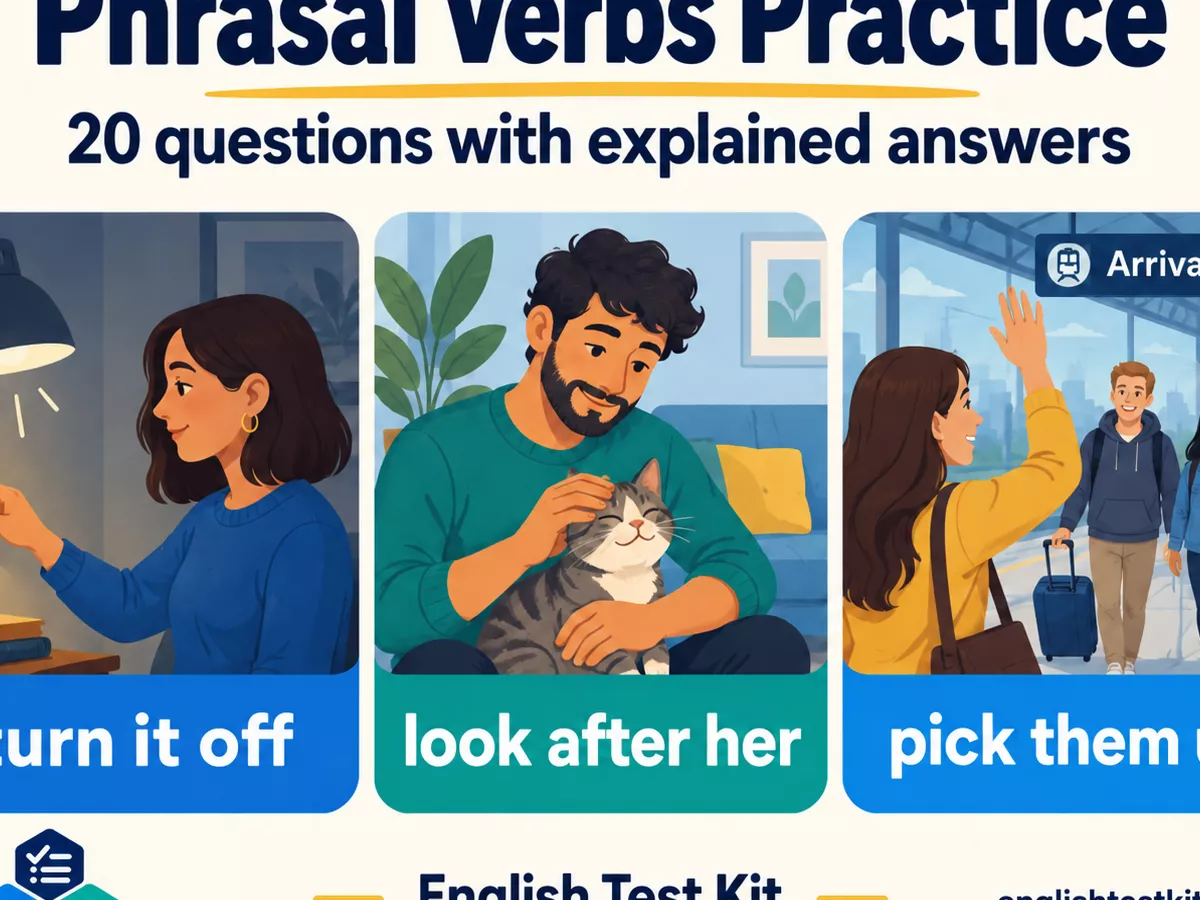
Phrasal Verbs Exercises: 20 Questions With Answers
Try 20 B1 phrasal verbs exercises with answers and explanations. Practise meanings, missing particles, separable verbs and pronoun word order.
13 min read
2,242 words
Updated Oct 12, 2026
On this page (20 sections)
These 20 B1 phrasal-verbs questions help you move from recognising a phrase to using it in a sentence. You will match meanings, choose particles, repair object positions and read short situations. Answer in the exercise cards, then choose Check my answers to see your score and why each answer fits. You can also work in a notebook. This is self-study practice, not an official CEFR assessment.
What you will practise
The lesson focuses on everyday situations: arranging travel, finding information, looking after pets, switching equipment off and deciding whether to accept an invitation. A particle is a small word such as up, off or out. Adding it can create a new meaning, so memorising only the main verb is not enough.
Keep a simple record with three columns: phrase, meaning in this sentence, and your own example. Write pick someone up, not only pick up, if the meaning requires an object. This shows you which words belong together and gives you a useful pattern to reuse.
Before you begin: meaning matters
Some phrases have more than one meaning. Turn down can mean refuse an offer or reduce a setting. Take off can mean remove clothing or leave the ground in an aircraft. The situation and object help you decide. A word-for-word translation can lead you to the wrong meaning even when you recognise every small word.
Review a larger reference: 100 Common English Phrasal Verbs With Meanings and Examples
A quick word-order check
Separable phrase with a noun: switch the lamp off or switch off the lamp. Both word orders can work.
Separable phrase with a personal object pronoun: switch it off. Put it or them between the verb and particle.
Inseparable phrase: look after the dog or look after it. Keep look after together; do not move the object into the middle.
A phrase with no object, such as get up in the morning, has no object to move. For multi-word phrases such as come up with a plan, keep the words up with together. A dictionary can show whether a particular meaning takes an object and whether that object can move.
Practice: 20 questions
Exercise 1: match the meanings (1–5)
Match each phrase with one meaning. Use each letter once: A = find unexpectedly; B = postpone; C = refuse an offer; D = care for someone or something; E = use the last of a supply.
Answer on paper, then open the explanations below. Enable JavaScript to check answers here.
Exercise 2: choose the missing particle (6–10)
Choose one option for each blank. Read the whole sentence: the situation tells you which meaning is needed.
Answer on paper, then open the explanations below. Enable JavaScript to check answers here.
Exercise 3: repair the word order (11–15)
Each sentence contains an object in the wrong place. Rewrite the whole sentence, changing only the phrasal-verb word order.
Answer on paper, then open the explanations below. Enable JavaScript to check answers here.
Exercise 4: choose the phrase in context (16–20)
Choose the option that completes the sentence naturally. These items practise meaning, tense and the complete phrase.
Answer on paper, then open the explanations below. Enable JavaScript to check answers here.
Answers and explanations
Complete each exercise and choose Check my answers to reveal its answers and explanations. You can also open the complete answer key below for self-study.
Show the complete answer key (1–20)
Exercise 1: match the meanings (1–5)
C — refuse an offer — Turn down means reject or refuse here; it does not describe reducing sound in this example.
E — use the last of a supply — Run out of means there is none left. Keep all three words together before the noun.
D — care for someone or something — Look after means take care of. The object follows after, so the phrase cannot be separated.
A — find unexpectedly — Come across means discover by chance rather than deliberately search for something.
B — postpone — Put off means move an arrangement to a later time. It does not mean cancel permanently.
Exercise 2: choose the missing particle (6–10)
off — Turn off means stop a machine or light from operating. Turn on would start it; turn up would increase its setting.
for — Look for means search for. Look after means care for, so it does not fit a missing passport.
out — Find out means obtain information. The question clause tells us that the speaker wants to learn a fact.
up — Get up means rise from bed. The description of leaving bed makes this meaning explicit.
off — Call off means cancel. The object pronoun it is correctly placed between called and off.
Exercise 3: repair the word order (11–15)
Please pick them up at the station. — Pick up is separable when it means collect someone. The pronoun them must go between the verb and particle.
My neighbour will look after it while I am away. — Look after is inseparable. Keep look after together, then put the pronoun it after the complete phrase.
The salary was too low, so she turned it down. — Turn down is separable in the sense of reject. An object pronoun belongs between turned and down.
This form is short. Please fill it in now. — Fill in is separable for completing a form. It goes between fill and in, not after the particle.
I ran into her at the supermarket yesterday. — Run into means meet unexpectedly here and is inseparable. Her follows into.
Exercise 4: choose the phrase in context (16–20)
give up — Give up means stop trying. The next sentence says the speaker wants to continue, so will not give up fits.
get over — Get over an illness means recover from it. This is an inseparable phrase: get over it.
come up with — Come up with means think of an idea. The two particles up with stay together before the object.
looking forward to — Look forward to expresses happy anticipation. It follows to; with an activity, use an -ing form such as travelling.
took off — Take off means remove clothing here. Took is the past form needed after was.
Check your learning
Choose Check my answers at the end of each exercise to see your score and explanations, up to 20 points in total. Accepted alternatives also count. Record your first attempt, then use Try again to practise mistakes. This is practice, not a CEFR level test, and your answers are not saved.
For a meaning mistake, record the complete phrase and its object in a new sentence.
For a word-order mistake, replace a noun with it or them and check whether the phrase is separable.
Use three phrases in situations from your week, then revisit the missed questions without the answer key.
Use the phrases beyond the exercise
Choose five phrases you might need this week. Make each example about a real situation: a device you turn off, a person you look after, something you are looking for, a plan you do not want to put off, and an event you look forward to. Change details to make the sentences yours rather than copying the answer key.
Read each sentence aloud, then replace a noun object with a pronoun where possible. Check the new word order carefully. Review any mistake tomorrow using a different example. Twenty correct choices do not guarantee that you can use every phrase in conversation, but explaining the choice and writing a fresh sentence will make your review more useful.
Frequently asked questions
Are all phrasal verbs separable?
No. Some allow a noun object between the verb and particle, some keep the complete phrase together, and some do not take an object. Learn the pattern for the meaning you need. For example, pick the children up allows separation, but look after the children does not.
Why is 'pick them up' correct but 'pick up them' not correct here?
In the collection meaning, pick up is separable. A personal object pronoun such as them must be placed between pick and up. A noun can normally appear in either position: pick the visitors up or pick up the visitors. This pronoun rule is not a rule for inseparable phrases.
How can I remember several meanings of the same phrase?
Record a short example for each meaning instead of writing one loose translation. Compare turn down an invitation with turn down the volume. Add the relevant object and a situation you recognise. When reading, check the whole sentence before deciding which meaning is intended.
Grammar references
British Council: separable and inseparable phrasal verbs
Cambridge Dictionary: look forward to and its following noun or -ing form
Related Lessons






Continue learning this topic
Review an explanation, study examples or try a related practice test.
- Practice test Science roundup links shared meals, exceptionally loud birds, and asteroid Bennu to bigger questions — C2 English Listening Practice Test
- Practice test Science roundup links shared meals, exceptionally loud birds, and asteroid Bennu to bigger questions — C2 English Grammar Practice Test
- Practice test Science roundup links shared meals, exceptionally loud birds, and asteroid Bennu to bigger questions — C2 English Vocabulary Practice Test