
Lesson
A2 · Elementary
Reading
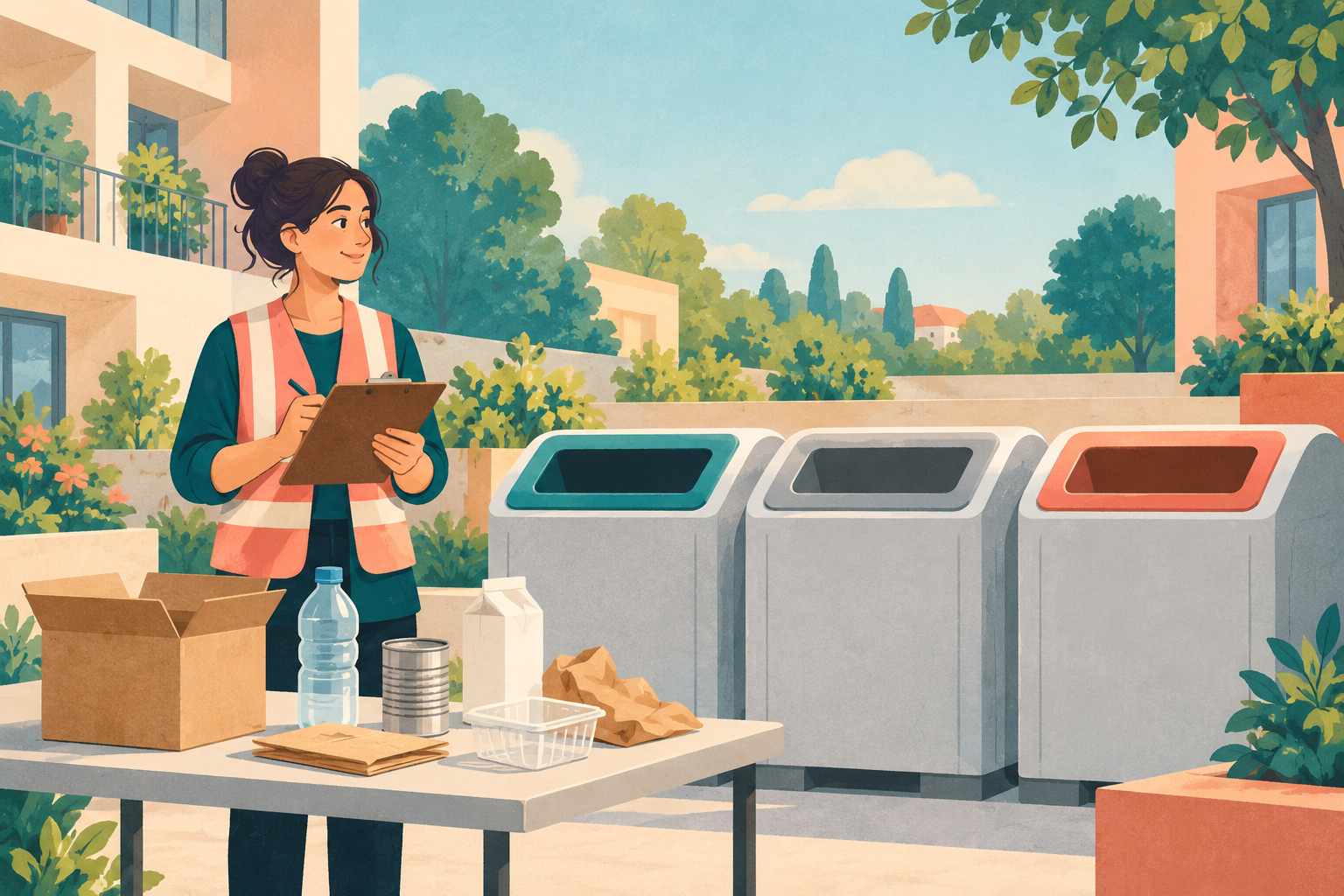
Sort It at the Community Recycling Point
Practise sixteen reading checks using three original recycling notices and six item cards, then write a short fictional information card.
9 min read
1,497 words
Updated Oct 15, 2026
On this page (7 sections)
A2 • 27 minutes • 16 scored checks. Practise sixteen reading checks using three original recycling notices and six item cards, then write a short fictional information card.
Welcome to a fictional collection point
Read the notices at the fictional Linden Community Recycling Point. Use these rules for the lesson. For real items, check current local instructions.
Your task is to help a visitor read the language accurately. Three notices tell you what is included and which conditions apply. Six cards describe objects. Do not guess missing details. When an item contains two materials, the notices may not tell you enough to answer yes or no.
Notice | Exact wording |
|---|---|
R • Paper point | Paper and cardboard, except wet items. Keep paper separate from plastic covers. |
S • Bottle point | Empty glass bottles only. No drinking glasses. |
T • Tin point | Empty metal food tins. No tins with food inside. |
Card | Description |
|---|---|
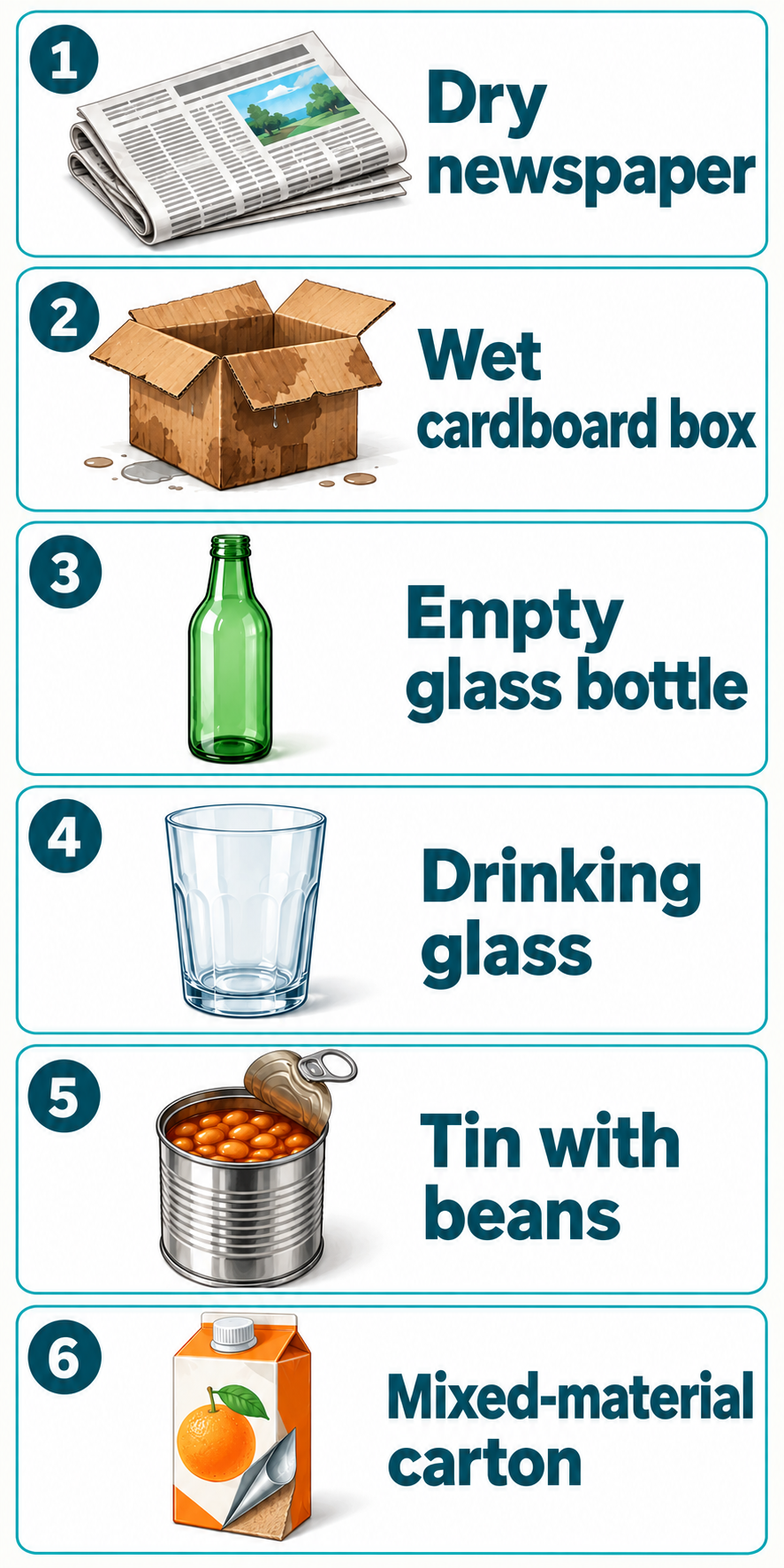
1 | A dry newspaper. Material: paper. No plastic cover. |
2 | A wet packing box. Material: cardboard. |
3 | An empty drinks bottle. Material: glass. |
4 | An empty drinking glass. Material: glass. |
5 | A food tin with beans still inside. Material: metal. |
6 | An empty, dry juice carton. Material: mixed cardboard and plastic. |
Build the material word bank
Read the material after each card's Material label. Paper, cardboard, glass, metal and plastic describe what an object is made of. Newspaper, box, bottle, drinking glass, tin and carton name objects. Keep these two kinds of information separate: several objects can share one material.
For these four answers, use the word bank in the first prompt. You do not need to decide a bin yet. The mixed-material card gives two materials explicitly. Name only the requested material; do not guess a percentage or assume the layers can be pulled apart.
Answer on paper, then open the explanations below. Enable JavaScript to check answers here.
Read what each notice accepts
Build a small reading grid in your notes: R, S and T down the left; accepted item, item not accepted and condition across the top. Copy short phrases, not your own local rules. A condition such as empty can apply to every accepted item in a notice.
Complete the three fields below. The word after except tells you the excluded condition. The word after glass names the permitted object. A second sentence can repeat a condition negatively: empty tins and no tins with food inside point to the same boundary.
Answer on paper, then open the explanations below. Enable JavaScript to check answers here.
Match items to the scheme
For each item, choose R, S, T, Excluded by a stated rule, or Not enough information. The last two choices mean different things. Excluded needs a phrase that conflicts with the item. Not enough information means that these notices leave the case unresolved.
Check all the details on the card before answering. An empty glass object can still have the wrong shape. A box can be made of an accepted material but have an excluded condition. Card 6 names a mixture; the notice about plastic covers does not tell you how this different object is treated.
Answer on paper, then open the explanations below. Enable JavaScript to check answers here.
Explain the exception
Short words can change an entire instruction. For the next three questions, copy exactly one word from the named notice. Focus on the word's job in the sentence rather than choosing the longest noun.
When reviewing, build a reason using the pattern: The card says …, while the notice says …. If the rule excludes the item, make that conflict clear. If the rule is incomplete, state the gap instead of inventing an answer.
Answer on paper, then open the explanations below. Enable JavaScript to check answers here.
Evidence-based answer review
Check your submitted answers and read the explanation attached to each question. The feedback quotes the exact phrase used. For a wrong answer, compare your selected item type and condition with that phrase. Rewrite the reason in one simple sentence before trying the exercise again.
This task has sixteen scored answers: four material matches, three notice fields, six item choices and three exception words. The short writing task below is extra. It helps you write the same rules clearly in a short text.
Write a simple information card
Write 40–50 words for a fictional visitor card covering R and S. Include the wet-item exception, the separation instruction and the empty-bottle restriction. Say that the system is fictional. Do not add jars, cartons or other categories that the source does not cover.
Check four things: did you preserve what is accepted, retain every condition, name the rule saying no correctly and avoid invented rules? Keep the card short and follow the notices. Compare your version with the model only after you have written it.
Your turn · self-review
Your transfer task
Write your own response first, then open the model and compare. Checklist: four source conditions retained; 40–50 words; fictional label; no unsupported destinations.
Practice only. Your writing stays on this page; it is not submitted or saved.
-
Model answer and explanation
This is a fictional collection point. R accepts paper and cardboard, except wet items. Keep paper separate from plastic covers. S accepts empty glass bottles only; drinking glasses are not accepted. Read the notices carefully and ask for information about items that are not described.
Related Lessons




Continue learning this topic
Review an explanation, study examples or try a related practice test.
- Practice test How community colleges are evolving to fill local data center jobs — C1 English Listening Practice Test
- Practice test How community colleges are evolving to fill local data center jobs — C1 English Grammar Practice Test
- Practice test How community colleges are evolving to fill local data center jobs — C1 English Vocabulary Practice Test