
Lesson
A1 · Beginner
Reading
Choose a Saturday Activity: Read Three Event Posters
Read three original community posters, match activities to fictional adults and make a practical plan. Fourteen explained reading checks with exact text evidence.
11 min read
1,838 words
Updated Oct 17, 2026
On this page (7 sections)
Three adults, three plans
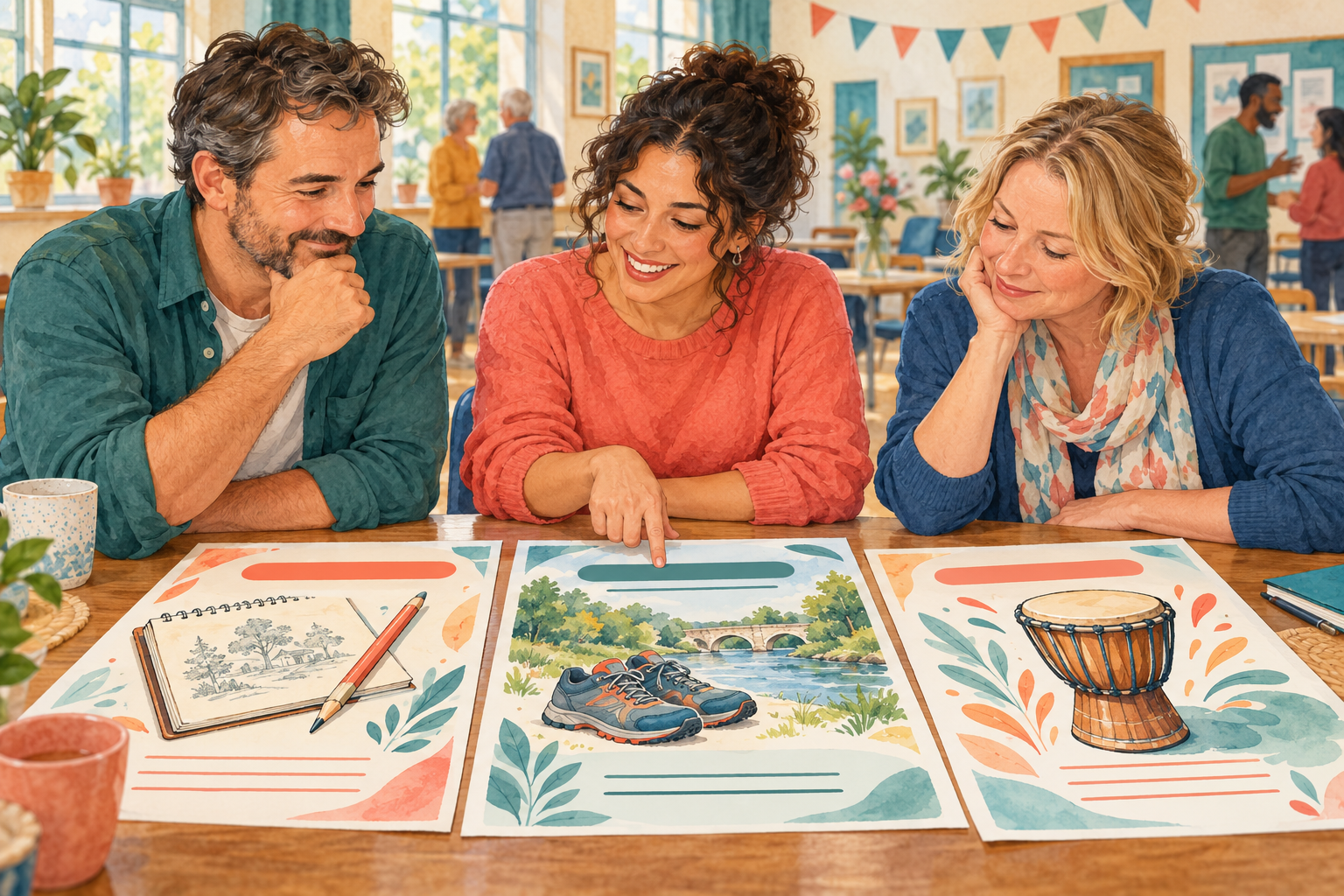
This lesson uses three invented posters and three fictional adults. Read the facts and choose a useful Saturday activity for each person. You do not need to like the same activities. Your job is to use each person’s needs. Take about 20 minutes. Keep the posters visible while you answer; this is a reading task, not a memory test.
Mia needs a free indoor activity. She has no art materials and can book before Saturday. Omar wants an outdoor activity. He has comfortable shoes and a water bottle. His budget is £3. Eva wants to make music. She has a water bottle, can spend £5 and can book before Saturday.
Picture key: the pencil, walking shoes and drum suggest different activities. Confirm every idea with the printed words. The pictures are not evidence about price, equipment or booking.
Read for the event type
First read the title and the action near the beginning of each poster. You do not need every detail yet. Ask what a visitor does: draws, walks or makes music. The same building can host different activities, so do not use “River Hall” as an activity name.
Answer on paper, then open the explanations below. Enable JavaScript to check answers here.
Notice the last sentence of Poster C. A concert is normally a performance you watch or listen to. Here the visitors try rhythms themselves. Small words can help you avoid choosing an event with the wrong purpose.
Scan for practical facts
Now scan for one fact at a time. For a place, look for Meet, Hall, Room, gate or Park. For a price, look for £ or free. For equipment, look for bring or provided. Stop when you have the exact answer; then check the words around it.
Fact to collect | Poster A | Poster B | Poster C |
|---|---|---|---|
Venue | Find the building and room. | Find the park and meeting point. | Find the building and room. |
Cost | Find the entry price. | Find the price per person. | Find the price per person. |
Entry condition | Is booking needed? | Is booking needed? | Is booking needed? |
Equipment | What must you bring? | What must you bring or wear? | What is provided? |
Answer on paper, then open the explanations below. Enable JavaScript to check answers here.
Keep the main venue and the smaller location together in your final plan. “River Hall” is correct but incomplete if you need to find the room. Do not confuse Room 3 with the start time, 10 a.m. A number becomes useful when you know what it describes.
Match people to activities
For each person, check two or more needs. A free activity is not enough for Mia if it is outdoors. Music is not enough for Eva if she cannot afford the price. Choose from all three posters, then underline two phrases in your own notes that support the choice.
Answer on paper, then open the explanations below. Enable JavaScript to check answers here.
The walk may look attractive to someone who wants a cheap event, but it does not meet an indoor requirement. The music session supplies equipment, but that does not make it free. Separate the activity, cost and equipment conditions before you decide.
Check the small line
Read this line from Poster A again: “Paper and pencils are provided for booked places.” Booked means arranged before the event. Mia can book, so the poster supports her plan. It does not promise provided pencils to somebody who arrives without a booking.
Another small detail matters: “Tea is available for £1.” Free entry does not make tea free. Mia can enter without spending money, but she should not write “free tea” on her activity card. Read the object after the price to see what the price covers.
Answer on paper, then open the explanations below. Enable JavaScript to check answers here.
Answers with evidence highlights
Check the feedback on each question. For 1–3, the key words are “sketching”, “walk outdoors” and “Try simple rhythms”. For 4–8, the exact facts are Room 3; £2 per person; drums; the river gate; a folder. These short phrases are enough because the question supplies the context.
For 9, A meets all of Mia’s needs: free, indoors and materials available after booking. For 10, B is outdoors and below Omar’s £3 limit. For 11, C is practical music at Eva’s £5 limit. A and B fail Eva’s activity requirement even though they cost less.
For 12, the booking condition is explicit, so the statement is supported. For 13 and 14, lunch and parking are absent, so the answers are not stated. “Not stated” does not mean there is definitely no lunch or parking. It means you cannot learn the answer from these posters.
If you made a mistake, name the reason: wrong event type, wrong number, missed condition or added information. Reread only the relevant line. This helps you build a useful checking habit.
Make a simple activity card
Choose one adult and complete six fields: person, activity, place, cost, bring or wear, booking. You may add the start time, but do not add transport, lunch or parking information that the poster does not give.
Your turn · self-review
Transfer task: your turn
Self-check: six fields; exact room; entry price separated from tea price; folder included; booking condition included; no invented information. Short phrases are acceptable.
Practice only. Your writing stays on this page; it is not submitted or saved.
-
Model answer and explanation
Person: Mia. Activity: hall sketching club. Place: River Hall, Room 3. Cost: free entry. Bring: a folder. Booking: book at the hall desk before Saturday.
Optional: write a new fictional poster for adults with the same six practical fields. Ask a partner to make an activity card from it. Compare their card with your intended facts. If a fact is missing or unclear, improve the words rather than adding a decorative picture.
Review the paired guide, How to Read Event Posters in English: Place, Price and What to Bring, if you mixed up bring and provided. Further related practice: Read the Community Centre Timetable; A2 Reading Comprehension: A Day Out — Questions and Answers; Can, Could and Be Able To: Ability and Permission. Related drafts become available when released.
Related Lessons





Continue learning this topic
Review an explanation, study examples or try a related practice test.
- Practice test UNLV Introduces a Minor in Teaching Mariachi as Demand for Instructors Grows — C2 English Listening Practice Test
- Practice test UNLV Introduces a Minor in Teaching Mariachi as Demand for Instructors Grows — C2 English Grammar Practice Test
- Practice test UNLV Introduces a Minor in Teaching Mariachi as Demand for Instructors Grows — C2 English Vocabulary Practice Test