
Lesson
B1 · Intermediate
Reading
Personality Adjectives: 20 Exercises With Answers
Practise personality adjectives with 20 B1 exercises and explained answers. Review meanings, word forms and respectful descriptions based on behaviour.
14 min read
2,472 words
Updated Oct 12, 2026
On this page (19 sections)
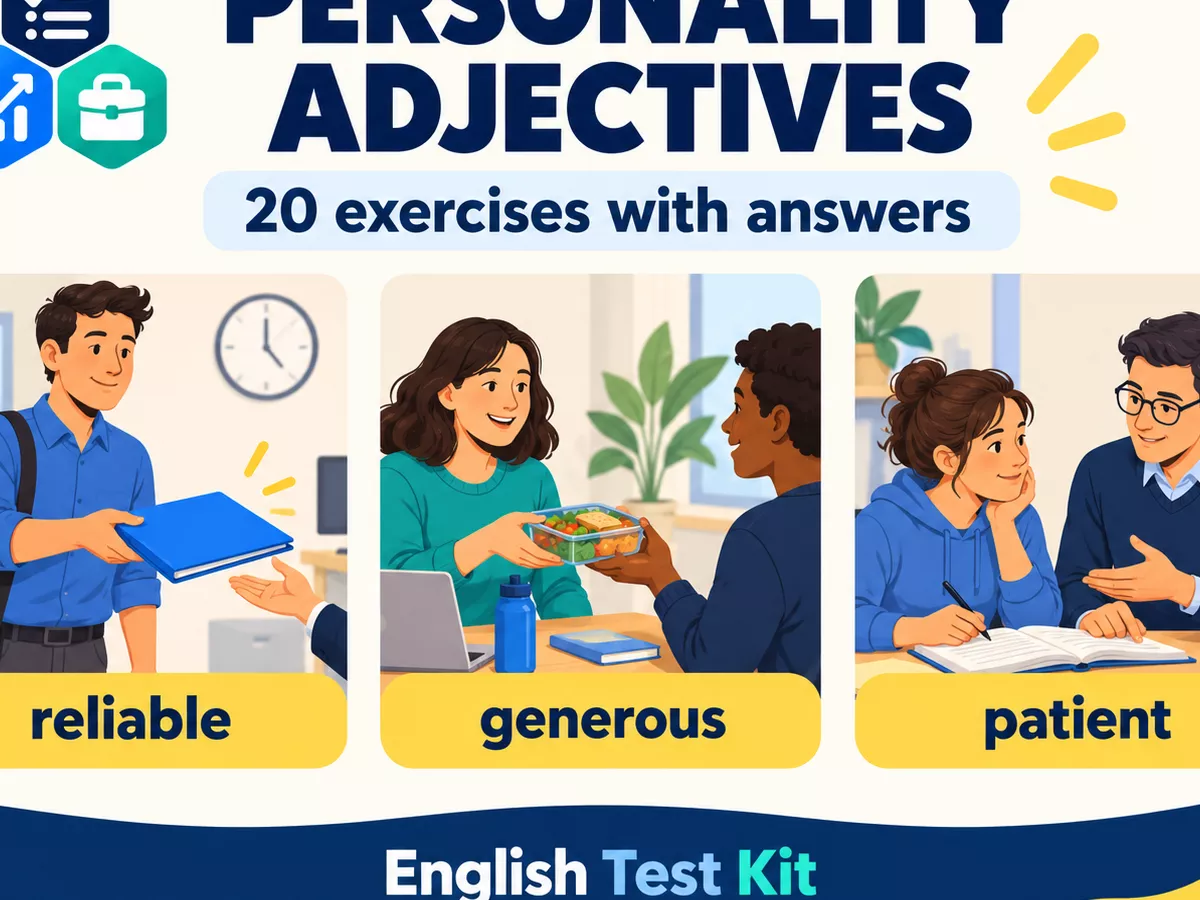
Reliable, generous and patient describe different ways people behave. This B1 lesson helps you choose personality adjectives from evidence, distinguish easily confused words and practise them in 20 exercises with explained answers. Work through matching, sentence completion, correction and short situations, then use the vocabulary in a respectful description of someone you know.
Describe behaviour, not appearance
A person's clothes, height, age or hairstyle do not prove that they are honest, selfish or hardworking. Choose an adjective because of what someone does in a particular situation. Nora is reliable because she keeps her appointments is more informative than Nora is reliable on its own. Even a clear example does not establish that somebody always behaves in the same way.
A useful description combines an adjective, evidence and a fair limit: He is usually patient when he explains a difficult task. Words such as usually, sometimes and in meetings help you avoid turning one event into a permanent judgement. This lesson is vocabulary practice, not a personality diagnosis or a test that sorts people into fixed categories.
Five useful positive adjectives
Reliable — someone you can depend on to keep commitments. I trust Mei to send the file when she says she will.
Generous — willing to share time, money or possessions. Arjun offers his spare materials to other learners.
Patient — able to stay calm while waiting or handling difficulties. Sara explains the steps again without becoming angry.
Curious — interested in finding things out. Luis asks how the water filter works.
Optimistic — expecting that something good may happen. Eva thinks their next attempt can succeed.
Generous does not mean rich, and optimistic does not mean certain to succeed. Learn the specific meaning rather than replacing every positive adjective with nice.
Contrasting words need context
Honest describes telling the truth or acting without deception. Selfish describes putting your own advantage before other people's needs. Careless describes not giving enough attention to what you are doing. Pessimistic describes expecting an unfavourable outcome. Use these words carefully: describing the action may be fairer than labelling the person.
Reserved describes someone who does not readily share personal feelings or thoughts. It is not automatically a criticism. Outgoing describes someone who readily engages with others. A reserved colleague can still be friendly, and an outgoing speaker can still be nervous about an unfamiliar task. Avoid assuming that one social style is better or that everybody behaves the same way in every setting.
Common adjective and noun mistakes
Use an adjective after be and before a noun: She is patient; she is a patient tutor. Patience is the noun: She has patience. Likewise, generous describes a person, while generosity names the quality. Confident is an adjective; confidence is a noun. Say He is confident or He has confidence, not He has confident.
English adjectives do not add a plural s: They are friendly, not friendlys. Use an adjective after a linking verb such as become: She became impatient. Negative prefixes are not all the same. Learn reliable–unreliable, patient–impatient and organised–disorganised as pairs. Do not create unpatient by guessing that un- can attach to every adjective.
Choose between sensible and sensitive
Sensible means showing practical judgement. Checking the cost and timetable before booking can be a sensible decision. Sensitive can describe being aware of feelings or reacting strongly to something. A sensitive response to a friend's worry is not the same as a sensible travel plan. The words are related to different meanings of sense and should not be exchanged just because they look similar.
The exercises give clear situations and limited options so the intended answer is identifiable. In real descriptions, more than one adjective may fit the same behaviour. Someone who explains calmly might be patient, helpful or considerate. When you write your own paragraph, different words can be valid if your example supports their actual meaning.
How to use this lesson
Read the short vocabulary explanations first. Answer the 20 numbered questions in the exercise cards, then choose Check my answers for each set. You can also work on paper. For sentence corrections, preserve the original meaning and fix only the faulty word or grammar. For the word bank, use the listed words once each. Review the explained answers before using Try again. This is self-study practice, not an official level test.
When you check an answer, explain why a distracting option does not fit. Then write one original example with the correct adjective. This makes review more useful than memorising a sequence of letters. If you used a different word in free writing, compare its meaning rather than assuming that anything outside a model answer is wrong.
Exercise 1: match meanings to adjectives (1–5)
Choose the adjective that matches each definition. Read the whole definition before answering.
Answer on paper, then open the explanations below. Enable JavaScript to check answers here.
Exercise 2: complete sentences from the word bank (6–10)
Use each word once: reliable, generous, patient, curious, optimistic. Each situation gives evidence for the intended meaning.
Answer on paper, then open the explanations below. Enable JavaScript to check answers here.
Exercise 3: correct the word or grammar (11–15)
Rewrite each sentence correctly. Change only the faulty word or verb; do not change its meaning.
Answer on paper, then open the explanations below. Enable JavaScript to check answers here.
Exercise 4: choose the best description in context (16–20)
Choose from the three options provided. These are short language scenarios, not a personality test or a judgement of a real person.
Answer on paper, then open the explanations below. Enable JavaScript to check answers here.
Answers and explanations
Complete each exercise and choose Check my answers to reveal its answers and explanations. You can also open the complete answer key below for self-study.
Show the complete answer key (1–20)
Try every question before checking this section. Compare both your answer and your reason. The number refers to the same numbered question above.
1. reliable — Reliable focuses on keeping commitments, not simply being cheerful or talkative.
2. generous — Generous describes willingness to give or share; it does not mean wealthy.
3. patient — Patient describes tolerance while waiting or dealing with difficulty.
4. curious — Curious means interested in learning or discovering things.
5. optimistic — Optimistic concerns positive expectations about the future, not certainty that every plan will succeed.
6. reliable — Keeping appointments is evidence that others can depend on Nora. Dependable would also fit in free writing, but reliable is the word in this bank.
7. generous — Sharing what he has shows generosity. The word does not describe how much money he owns.
8. patient — Remaining calm during repeated explanations is evidence of patience.
9. curious — The reason for his questions is an interest in understanding something.
10. optimistic — Ava expects a positive future outcome. This does not imply that she ignores the earlier problem.
11. She is a very patient person. — Use the adjective patient before person. Patience is the noun.
12. He is very generous with his time. — After is very, use the adjective generous. Generosity is a noun.
13. My sister is confident when she speaks to a group. — Either repair is correct: is confident uses be plus an adjective; has confidence uses have plus a noun. Do not use has confident. Also accepted: My sister has confidence when she speaks to a group.
14. She becomes impatient when the bus is late. — The usual opposite of patient is impatient, with im-, not un-.
15. They are friendly to new students. — Adjectives do not take a plural s in English, even when the subject is plural.
16. honest — Admitting the truth is evidence of honesty in this situation.
17. pessimistic — Pessimistic describes expecting an unfavourable outcome; it does not mean reserved or generous.
18. sensible — Sensible means showing practical judgement. Sensitive concerns reactions or awareness of feelings, not this decision-making meaning.
19. reserved — Reserved describes someone who does not readily show feelings or talk about personal matters. It is not automatically a negative trait.
20. organised — Preparing materials and a schedule shows organisation in this context. It does not prove a fixed trait in every situation.
Check your learning
Choose Check my answers at the end of each exercise to see your score and explanations, up to 20 points in total. Accepted alternatives also count. Record your first attempt, then use Try again to practise mistakes. This is practice, not a CEFR level test, and your answers are not saved.
For a meaning mistake, compare the adjective with the person's action; appearance alone is not evidence.
For a word-form mistake, make a pair such as patient/patience or confident/confidence, then write an example with each.
Write a respectful description using two adjectives and specific evidence. Review the questions you missed without copying the key.
Write a fair three-sentence description
Describe a classmate, colleague or fictional character using two personality adjectives. Give a specific action as evidence for each, and include one expression such as usually or in this situation. Do not use appearance as proof. Check adjective position, verb choice and whether the description is respectful. If two adjectives express almost the same idea, replace one with a more precise word.
Frequently asked questions
Can more than one personality adjective fit the same action?
Yes. A person who explains a task calmly may be patient and helpful. The exercises limit the options or supply a word bank to make the intended answer clear. In your own writing, other accurate adjectives are acceptable when the evidence supports them.
Is reserved a negative personality adjective?
Not necessarily. Reserved describes a tendency not to share feelings or personal thoughts readily. It does not mean dishonest, unfriendly or unkind. Explain the context and avoid presenting a quiet style as a fault.
How can I remember patient and patience?
Use an example pair: The tutor is patient; the tutor has patience. Patient is the adjective describing the tutor, and patience is the noun naming the quality. Apply the same pattern to generous and generosity, or confident and confidence.
Continue practising
Read Adjectives to Describe People
Build everyday English vocabulary
Language references
All situations, questions and model answers in this lesson are original. Learner dictionary meanings and primary teaching references were checked for the distinctions and word forms.
Cambridge Dictionary: Reliable
Related Lessons






Continue learning this topic
Review an explanation, study examples or try a related practice test.
- Practice test Yes/No questions, short answers, and simple conversation responses — A1 English Grammar Practice Test
- Practice test Question words: who, what, where, when, why, how, how often, and how many — A1 English Grammar Practice Test
- Practice test Past simple: regular and irregular verbs — A1 English Grammar Practice Test