
Lesson
B1 · Intermediate
Vocabulary
English Collocations Practice: 20 Exercises With Answers
Practise English collocations with 20 B1 matching, gap-fill and correction exercises. Check explained answers, fix common mistakes and use phrases in context.
9 min read
1,553 words
Updated Oct 9, 2026
On this page (17 sections)
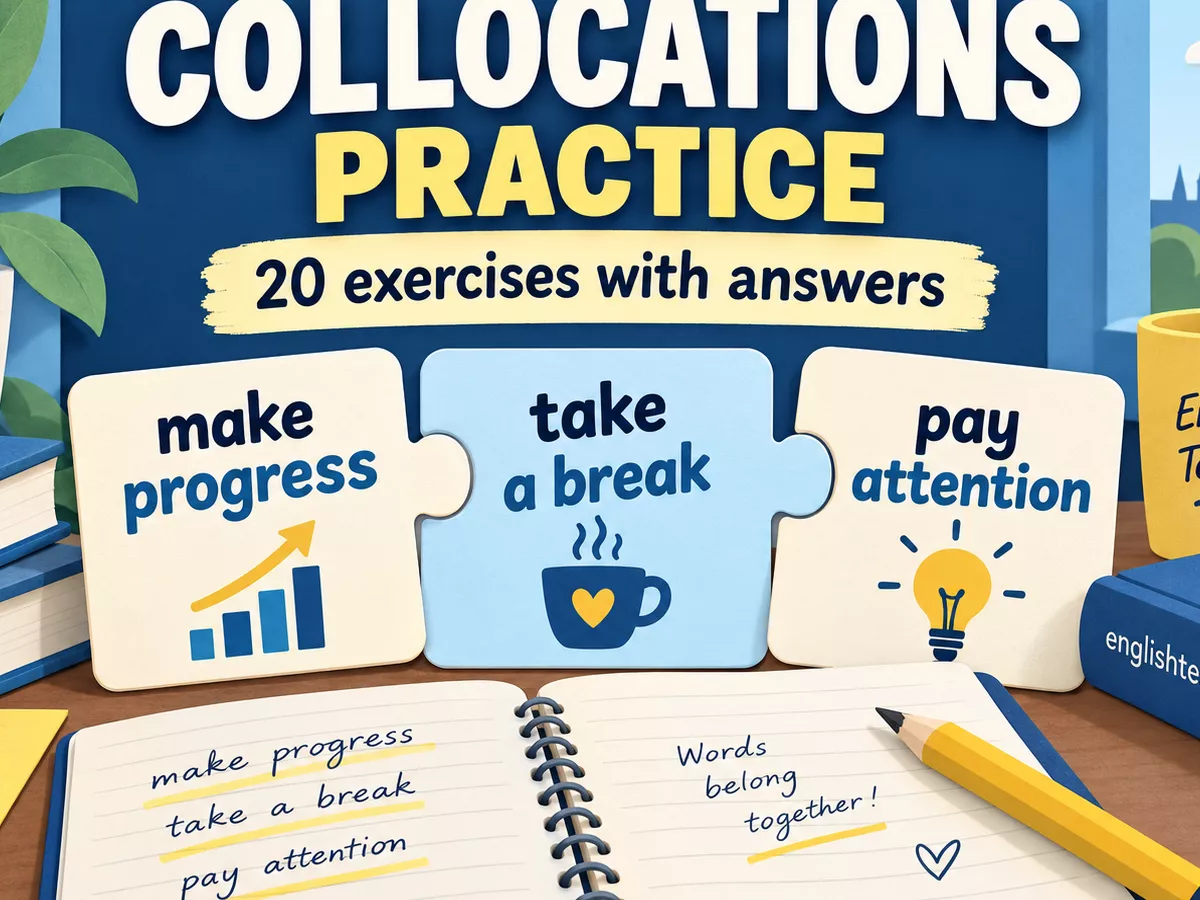
These 20 English collocations exercises practise natural word partnerships such as make a decision, take a break and pay attention. Match five phrases, complete ten sentences and correct five mistakes. Answer in the exercise cards, then choose Check my answers to see your score and explanations. You can also work on paper. This is B1 self-study practice, not a graded English-level test.
What you will practise
Recognise natural combinations such as make a decision and pay attention.
Choose collocations that fit a complete sentence rather than translating single words.
Check verb tense and uncountable nouns as well as the word partnership.
Before you begin
A collocation is a combination of words commonly used together. For example, strong goes with coffee and heavy goes with rain. A different word may be grammatically possible but not the usual choice for that meaning. Learning the whole phrase makes it easier to use it in your own sentence.
Review the reference: 50 Common Collocations in English
Try this new practice set without the reference open. It uses different sentences from the reference guide. In the matching task, use every ending once. In the sentence task, choose only from the given options. Natural English can have alternatives outside a particular exercise.
Practice: 20 questions
Exercise 1: match the word partners (1–5)
Use each ending once: attention · a promise · a bus · a decision · a break. Match it with the verb to form a natural expression.
Answer on paper, then open the explanations below. Enable JavaScript to check answers here.
Exercise 2: complete the sentence (6–15)
Choose A, B, or C. Each sentence has one intended answer among these options.
Answer on paper, then open the explanations below. Enable JavaScript to check answers here.
Exercise 3: repair the phrase (16–20)
Rewrite each sentence with a natural collocation or noun form. Keep the main meaning. You may need to change more than one word.
Answer on paper, then open the explanations below. Enable JavaScript to check answers here.
Answers and explanations
Complete each exercise and choose Check my answers to reveal its answers and explanations. You can also open the complete answer key below for self-study.
Show the complete answer key (1–20)
Check the reason as well as the answer. For rewriting tasks, the answers are models; another natural sentence with the same meaning may also be correct.
Answers 1–5
a decision — Make a decision means choose what you will do.
a break — Take a break means stop working or studying briefly.
attention — Pay attention means concentrate on what you hear or see.
a promise — Keep a promise means do what you said you would do.
a bus — Catch a bus means get on it before it leaves.
Answers 6–15
make — Make plans is the usual expression for deciding future arrangements.
transport — Public transport describes shared travel services.
build — Build trust means develop confidence in each other over time.
close — Close relationship describes a strong personal connection.
give — Give a presentation means present information to an audience.
fresh — Fresh air is clean air from outside.
save — Save time means reduce how much time an activity takes.
guided — A guided tour is led by someone who explains the place.
take — Take responsibility means accept a duty or obligation.
got — Get home means arrive at your home; got is the past form.
Answers 16–20
She did research for the history project. — Use do research for investigating a subject; did matches the past tense.
Could I make a suggestion about the timetable? — Use make a suggestion when offering an idea.
Could you give me some advice about the interview? — Advice is uncountable, so an advice is not natural. Also acceptable: “Could you give me a piece of advice about the interview?” or “Could you give me advice about the interview?”
I got home at six after work. — Get home describes arriving at home; catch goes with transport such as a bus.
We keep in touch after the course ends. — Keep in touch means continue communicating.
Review your result
Choose Check my answers in each exercise to see your score, up to 20 points in total. Explicitly listed alternatives in the correction task also count. Read the explanations and use Try again to practise mistakes. This score is a practice check, not a CEFR level result. For each missed phrase, write a new sentence about your own life.
Underline the whole phrase, not just the verb.
Check the tense: make becomes made; get becomes got.
Check whether a noun is countable: a suggestion, but some advice.
Return to your five hardest phrases tomorrow and recall them without looking.
Use five phrases in a short paragraph
Write four or five sentences about preparing for a course, a trip, or a busy day. Include five collocations and connect the sentences into a real story. Do not write a disconnected list.
Model: Before our study trip, we made plans and booked a room. We caught a bus to the museum and joined a guided tour. I paid attention to the guide and took notes. After the visit, we took a break together.
Frequently asked questions
What is a collocation in English?
A collocation is a familiar combination of words, such as strong coffee or heavy rain. Learning the phrase together helps you choose natural words in context rather than translate each word separately.
How should I use these collocations exercises?
Complete the matching, sentence-completion and correction tasks before checking the answers. Give yourself up to 20 points, then write a new sentence for each phrase you missed. This practice score does not measure your CEFR level.
Are collocations the same as phrasal verbs?
No. A collocation is a common word partnership; a phrasal verb combines a verb with a particle, such as look up. The categories can overlap, but recognising natural word partners and understanding a phrasal verb are different learning tasks.
Keep practising
Review 50 English collocations with meanings and example sentences
Related Lessons





Continue learning this topic
Review an explanation, study examples or try a related practice test.
- Practice test Yes/No questions, short answers, and simple conversation responses — A1 English Grammar Practice Test
- Practice test Question words: who, what, where, when, why, how, how often, and how many — A1 English Grammar Practice Test
- Practice test Past simple: regular and irregular verbs — A1 English Grammar Practice Test