
Lesson
B2 · Upper-intermediate
Reading
Why Did the Total Change? Read Two Fictional Bills
Read two original fictional statements, track charges, payments and credits, and explain a changed total through twenty source-based language checks.
12 min read
2,040 words
Updated Oct 29, 2026

On this page (9 sections)
B2 • 35 minutes • 20 scored checks. Read two original fictional statements, track charges, payments and credits, and explain a changed total through twenty source-based language checks.
Two fictional household-service statements
Read two original statements for an invented household service. They are language-learning documents for a fictional adult customer. Both use pounds and explicitly define payments and credits as reductions. You do not need knowledge of tax, interest or currency conversion.
Read A before B. Mark each date's label, then follow the named entries in the supplied calculation. A later issue date does not mean every event on that statement happened in that month: B can record an earlier payment.
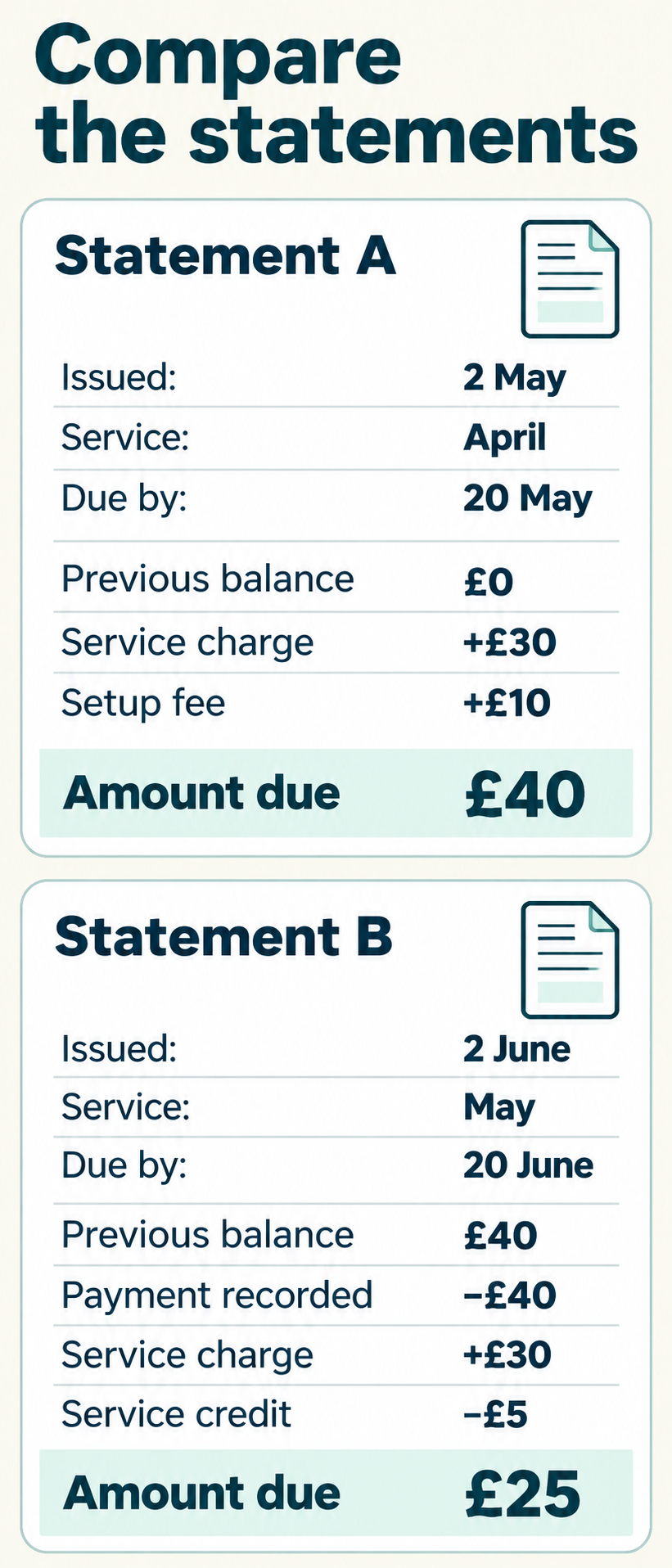
Statement A
Meadow Home Services — fictional statement A. This classroom document covers an invented household service for an adult customer. Its labelled entries appear below. Currency: pounds sterling (£). Issued: 2 May. Service period: 1–30 April. Payment due by: 20 May. In this document, due by means the latest payment date printed on the statement; it does not describe a payment already made. The previous balance is £0. The regular service charge for April is £30. A setup fee of £10 is also listed. The note beside this fee says: one-time setup charge, April only. No payments and no credits are recorded on this statement. Amount due: £40. Calculation supplied for the reading task: 0 + 30 + 10 = 40. The sign convention is explicit: charges increase the total; recorded payments and credits reduce it. A credit is a reduction in the amount shown, not necessarily a refund sent to a customer. The statement lists only entries included when it was issued. It does not report later transactions. For comparison, use each named line item rather than assuming that a changed total means a changed service price.
Statement B
Meadow Home Services — fictional statement B. This is the next classroom document for the same invented household service. Currency: pounds sterling (£). Issued: 2 June. Service period: 1–31 May. Payment due by: 20 June. The document uses the same convention as statement A: charges increase the amount; payments and credits are subtracted. Due by identifies the latest payment date printed here. Previous balance: £40. Payment recorded on 18 May: £40, shown as −£40 in the calculation. This clears the carried balance in this statement. Regular service charge for May: £30, unchanged from April. No setup fee is listed for May. A service credit of £5 is shown as −£5. The statement does not explain why this credit was applied. Amount due: £25. The supplied calculation is 40 − 40 + 30 − 5 = 25. This document includes entries recorded by its issue date. It does not establish whether a later payment was made after 2 June. The regular charge, the earlier payment and the new credit are different line items with different labels. The figures do not establish a change in household usage or an error by the provider.
Entry | A • issued 2 May | B • issued 2 June |
|---|---|---|
Previous balance | £0 | £40 |
Recorded payment | £0 | −£40 |
Regular service charge | £30 | £30 |
One-time setup fee | £10 | Not listed |
Service credit | £0 | −£5 |
Amount due | £40 | £25 |
Find the document labels
Match six labels with their meanings in these particular documents. Issued, service period and due by refer to different dates. By plus a date marks the latest date stated here; it does not mean a payment has already happened.
Use the documents' explicit sign convention. A credit reduces the total in these examples, while a payment records a different kind of reduction. The word balance needs its time reference: previous balance is carried into the calculation, and amount due is its resulting total.
Answer on paper, then open the explanations below. Enable JavaScript to check answers here.
Read the first statement
Complete a five-field reading card for statement A. Copy the requested date, period or amount. The issue date, the service dates and the deadline are all visible, but they answer different questions.
For amounts, you may use the pound sign or write pounds. Keep the named line item attached to the number in your notes. The setup fee is £10; the total shown is £40. Replacing one with the other changes the meaning even though both are numbers from A.
Answer on paper, then open the explanations below. Enable JavaScript to check answers here.
Compare the second statement
Compare the same line labels across the two statements. B first carries £40 forward and subtracts the recorded £40 payment, so those entries leave zero before the new charge and credit. Then £30 minus £5 gives £25.
A's total is £30 plus the £10 one-time fee, or £40. B's £25 is £15 lower. The source-supported difference is the absent £10 fee plus the £5 credit, while the regular charge stays at £30. You do not need to infer usage or a change in price.
Answer on paper, then open the explanations below. Enable JavaScript to check answers here.
Check proposed explanations
Classify each proposed explanation as supported, contradicted or not stated. Supported needs positive source evidence. Contradicted means the source states the opposite. Not stated means that the documents leave the claim unanswered.
Be especially careful with why. A document can show that a credit exists without explaining why it was applied. Similarly, a record that stops at the issue date cannot establish a later payment. Avoid filling either gap with a plausible story.
Answer on paper, then open the explanations below. Enable JavaScript to check answers here.
If a proposed reason goes beyond the statement, check evidence before drawing a conclusion.
Review the complete evidence
Review twenty answers: six label matches, five details from A, five comparisons and four explanation checks. The feedback cites exact labels or sentences and shows the relevant calculation. Check date order as well as signs: 18 May precedes B's issue date of 2 June.
Keep recorded information separate from present-day account status. Your job is to describe their wording and its limits accurately.
Write a neutral account summary
Write 80–100 words comparing the two statements. Include the unchanged regular charge, the absent one-time fee, the new credit, both totals and one genuine unanswered question. Use a neutral tone and explain only what the labelled entries support.
Check every number against the table and every cause against the text. Explain the £15 difference through the listed entries. State that the reason for the credit is unknown rather than inventing poor service, lower usage or an accounting mistake.
Your turn · self-review
Your transfer task
Write your own response first, then open the model and compare. Checklist: 80–100 words; correct totals and £15 difference; unchanged regular charge; cleared previous balance; at least one unknown; no accusation or payment commitment.
Practice only. Your writing stays on this page; it is not submitted or saved.
-
Model answer and explanation
Statement A shows £40 due: a £30 regular service charge and a £10 one-time setup fee. Statement B records a £40 payment that clears the carried balance. Its new regular charge remains £30, but the setup fee is absent and a £5 service credit reduces the amount due to £25. The £15 lower total is therefore explained by those listed differences, rather than a change in the regular charge. The documents do not say why the credit was applied or whether any further payment occurred after 2 June.
Related Lessons






Continue learning this topic
Review an explanation, study examples or try a related practice test.
- Practice test At the University of Maryland, a historic campus farm remains a classroom — C2 English Reading Practice Test
- Practice test New Mexico’s Alien Throne Rock Formation Collapses After Heavy Rain — B2 English Reading Practice Test
- Practice test First-Time Homebuyers Are Scarce, but More Are Paying Cash — B1 English Reading Practice Test