
Lesson
B2 · Upper-intermediate
Listening
Disagree Without Ending the Conversation
Follow a three-speaker planning discussion, identify stance and boundaries, and practise respectful disagreement with explained models.
11 min read
1,924 words
Updated Nov 5, 2026

On this page (5 sections)
The situation and your goal
Mara, Joel and Priya are planning a fictional community skills day. Their priorities overlap, but their first ideas differ. Listen for each concern, the response it receives and the points that remain undecided. You will complete twelve checks, revise two blunt responses and write a short dialogue. Allow about thirty-five minutes, including replay.
On your first listen, decide whether the discussion ends with a final plan or a draft. On the second listen, note one acknowledgement, one genuine question, one alternative and one clear boundary. Do not label a sentence as polite only because it contains could. Ask whether it accurately represents the speaker’s view and leaves room for a useful response.
Useful expressions
‘I can see why…’ acknowledges a reason without promising agreement. ‘My concern is…’ introduces a specific issue. ‘That is a fair point’ recognises a valid contribution. ‘My availability is still…’ repeats a boundary. ‘Provisional’ means not yet final. ‘Hand it over’ means pass responsibility to another person. These expressions are useful only when they match what the speaker actually means.
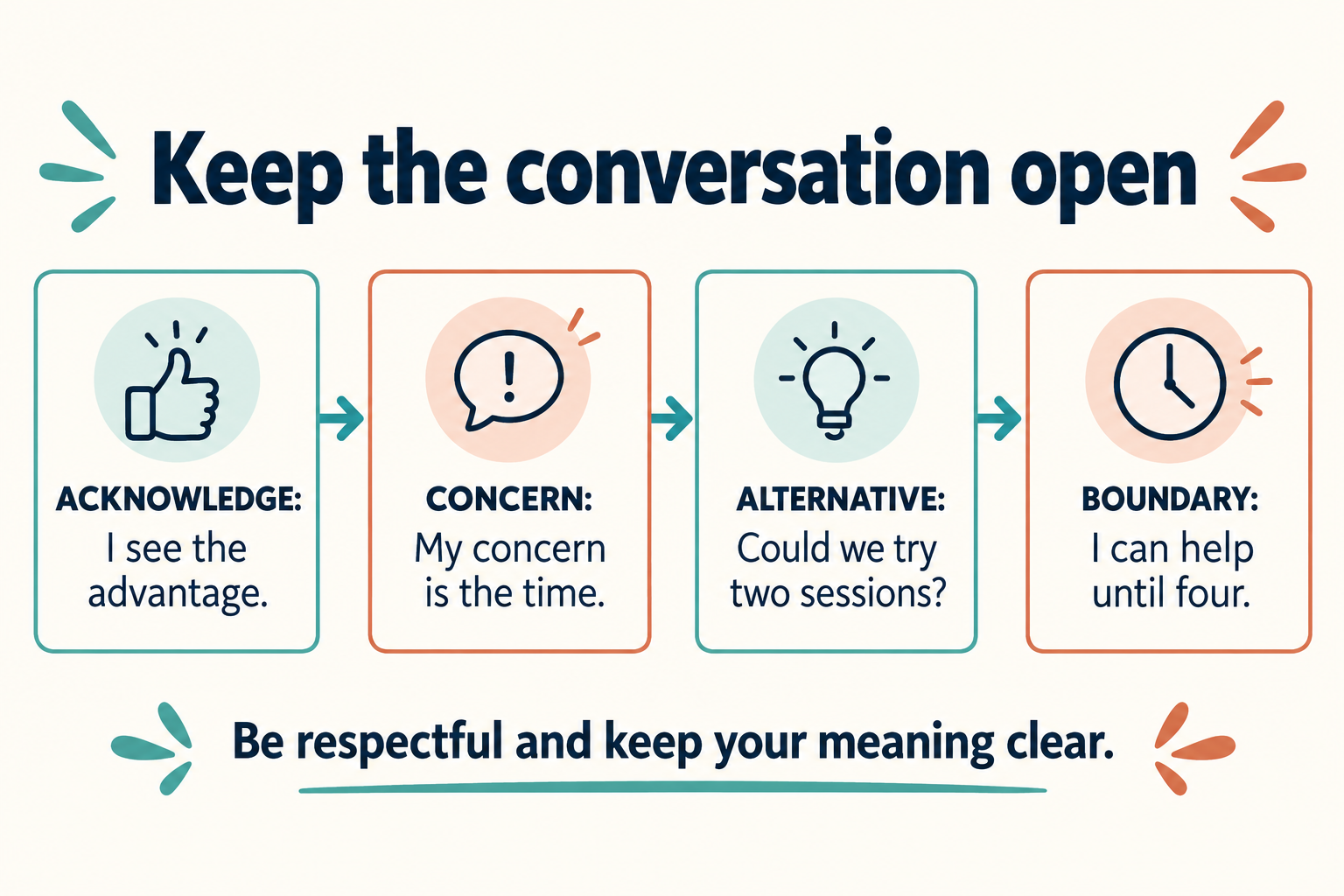
After the listening checks, use the visual review to compare four useful response tools with the discussion. It includes a boundary from the recording, so leave this review until you have answered the questions. You do not need to use every tool in every response.
Listen and learn
Community skills day: three-speaker discussion
Open audio separatelyRead the transcript
Mara: We need to decide how to run next month’s community skills day. I suggest three long workshops in the main hall. Everyone would hear the same introduction, and we would not need to move equipment between rooms.
Joel: I can see why that would be simpler to organise. My concern is that three long workshops could be tiring, especially for visitors who can only stay for an hour. Could we run shorter sessions that people can join separately?
Priya: That might make the event more flexible. I would still like one shared introduction, though, so that newcomers know where to go. Perhaps we could have a brief welcome and then two rounds of shorter workshops.
Mara: I am not sure two rounds would give each tutor enough time. We promised practical activities, not just demonstrations. How would we make sure people actually try the skills?
Joel: That is a fair point. What if each workshop focused on one small task? The bicycle session, for example, could cover checking tyre pressure rather than repairing an entire bicycle.
Priya: I like the narrower focus. We also need to discuss the finish time. I can help until four, but I am not available after that. I could prepare the welcome desk in the morning, and I can hand it over before I leave.
Mara: Would you be able to stay until five if we made the final session shorter?
Priya: I understand that we need enough people at the end, but my availability is still until four. Could we ask for one afternoon volunteer to cover the last hour?
Joel: That sounds worth checking. I can contact the volunteer coordinator, but I cannot promise someone will be available. Shall we keep the final hour provisional until we hear back?
Mara: Yes. Let us plan a short welcome and two focused workshop rounds, then check the timetable with the tutors. We can confirm the finish time after the coordinator replies.
Priya: That works for me. We have a draft plan, and we know which details still need a decision.
Practice tasks
Try each item before opening the answer. Read the explanation even when your answer is correct.
Answer on paper, then open the explanations below. Enable JavaScript to check answers here.
Visual review: four response tools
The image presents four useful tools: acknowledge a real advantage, state a time concern, suggest two sessions, and keep a four-o’clock availability boundary. The sample phrases are “I see the advantage”, “My concern is the time”, “Could we try two sessions?” and “I can help until four”. Choose the tools you need; not every response requires all four. Tone and context still matter.
Your turn · self-review
Apply it and compare
Write or say your own answer first. The models are examples, not the only acceptable answers. Use the checklist to review your work; open responses are not automatically assessed.
Practice only. Your writing stays on this page; it is not submitted or saved.
-
Model answer and explanation
“I’m concerned that a long introduction would leave less time for the activities. Could we keep the welcome brief?” The revision gives an observable trade-off rather than claiming to know everyone’s preference.
-
Model answer and explanation
“I can help until four, but I’m not available after that. I can hand over the desk before I leave.” The limit remains clear; the handover is a relevant next step, not a promise to extend the shift.
-
Model answer and explanation
1. A: “I suggest one four-hour workshop so we only set up once.” 2. B: “I can see the advantage, but four hours may be too long for some visitors. Could we split it into two sessions?” 3. A: “How would we manage the extra setup time?” 4. B: “We could leave the tables ready between sessions. I can help until three, but not later.” 5. A: “Then we need someone else for the second session. Shall we check before confirming?” 6. B: “Yes. We can keep the second session provisional until we have cover.” Self-check: specific concern, truthful acknowledgement, workable alternative, clear boundary, no guaranteed help that has not been confirmed.
Full transcript: read after listening
Mara: We need to decide how to run next month’s community skills day. I suggest three long workshops in the main hall. Everyone would hear the same introduction, and we would not need to move equipment between rooms.
Joel: I can see why that would be simpler to organise. My concern is that three long workshops could be tiring, especially for visitors who can only stay for an hour. Could we run shorter sessions that people can join separately?
Priya: That might make the event more flexible. I would still like one shared introduction, though, so that newcomers know where to go. Perhaps we could have a brief welcome and then two rounds of shorter workshops.
Mara: I am not sure two rounds would give each tutor enough time. We promised practical activities, not just demonstrations. How would we make sure people actually try the skills?
Joel: That is a fair point. What if each workshop focused on one small task? The bicycle session, for example, could cover checking tyre pressure rather than repairing an entire bicycle.
Priya: I like the narrower focus. We also need to discuss the finish time. I can help until four, but I am not available after that. I could prepare the welcome desk in the morning, and I can hand it over before I leave.
Mara: Would you be able to stay until five if we made the final session shorter?
Priya: I understand that we need enough people at the end, but my availability is still until four. Could we ask for one afternoon volunteer to cover the last hour?
Joel: That sounds worth checking. I can contact the volunteer coordinator, but I cannot promise someone will be available. Shall we keep the final hour provisional until we hear back?
Mara: Yes. Let us plan a short welcome and two focused workshop rounds, then check the timetable with the tutors. We can confirm the finish time after the coordinator replies.
Priya: That works for me. We have a draft plan, and we know which details still need a decision.
Related Lessons






Continue learning this topic
Review an explanation, study examples or try a related practice test.
- Practice test At the University of Maryland, a historic campus farm remains a classroom — C2 English Listening Practice Test
- Practice test At the University of Maryland, a historic campus farm remains a classroom — C2 English Grammar Practice Test
- Practice test At the University of Maryland, a historic campus farm remains a classroom — C2 English Vocabulary Practice Test