
Lesson
B1 · Intermediate
Grammar
How a T-Shirt Is Made: Passive Voice Practice
Follow a simplified cotton T-shirt process, listen to the narration, and practise sequence, passive forms and useful agents in 14 checks.
11 min read
1,847 words
Updated Nov 4, 2026

On this page (11 sections)
Your goal
Describe a simple manufacturing process using present passive forms. You will follow materials through a series of changes, identify the order of stages and decide when an agent is useful. Allow about 30 minutes. Read the process once for the main idea before studying individual verb forms.
Before you read or listen
Predict the order: fabric, cotton fibres, a finished T-shirt, yarn. Yarn is a long thread used to make fabric. A seam is the line where pieces of fabric are sewn together. A pattern is a planned shape used for cutting. Inspect means check carefully. Dye means add colour. Sew means join with thread; its past participle here is sewn.
On the first listen, ask what changes at each stage. On the second listen, note five passive verbs. Use the transcript afterwards to check details. The audio is a clear model of the complete passage; replay any part you need.
Listen and learn
How a T-Shirt Is Made: full narration
Open audio separatelyRead the transcript
Narrator: A cotton T-shirt starts with fibres, not fabric. This is a simplified example of one common production route. Different factories may use different equipment or complete some stages in a different order. First, harvested cotton is cleaned, and its seeds are removed. The fibres are prepared and spun into yarn. Next, the yarn is knitted into fabric. For many everyday T-shirts, knitted fabric is used because its loops allow it to stretch. In this example, the fabric is prepared for dyeing, dyed blue, and dried. A pattern is used to mark the shapes for the front, back and sleeves. These pieces are cut from the fabric. They are then sewn together, and a neck band is added. At this stage, the separate pieces become a T-shirt. The finished shirt is inspected. A worker checks its size, seams and appearance. If a problem is found, the shirt is set aside for attention. Shirts that pass the checks are folded and packed. This description focuses on the materials and the steps, so many sentences are passive. Workers and machines carry out the actions, but their names are not needed in every sentence. This is a language-learning overview, not a complete technical manual or a claim that every cotton shirt follows exactly this route.
Read: from cotton to a finished shirt
A cotton T-shirt starts with fibres, not fabric. This is a simplified example of one common production route. Different factories may use different equipment or complete some stages in a different order.
First, harvested cotton is cleaned, and its seeds are removed. The fibres are prepared and spun into yarn. Next, the yarn is knitted into fabric. For many everyday T-shirts, knitted fabric is used because its loops allow it to stretch.
In this example, the fabric is prepared for dyeing, dyed blue, and dried. A pattern is used to mark the shapes for the front, back and sleeves. These pieces are cut from the fabric. They are then sewn together, and a neck band is added. At this stage, the separate pieces become a T-shirt.
The finished shirt is inspected. A worker checks its size, seams and appearance. If a problem is found, the shirt is set aside for attention. Shirts that pass the checks are folded and packed.
This description focuses on the materials and the steps, so many sentences are passive. Workers and machines carry out the actions, but their names are not needed in every sentence. This is a language-learning overview, not a complete technical manual or a claim that every cotton shirt follows exactly this route.
Notice the grammar
Cotton is cleaned uses a singular material noun, so it takes is. The pieces are cut uses a plural subject, so it takes are. Cut has the same spelling in its base and participle forms. Spin changes to spun; knit becomes knitted; sew becomes sewn in this lesson.
The passage does not say that workers are unimportant. Its topic is the shirt and its materials. Add an agent when it answers a useful question: The sample was checked by the quality manager. Avoid repeating by workers after every process verb. For a finished batch last week, change be to was or were while keeping the participles.
Process diagram in words
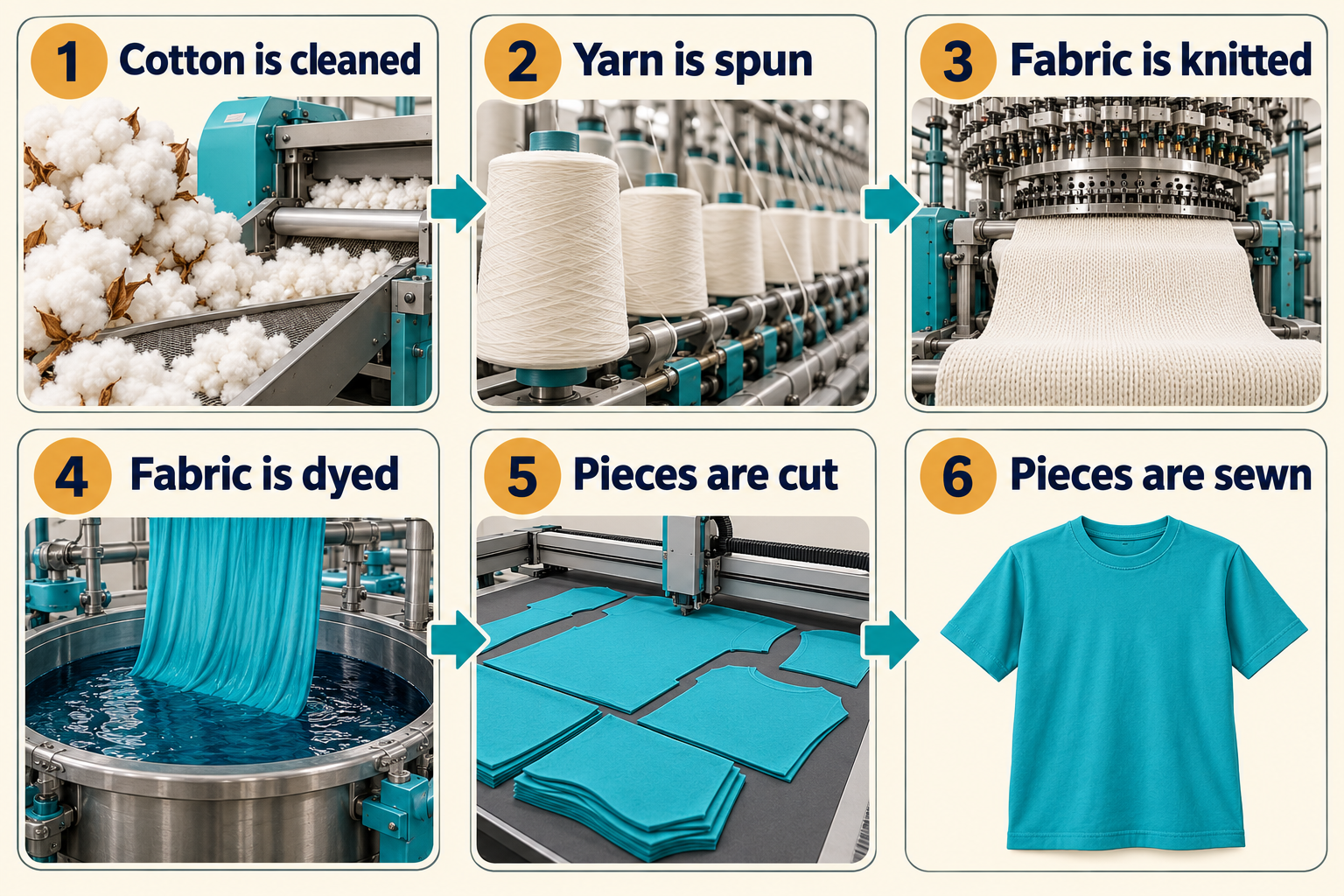
The diagram summarises six stages: cotton is cleaned; yarn is spun; fabric is knitted; fabric is dyed; pieces are cut; pieces are sewn. The passage adds preparation, inspection and packing. The six-picture strip is a summary, so it does not show every action.
Write 70–90 words
Explain the route to someone who has never visited a clothing factory. Use at least five passive verbs and three sequence expressions. Make clear that this is one simplified example. The model is one possible answer, not the only correct paragraph. Check that your sequence matches the passage and that is/are agrees with each subject.
Factual scope
The example follows a common knitted cotton, fabric-dyed, cut-and-sew route. Cotton can also be dyed at other stages, and garments can be produced by other methods. The manufacturing overview was checked against CottonWorks material on yarn manufacturing, knitting, dyeing and garment manufacturing. No claim about environmental impact or working conditions is made.
Practice: check meaning and form
Choose or type your answers. Then read every explanation. The short checks give feedback on these answers only.
Answer on paper, then open the explanations below. Enable JavaScript to check answers here.
Answer key and explanations
1. Cotton fibres — The passage begins with cotton fibres before yarn and fabric.
2. Yarn — The fibres are spun into yarn.
3. It is knitted into fabric. — Knitting changes yarn into fabric.
4. before cutting. — The passage dyes and dries the fabric before the pattern and cutting stage.
5. They are sewn together. — Sewing joins the cut pieces into a garment.
6. They are folded and packed. — Packing follows successful inspection.
7. is — Cotton is an uncountable material noun here and takes is.
8. are — Sleeves is plural, so the present passive uses are.
9. spun — The irregular participle of spin is spun.
10. sewn — The passage uses sewn, the common participle of sew. Sewed is also a possible participle.
11. The shirts were inspected yesterday. — Yesterday requires past be, and plural shirts requires were.
12. The focus is on materials and process stages. — Omitting agents keeps the process in focus; it does not deny that people work.
13. The sample was checked by the quality manager. — It identifies who took responsibility for checking the sample.
14. This is one simplified manufacturing route. — The opening and closing explicitly limit the description to an example route.
Your turn · self-review
Use the language yourself
Write or speak first, then compare these possible models. Your wording may be different. This is self-check practice; it does not automatically score your writing or pronunciation.
Practice only. Your writing stays on this page; it is not submitted or saved.
-
Model answer and explanation
First, cotton is cleaned and its seeds are removed. The fibres are spun into yarn, and the yarn is knitted into fabric. In this example, the fabric is dyed before it is cut. Pieces for the front, back and sleeves are cut using a pattern. Next, the pieces are sewn together and a neck band is added. The finished T-shirt is inspected for problems. Finally, shirts that pass the checks are folded and packed. Workers and machines are involved at several stages.
-
Model answer and explanation
The fabric was dyed yesterday. The pieces were cut using a pattern.
Self-check and next step
Check the meaning first, then the form. Read your answer aloud at a comfortable speed. Correct one feature, try again, and compare with the examples. Ask a teacher or partner for feedback if you are unsure.
Useful reference
Related Lessons






Continue learning this topic
Review an explanation, study examples or try a related practice test.
- Practice test First-Time Homebuyers Are Scarce, but More Are Paying Cash — B1 English Listening Practice Test
- Practice test First-Time Homebuyers Are Scarce, but More Are Paying Cash — B1 English Grammar Practice Test
- Practice test First-Time Homebuyers Are Scarce, but More Are Paying Cash — B1 English Vocabulary Practice Test
- Course lesson Advanced passives: Reporting beliefs and expectations – C1: Precision and Expression
- Course lesson Passive voice: Is made, was built and can be done – B1–B2: Grammar in Context
- Course lesson Passive forms: Continuous, perfect and modal passives – B1–B2: Grammar in Context