
Lesson
A2 · Elementary
Reading
A2 Reading Comprehension: A Day Out — Questions and Answers
Practise A2 reading comprehension with an original day-out story, useful vocabulary and 10 questions with explained answers and exact passage evidence.
11 min read
1,942 words
Updated Oct 13, 2026
On this page (13 sections)
Read an original A2 story about two cousins visiting a riverside town. This lesson includes ten multiple-choice questions, useful vocabulary and an answer key with exact evidence from the text. Practise finding times, reasons and changes of plan without needing facts from outside the story.
How to use this reading lesson
Read the whole text once without a dictionary. Identify the situation and the writer's main point.
Read the ten questions. Return to the relevant paragraph and underline the words that support your answer.
Write your answers before opening the answer section. Choose one option for each question.
Choose Check my answers to see your score out of ten and compare your choices with the explanations. Use Try again after reviewing any mistakes. This is self-study practice, not an official level test.
Useful vocabulary before you read
a day out — a visit away from home for enjoyment, usually without staying overnight.
opening times — the hours when a place is open to visitors.
full — with no space available for more people in this context.
entry — permission to go inside a place; free entry means no admission charge.
a tour — a visit around a place with someone who explains it.
instead — in place of another action or choice.
A day out in Westford
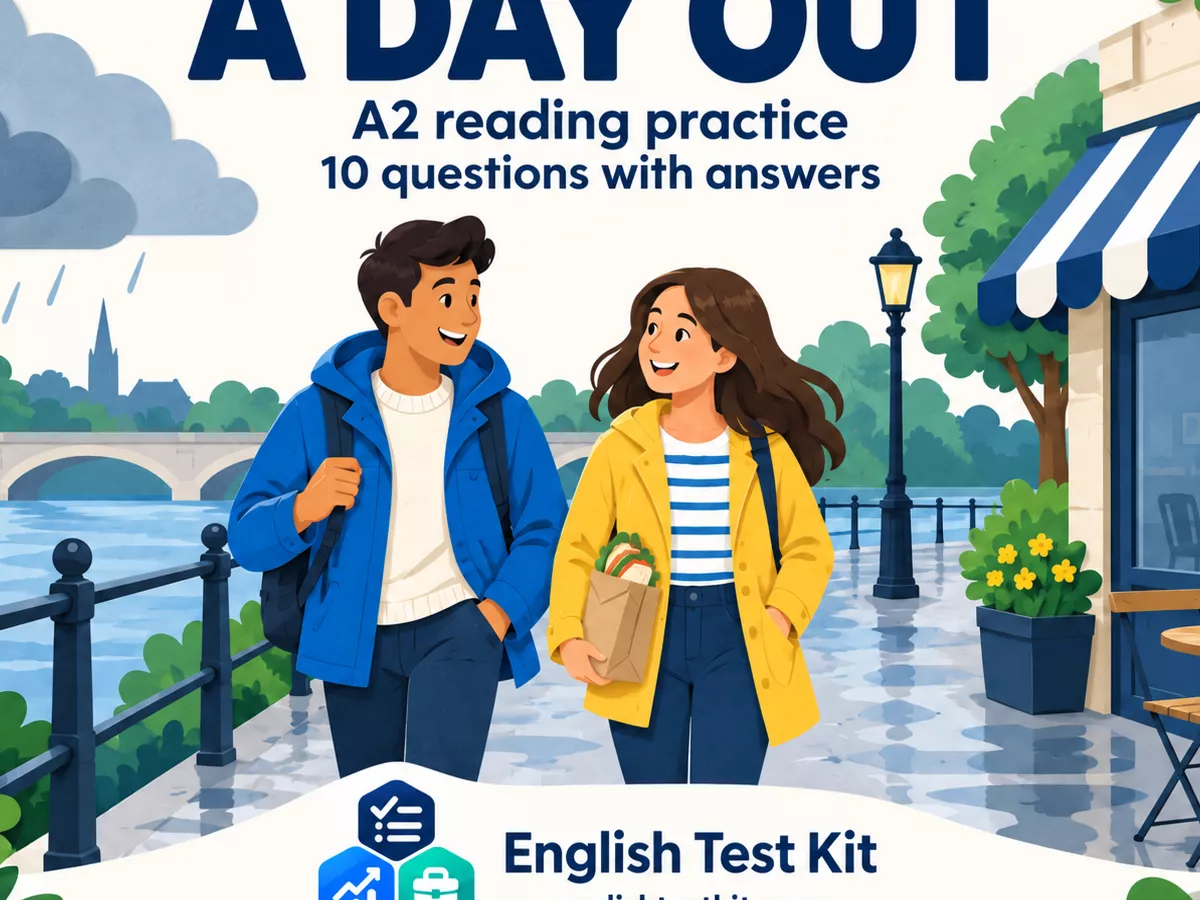
Last Saturday, Leo and his cousin Maya planned a day out in Westford. They wanted to visit a small museum near the river. Leo checked the opening times online on Friday evening. The museum opened at ten, so they agreed to meet at the bus stop at half past nine. Maya brought her camera and a light jacket. Leo packed two bottles of water.
The bus journey took twenty minutes. When they arrived, Maya felt hungry and suggested a café. The café was full, so they bought sandwiches and ate beside the river. A small sign asked visitors not to feed the birds. They put their empty bags in a bin before walking to the museum.
Inside the museum, they saw old photographs of Westford. Leo liked a picture of the first railway station. Maya enjoyed a room about life in the town a hundred years ago. Entry was free, but they paid three pounds each to join a short tour. The guide showed them an old school desk and explained how children wrote their lessons.
After the tour, they wanted to walk through the park. However, dark clouds appeared and it began to rain. They changed their plan and went to a bookshop instead. Maya bought a postcard, and Leo found a book about trains. They waited there until the rain stopped. Neither of them bought an umbrella.
At four o'clock, they caught the bus home. Maya said her favourite part was the museum tour because the guide told interesting stories. Leo was glad they had checked the opening times. They decided to visit the park another day.
Ten reading questions
Choose one of the three answers for each question. Use the numbered passage paragraphs as evidence, then check the explained answer key.
Answer on paper, then open the explanations below. Enable JavaScript to check answers here.
Answers and explanations
Complete each exercise and choose Check my answers to reveal its answers and explanations. You can also open the complete answer key below for self-study.
Show the complete answer key (1–10)
B. Two cousins enjoying a day out and changing one part of their plan. — Their main plan is a day out. They visit the museum and later replace a park walk with a bookshop visit because of rain. Evidence, paragraph 1: “Last Saturday, Leo and his cousin Maya planned a day out in Westford.”
C. On Friday evening. — The check happens the evening before their Saturday trip, not after they arrive. Evidence, paragraph 1: “Leo checked the opening times online on Friday evening.”
A. At half past nine. — Half past nine is 9:30. Ten is the museum's opening time, not their meeting time. Evidence, paragraph 1: “they agreed to meet at the bus stop at half past nine.”
B. The café was full. — The word so connects the full café with their decision to buy sandwiches and eat elsewhere. Evidence, paragraph 2: “The café was full, so they bought sandwiches and ate beside the river.”
A. Feed the birds. — The sign is about feeding birds. It does not say that photographs or walking are forbidden. Evidence, paragraph 2: “A small sign asked visitors not to feed the birds.”
C. Three pounds. — Entry to the museum was free, but the tour cost three pounds per person. Do not confuse entry with the optional tour. Evidence, paragraph 3: “Entry was free, but they paid three pounds each to join a short tour.”
A. A picture of the first railway station. — Leo's favourite photograph shows the railway station. Maya prefers the room about earlier town life. Evidence, paragraph 3: “Leo liked a picture of the first railway station.”
C. It began to rain. — Rain is the stated reason for the change of plan. The story gives no information about the park being closed. Evidence, paragraph 4: “However, dark clouds appeared and it began to rain.”
B. In place of their planned park walk. — Instead shows a replacement: they choose the bookshop rather than continue with the planned park walk. Evidence, paragraph 4: “They changed their plan and went to a bookshop instead.”
A. The museum tour. — Maya names the tour as her favourite because the guide tells interesting stories. Neither cousin buys an umbrella. Evidence, paragraph 5: “Maya said her favourite part was the museum tour because the guide told interesting stories.”
Check your learning
Choose Check my answers at the end of each exercise to see your score and explanations, up to 10 points in total. Accepted alternatives also count. Record your first attempt, then use Try again to practise mistakes. This is practice, not a CEFR level test, and your answers are not saved.
For a missed detail, find the numbered paragraph and underline the words that support the answer.
For a time or price mistake, label what each number describes instead of remembering the number alone.
Summarise the day in four sentences. Later, try the questions again without looking at the key.
Reading strategy: check words, not guesses
Words such as so, but and however connect the story's events. So introduces a result: the café is full, so the cousins eat elsewhere. But separates two prices: museum entry is free, but the guided tour is not. However introduces the change caused by rain.
Keep similar details separate. The museum opens at ten, while the cousins meet at 9:30. The tour costs three pounds each, while entry costs nothing. Underline the subject and the action beside each number before choosing an answer.
Do not use the illustration to answer. The picture introduces the topic, but the written passage is the evidence. An umbrella might be useful on a rainy day; the story still says neither cousin bought one.
Use the reading in your own writing
Write four sentences about the cousins' day using first, then, after that and finally. Include one reason with because. Check your summary against the passage: do not add activities they did not do.
Model opening: First, Leo and Maya met at the bus stop at half past nine. Then they travelled to Westford. Now complete the summary in your own words. This writing task is open-ended and has no automatic grade.
Frequently asked questions
Is this reading lesson suitable for A2 learners?
The text is designed as A2 practice: it uses everyday activities, clear past-tense events and familiar linking words. A few useful words are explained before the story. If it feels difficult, read one paragraph at a time and find a single fact before rereading the whole text.
Should I translate every word while reading?
No. Start with the situation and the main idea, then focus on words connected to a question. Use the vocabulary notes and the surrounding sentence before checking a dictionary. Understanding the main action matters more than translating every description.
Does my score out of ten show my English level?
No. It shows how well you understood this particular text. Review the evidence for any missed answer and try another text on a different topic. A CEFR level estimate requires broader assessment, not one short self-study passage.
Keep practising your reading
Build a habit of choosing one short text, stating its main idea and finding two exact details. These guides explain techniques you can use beyond this lesson:
Related Lessons



Continue learning this topic
Review an explanation, study examples or try a related practice test.
- Practice test Science roundup links shared meals, exceptionally loud birds, and asteroid Bennu to bigger questions — C2 English Listening Practice Test
- Practice test Science roundup links shared meals, exceptionally loud birds, and asteroid Bennu to bigger questions — C2 English Grammar Practice Test
- Practice test Science roundup links shared meals, exceptionally loud birds, and asteroid Bennu to bigger questions — C2 English Vocabulary Practice Test