
Lesson
A2 · Elementary
Listening
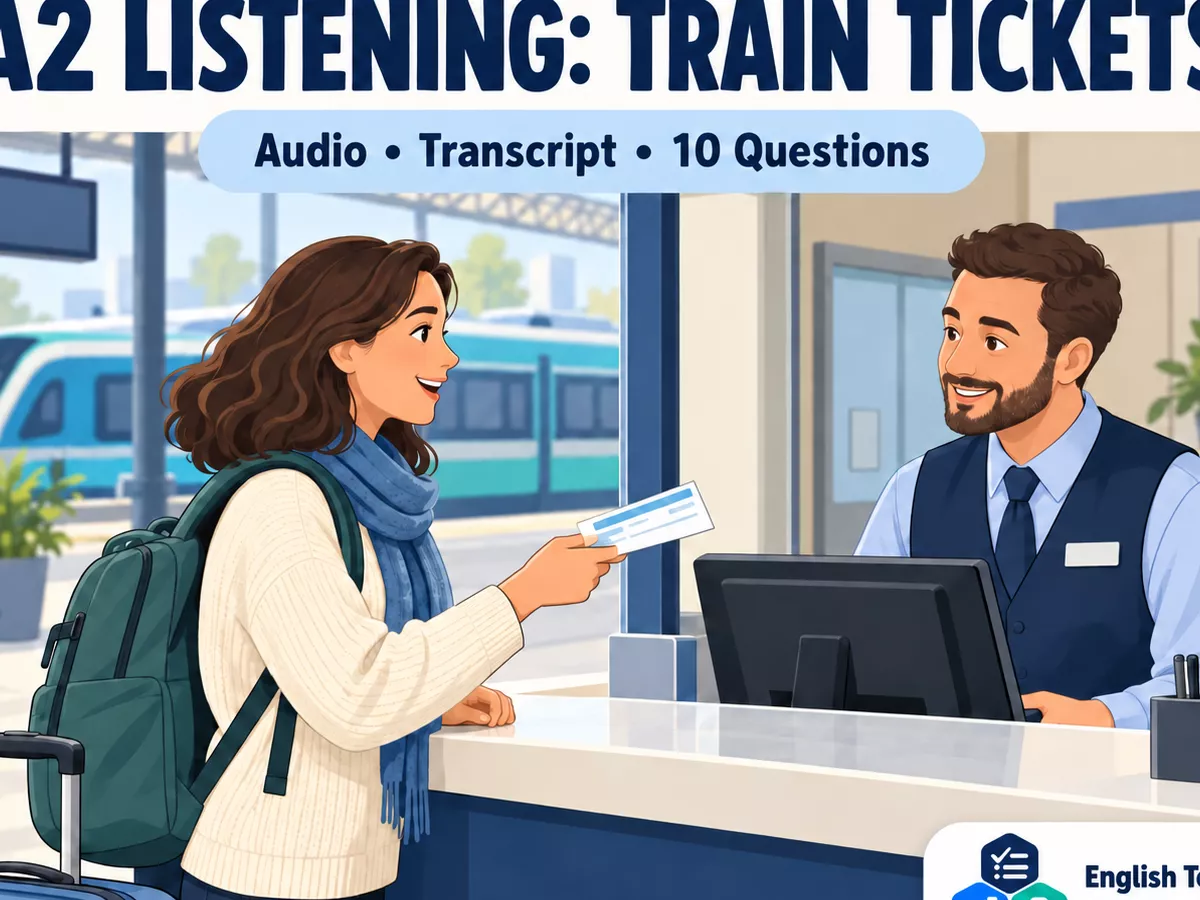
A2 Listening Practice: Buying a Train Ticket — Audio and Answers
Practise A2 listening with a train-ticket dialogue, original audio and transcript. Try 10 questions with explained answers about times, prices and choices.
11 min read
1,849 words
Updated Oct 14, 2026
On this page (14 sections)
Practise A2 listening with a train-ticket dialogue, original audio and transcript. Try 10 questions with explained answers about times, prices and choices. This is an original practice conversation, not a recording from an official exam. The level label helps you choose a lesson; it is not a certified assessment of your English.
How to use this listening lesson
Listen once without reading the transcript. Identify the speakers' purpose and the final decision.
Read the ten questions and listen again. Write your own answers before looking at the key.
Check each answer against the matching speaker turn in the transcript. Replay any detail you missed.
Practise the useful phrases aloud, then retell the final arrangement in two or three sentences.
What to listen for at a ticket desk
A traveller usually gives a destination and a preferred time, then chooses a ticket type. The clerk may offer a different train or ask a short question. Listen for what the traveller finally buys, not just for the first request. In this lesson, one requested train is unavailable and another is accepted.
Make a simple set of notes with five labels: destination, ticket type, departure, arrival and platform. Leave room for the price and payment method. Short notes can help you compare the details after listening without copying the full conversation.
Useful ticket and clarification phrases
Could I have a ticket to...? — make a polite request.
A single ticket — one journey in one direction. A return ticket — travel there and back, subject to its conditions.
A direct train — no change of train is needed on the journey described.
What time does it arrive? — ask about arrival at the destination.
What time does it leave? — ask about departure.
Could you repeat...? — ask for clarification when a number is unclear.
I'll pay by card — state your chosen payment method. It does not mean cash is unavailable.
Understanding numbers and the final confirmation
Nine twenty means 9:20, ten fifteen means 10:15, and eleven oh five means 11:05. Pay attention to whether a number is a departure time, an arrival time, a price or a platform. You cannot choose correctly from the number alone.
The final confirmation brings the chosen day, departure time, platform and arrival time together. Listen once more and say that confirmation in your own words. The fictional prices and times in this lesson are designed for English practice, not for planning an actual train journey.
A2 listening: Buying a train ticket
Use the audio player attached to this lesson. Read the transcript after your first listening attempt, or earlier if you need reading support. The named places, arrangements, prices and transport details below are invented for language practice; do not use them as real travel information.
Speaker | Dialogue |
|---|---|
1. Traveller | Hello. Could I have a ticket to Westford for Saturday morning, please? I would like to leave on the nine twenty train. |
2. Ticket clerk | Certainly. Is that a single ticket, or would you like a return? |
3. Traveller | A single, please. I am staying with my cousin, and she will drive me home on Sunday. |
4. Ticket clerk | I'm sorry, but the nine twenty train is full. The next train leaves at ten fifteen. Would that be all right? |
5. Traveller | Yes, ten fifteen is fine. What time does it arrive in Westford? I need to meet my cousin before lunch. |
6. Ticket clerk | It arrives at eleven oh five. It is a direct train, so you do not need to change trains during the journey. |
7. Traveller | That's good. How much is the adult ticket? |
8. Ticket clerk | It is twelve pounds. You can pay by cash or card. This ticket is for the ten fifteen train only. |
9. Traveller | I'll pay by card, please. Which platform does the train leave from? |
10. Ticket clerk | Platform three. Walk past the small shop, then turn left. The platform number is also on your ticket. |
11. Traveller | Sorry, could you repeat the platform number? Did you say two or three? |
12. Ticket clerk | Three. Platform three. Here is your ticket. Please keep it with you because you will need it when you leave the station in Westford. |
13. Traveller | Thank you. So that's Saturday, ten fifteen, from platform three, arriving at eleven oh five. |
14. Ticket clerk | That's right. Have a good journey. |
Ten listening comprehension questions
Choose the best answer to each question. Listen for the final agreed details, then use the transcript to check your evidence before reading the explained answer key.
Answer on paper, then open the explanations below. Enable JavaScript to check answers here.
Answers and explanations
Show the complete answer key (1–10)
A. Westford. The destination is named in the traveller's first request. It is not the name of the departure station. Evidence (turn 1): “a ticket to Westford”
B. Saturday. The traveller requests Saturday morning. Sunday is the day her cousin will drive her home. Evidence (turn 1): “for Saturday morning”
C. A single ticket. She chooses a single because her cousin will drive her home. A return includes a journey back as well. Evidence (turn 3): “A single, please.”
A. The train is full. The clerk says the earlier train is full, so they choose the next departure. The train has not been cancelled. Evidence (turn 4): “the nine twenty train is full”
B. 10:15 a.m. The clerk offers ten fifteen and the traveller accepts it. Nine twenty was the original request, not the final choice. Evidence (turn 4): “The next train leaves at ten fifteen.”
C. 11:05 a.m. Eleven oh five is the arrival time. The traveller repeats it in the final confirmation. Evidence (turn 6): “It arrives at eleven oh five.”
A. No, it is a direct train. The clerk explains that direct means the traveller does not need to change trains on this journey. Evidence (turn 6): “It is a direct train”
B. £12. The clerk gives the adult price as twelve pounds. This is a fictional practice price, not a current fare. Evidence (turn 8): “It is twelve pounds.”
C. By card. Cash and card are both offered, but the traveller chooses card. Distinguish an available option from the final decision. Evidence (turn 9): “I'll pay by card, please.”
A. Platform 3. The traveller asks whether the number is two or three. The clerk clearly repeats three. Evidence (turn 12): “Three. Platform three.”
Check your learning
Choose one answer for each question, then select Check my answers to see your score, up to 10. Read the explanations and transcript evidence before using Try again. Record your first attempt before correcting mistakes. This is practice, not a CEFR level test, and your answers are not saved.
If a time confused you, separate the first request, the accepted departure and the arrival time.
If a ticket detail was wrong, replay the choice of single or return, the price, payment and platform confirmation.
Say a new ticket request aloud and include one polite clarification question before confirming the details.
Build your own short conversation
Use the speakers' phrases in a new situation, but change the names and details. Take turns making a request, responding, asking for clarification and confirming the final information. Record yourself if you wish, then listen for understandable numbers, natural pauses and complete questions. Accuracy matters more than copying the voices exactly.
Frequently asked questions
What is the difference between a single and a return ticket?
A single covers a journey in one direction. A return includes travel back as well, subject to the ticket's conditions. In this dialogue the traveller buys a single because her cousin will drive her home.
Why are both 9:20 and 10:15 mentioned?
The traveller first asks for 9:20, but that train is full. The clerk offers 10:15 and the traveller accepts it. Listen for the response after a request so that you can identify the final choice rather than the original preference.
Can I use these prices and times for real travel?
No. Westford and the ticket details are invented for language practice. For a real trip, check the operator's current timetable, fares, ticket conditions and platform information. This lesson teaches English listening, not travel advice.
Continue practising
Practise an everyday listening routine; Review clear sentence structure
Choose a small listening target for your next practice session: a time, a reason, a price or a final decision. Keeping that target specific makes it easier to notice improvement. Return to this lesson after a few days and see whether you can understand the conversation without opening the transcript.
Related Lessons



Continue learning this topic
Review an explanation, study examples or try a related practice test.