
Guide
B2 · Upper-intermediate
Reading
Understand Household Bills in English: Charges, Credits and Due Dates
Learn statement labels, date roles and charge/credit conventions through fictional bills, then explain only the differences the line items support.
8 min read
1,351 words
Updated Oct 28, 2026
On this page (7 sections)
B2 • 19 minutes • 10 scored checks. Learn statement labels, date roles and charge/credit conventions through fictional bills, then explain only the differences the line items support.
Before looking for dates and totals, review scanning and evidence strategies.
Know which date and total you are reading
This is a language guide using invented household-service statements. We use pounds (£) and define the signs explicitly: charges are added; recorded payments and credits are subtracted. Actual providers may use different labels or layouts.
Issued is the date the statement was created. Service period identifies the dates covered by the service. Payment due by identifies the latest payment date printed on this example. Amount due is the resulting amount shown after the listed entries. These labels answer different questions even when their dates appear close together.
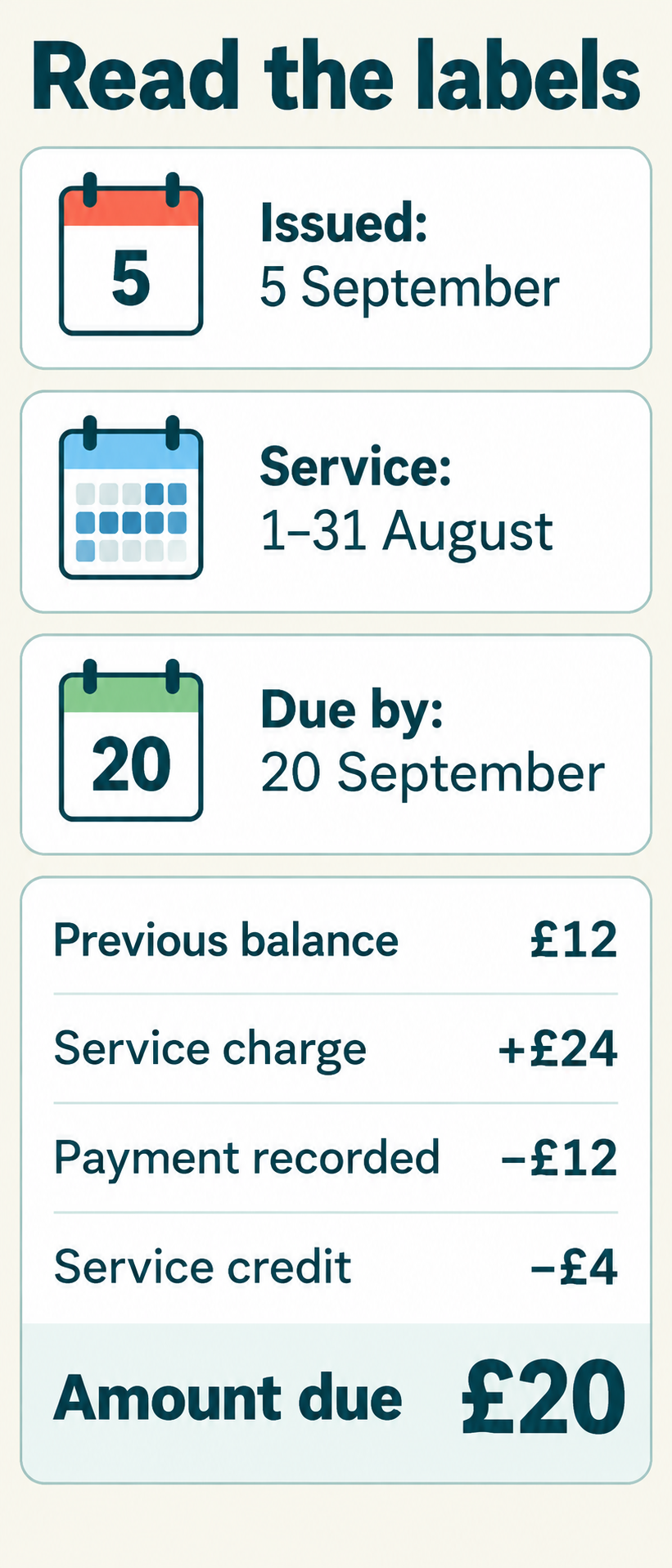
Label | Fictional statement entry |
|---|---|
Issued | 5 September |
Service period | 1–31 August |
Payment due by | 20 September |
Previous balance | £12 |
Current service charge | +£24 |
Payment recorded | −£12 |
Service credit | −£4 |
Amount due | £20 |
Core bill vocabulary
A charge is an amount added for a service or item. A fee is a named charge, such as a setup fee. Payment is money recorded as paid; a bill may list when it was recorded. A credit reduces the amount under this document's stated convention. It does not automatically mean that money was sent back as a refund.
Balance is the amount remaining after the relevant entries. Previous means before the current period; current means the period or document now being discussed. Outstanding describes an amount still shown as unpaid in that document. Do not replace the provider's precise meaning with a universal definition: use the document's labels, date and notes together.
Follow the account story
Follow the September example in order. The previous balance is £12. The current service charge adds £24, producing £36 before reductions. A recorded payment of £12 reduces that to £24. A £4 service credit reduces it to £20, the amount due printed on the statement.
The simple calculation is 12 + 24 − 12 − 4 = 20. The calculation helps you follow the account story. Read each label before its number. A payment and a credit both reduce this total, but they describe different kinds of entries. Do not call a credit a payment unless the source does.
Read line items and footnotes
A line item is one named entry in a statement. A footnote can qualify that entry. Example footnote: £6 setup fee: one-time charge in July only. One-time distinguishes this fee from a recurring charge, which repeats according to the arrangement stated in the document.
Match the footnote to its exact label rather than applying it to every charge. A note about a setup fee does not say that the regular service charge occurs only once. Conversely, a familiar-looking monthly layout does not prove every entry recurs. Use one-time or recurring only when the supplied wording supports it.
Compare two periods
Separate comparison cards: July lists a £24 service charge and a £6 one-time setup fee, total £30. August lists the same £24 service charge and a £4 service credit, total £20. Both cards state that there is no carried balance. The £10 difference comes from removing the £6 fee and subtracting the £4 credit.
A lower final total alone does not prove lower usage, a cheaper tariff or a provider mistake. Here the service charge stays the same. Compare like-labelled entries before explaining the total. A neutral summary says which entries changed and which remained, without inventing a cause for the credit.
Entry | July card | August card |
|---|---|---|
Service charge | £24 | £24 |
One-time setup fee | £6 | Not listed |
Service credit | Not listed | −£4 |
Total | £30 | £20 |
Missing information and cautious explanations
A statement reports what it includes at its issue date. The September example does not tell you whether another payment was received after 5 September. It also does not explain why the service credit was applied. These are gaps in the supplied information, not proof that anything is wrong.
Use cautious phrases: the statement lists, the total shown is lower because, or the reason is not stated. Check which named entry supports each part of your summary.
Ten checks and a reading checklist
Complete ten checks on label meanings, dates, line items and supported explanations. Each explanation cites the source entry or wording used. The two comparison cards are separate examples from the September account story; do not merge their numbers.
Use this reading checklist: identify the period and issue date, find the total and deadline label, read each plus or minus convention, match notes to entries, compare the same labels, then mark unknowns. You are explaining what the document says, not deciding whether or how anyone should pay.
Answer on paper, then open the explanations below. Enable JavaScript to check answers here.
Your turn · self-review
Your transfer task
Write your own response first, then open the model and compare. Check: correct entries and £10 change; same service charge; reason for credit left unknown; no payment advice.
Practice only. Your writing stays on this page; it is not submitted or saved.
-
Model answer and explanation
The total falls from £30 to £20 because the £6 one-time setup fee is absent and a £4 service credit appears, while the £24 service charge stays the same. The cards do not state why the credit was applied.
Related Guides






Continue learning this topic
Review an explanation, study examples or try a related practice test.
- Practice test A Midlife Reset Begins With Understanding the Flow State — C1 English Listening Practice Test
- Practice test A Midlife Reset Begins With Understanding the Flow State — C1 English Grammar Practice Test
- Practice test A Midlife Reset Begins With Understanding the Flow State — C1 English Vocabulary Practice Test