
Guide
B2 · Upper-intermediate
Reading
How to Summarise a Text Without Changing Its Meaning
Shorten one everyday source while preserving its main message, conditions and important limits.
8 min read
1,439 words
Updated Oct 18, 2026

On this page (9 sections)
B2 · 24 minutes · 8 explained checks. Work through the examples, try the questions, then use the final checklist. All people, venues and notices in this resource are fictional.
Define the reader’s job
A summary is a shorter account that preserves the source’s relevant meaning. It is not a sentence-by-sentence translation into synonyms. Before writing, decide who will read it and what that person needs to do. A forty-word reminder about returning tools can omit the history of the lending scheme. A ninety-word overview for new borrowers may need eligibility, induction, lending hours and exceptions.
There is no universal percentage that every summary should retain. The purpose and the density of the source matter. A short notice containing five conditions may allow little compression without distortion. A longer account with repeated examples may shrink considerably. In both cases, brevity is useful only while the reader can still make the right decision. For a challenging source, you can read complex meaning before trying to summarise it in the optional C1 guide on tone, evidence and implication.
Find the message and essential facts
Consider this fictional notice: “Residents may borrow tools after completing the free induction. The lending desk opens on Wednesdays from four to six. Return borrowed tools to a volunteer at the desk within seven days. Do not leave them outside. The new Friday session is planned for 14 June, subject to enough volunteers. The noticeboard also displays photographs of last year’s repair day.”
For a first-time borrower, the essential skeleton includes residents, tools, induction first, Wednesday hours, seven-day return, return to a volunteer and the conditional Friday plan if it affects the intended visit. The photographs are background. Who, what, when, where and under what conditions are useful prompts, but they are not a rigid checklist requiring irrelevant details. Ask what would change the reader’s action if it were missing.
Select before rewriting
Make brief fact notes before polishing sentences: eligible group = residents; prerequisite = free induction; existing hours = Wednesday 4–6; return = within seven days, to a volunteer; Friday = planned, depends on volunteers. These notes separate the essential content from the original sentence shapes. They also reveal whether two facts can be combined.
You may briefly look away from the source to draft in your own syntax, but always reopen it for checking. Memory can replace precise conditions with what you expect a service to offer. In particular, do not assume that free induction means free borrowing, or that a planned date is confirmed. If a fact is unclear in the source, a summary cannot responsibly make it certain.
Paraphrase while keeping fixed details
A faithful paraphrase might say “Residents can borrow tools once they have completed a free induction.” The wording changes, but eligibility and sequence remain. Names, numbers, necessary technical terms and ordinary words can stay the same. Replacing tools with implements adds no value if it makes a practical note less natural.
Compression often comes from combining clauses: “Borrowed tools must be returned to a desk volunteer within seven days.” This retains who receives them and the deadline. Do not compress it to “Return tools next week,” which may suggest a calendar week rather than seven days from borrowing. Keep precision where it helps the reader act correctly, even if the result is a few words longer.
Preserve restrictions and uncertainty
Small words carry large consequences. Only limits a group or action. Unless gives an exception. Before and after fix sequence. May can express permission or possibility, depending on context. Planned and subject to make a future statement less certain than a confirmed announcement. Highlight these words before shortening a source.
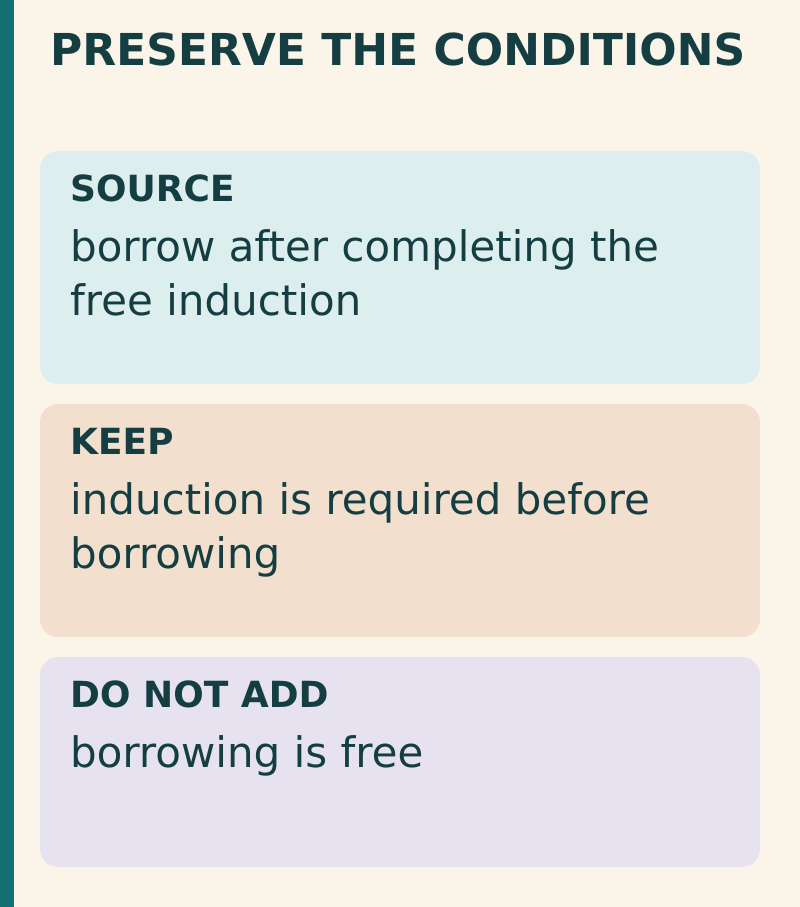
“Residents can borrow tools for free” is not a faithful version of the induction sentence. It drops the required induction and moves free onto borrowing. Likewise, “Friday sessions begin on 14 June” turns one planned session into a recurring series and removes the volunteer condition. A faithful version is “One Friday session is planned for 14 June if enough volunteers are available.” Singular and plural are factual choices, not cosmetic details.
Audit both directions
First move from summary to source: for every claim in your summary, find the exact source phrase that supports it. If your summary says “all residents,” “every Friday” or “free equipment,” ask whether those claims really appear. A fluent sentence can contain an invented fact.
Then move from source to summary: check whether every essential condition survived. A summary may contain only true statements and still mislead through omission. “The desk opens on Wednesday” is true but may be inadequate if a newcomer needs the four-to-six time window. The two-way audit checks both unsupported additions and harmful losses. It is more reliable than merely rereading your summary and deciding that it sounds reasonable.
Eight checks and a summary checklist
Miniature model: “Residents can borrow tools after a free induction. The desk opens Wednesdays, 4–6. Return tools to a volunteer within seven days; do not leave them outside. One Friday session is planned for 14 June if enough volunteers are available.”
The model retains the borrowing condition, current hours, return method and deadline, plus the conditional future plan. It omits photographs because they do not affect borrowing. For a return-only reminder, a shorter model is appropriate: “Return borrowed tools to a volunteer at the desk within seven days. The desk opens on Wednesdays from four to six. Do not leave tools outside.” The purpose changes selection; it never authorises changing the facts.
Check your understanding
Choose the best answer for the stated purpose. In short answers, type only the requested words. For open rewrites, compare meaning as well as form: other well-formed answers may be possible. Each submitted answer reveals an explanation.
Answer on paper, then open the explanations below. Enable JavaScript to check answers here.
Your final check
Read the complete sentence or source again. Check the actor, action, time, quantities, conditions and intended meaning. Explain why your version works rather than memorising its surface form. Revisit any question whose explanation differs from your reasoning.
Related Guides






Continue learning this topic
Review an explanation, study examples or try a related practice test.
- Practice test Air Canada Rebooking Left a Delayed Traveler Without a Return Flight — C2 English Listening Practice Test
- Practice test Air Canada Rebooking Left a Delayed Traveler Without a Return Flight — C2 English Grammar Practice Test
- Practice test Air Canada Rebooking Left a Delayed Traveler Without a Return Flight — C2 English Vocabulary Practice Test