
Guide
A2 · Elementary
Reading
Recycling Vocabulary in English: Read Labels and Sorting Notices
Learn material words, only and except, then use exact notice wording to classify items in an explicitly fictional recycling scheme.
8 min read
1,321 words
Updated Oct 15, 2026
On this page (7 sections)
A2 • 15 minutes • 8 scored checks. Learn material words, only and except, then use exact notice wording to classify items in an explicitly fictional recycling scheme.
Read the local scheme first
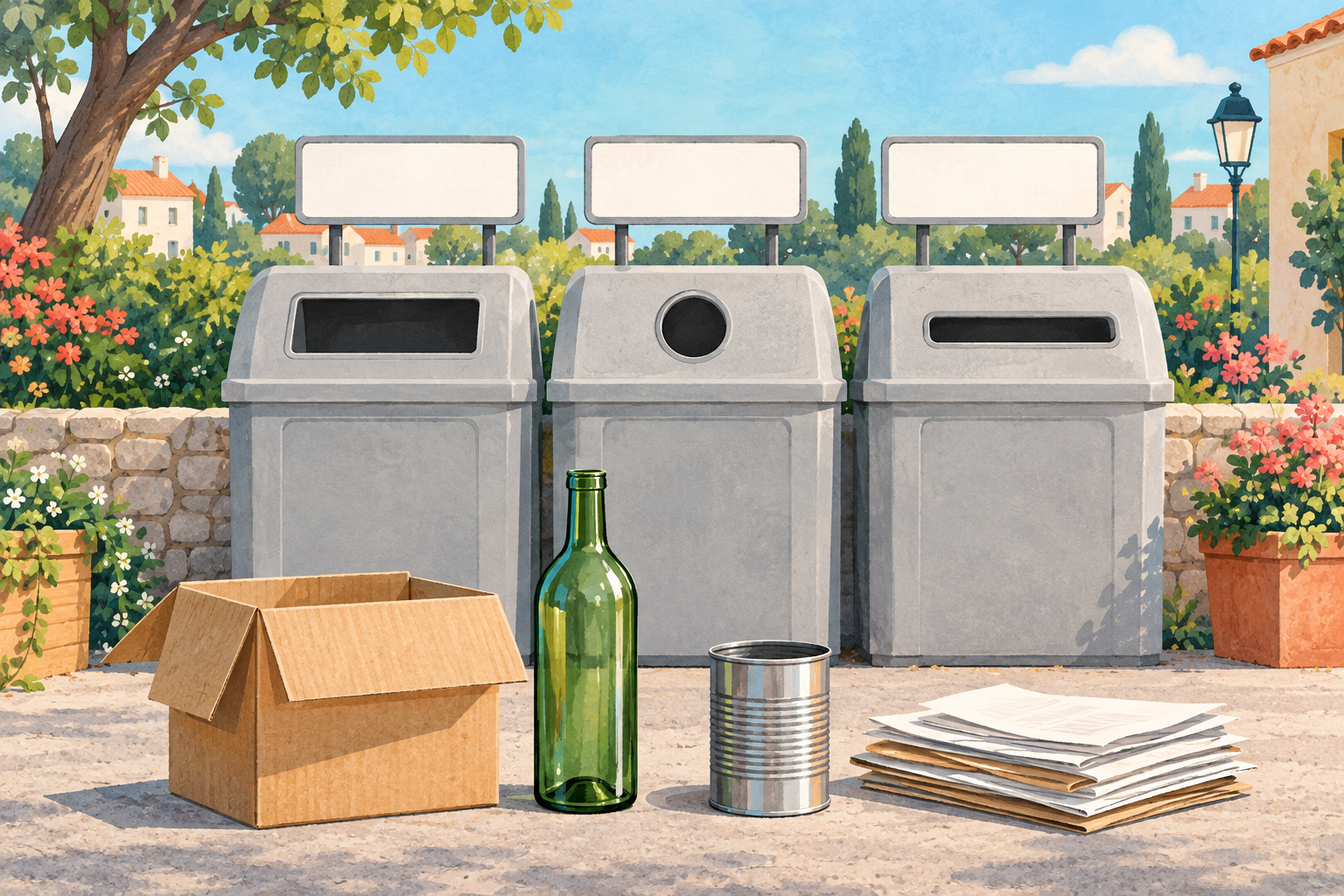
Oak Court is an invented collection point. Use its notices for this reading task. For real disposal decisions, consult current local instructions; local acceptance rules can differ.
Start with the notice, not the colour of a bin or a familiar symbol. Read the whole instruction, including short words such as only and no. A picture of a bottle may help you find the subject, but the exact wording gives the rule. In this guide, a question about Oak Court means only the invented rules printed below.
Notice | Exact wording |
|---|---|
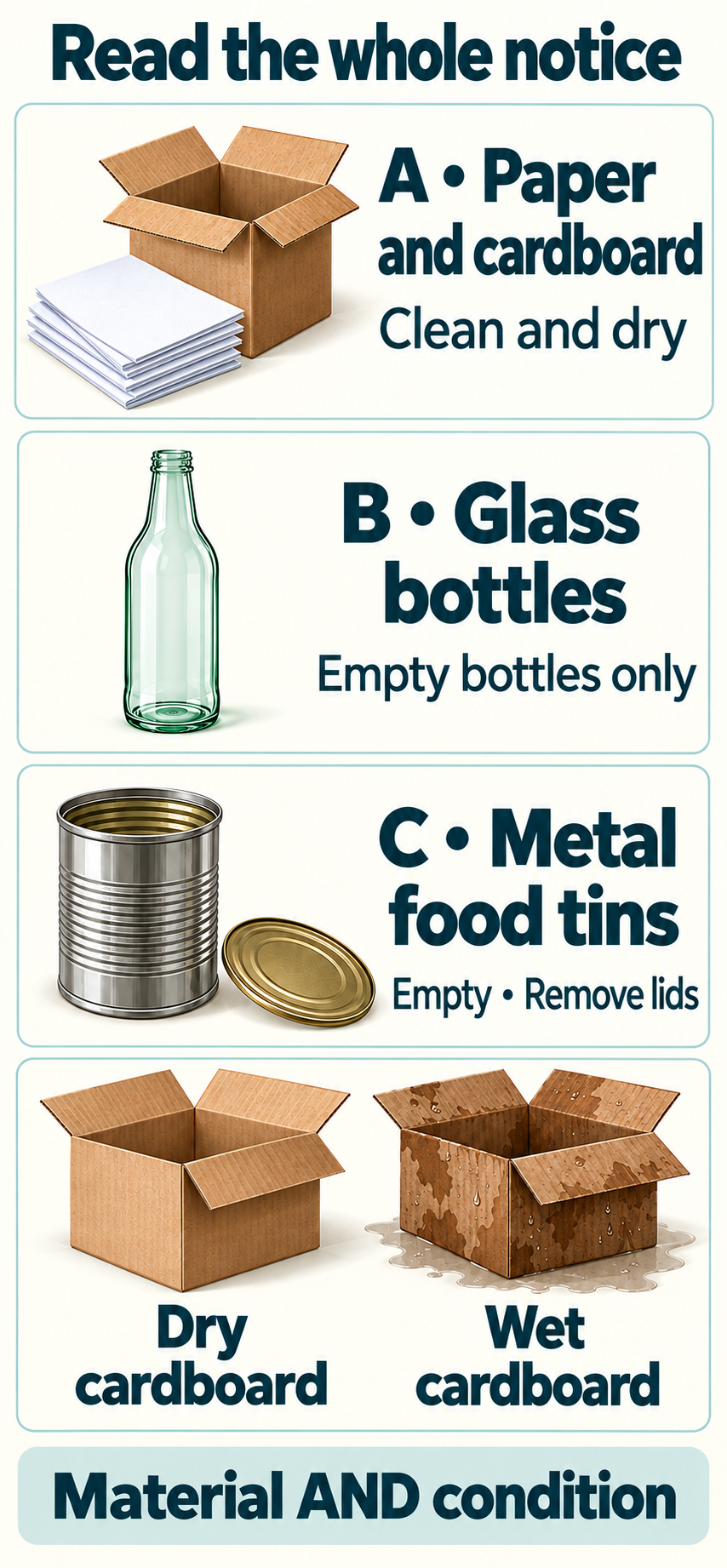
A • Paper | Clean, dry paper and cardboard. No wet items. |
B • Glass | Empty glass bottles only. No jars or drinking glasses. |
C • Metal | Empty metal food tins. Remove lids. |
Materials and item words
A material is what something is made of. Paper is used for newspapers and letters. Cardboard is thicker and is often used for boxes. Glass can be used for bottles and jars. Metal can be used for food tins. Plastic can be used for bottles, trays and wrappers. Compare a paper letter with a thicker cardboard packing box.
An item word tells you the object's form or use. A bottle has a narrow opening. A carton is a light box-like container, often used for drinks or food. A container holds something. Packaging is the material around a product. A carton can contain more than one material, so do not replace the item description with a guess about its contents. Read any description supplied.
To see how material names and item names work in English, review material nouns and counting units.
Sorting and collection vocabulary
A bin is a container for items people throw away or collect. Collection can mean the act or time of taking those items away: collection is on Thursday. Recycling refers to processing materials for further use. General waste names a separate waste category in many notices; it does not mean that this guide knows where every rejected item belongs.
Reusable means designed or suitable for use again. Single-use means intended for one use. Neither word tells you whether Oak Court accepts an item. A reusable glass drinking cup is still not a bottle. A recycling symbol may describe a material or a general possibility, but it does not prove acceptance in a particular local scheme. Look for the written local rule.
Words that change the instruction
Only narrows a group: bottles only excludes other shapes. Except removes a named part of a group: paper except wet paper excludes the wet items. Not accepted means the scheme does not take the item. No jars is a short way of excluding jars. Read the noun after no carefully; no jars is different from no glass.
Empty describes condition: nothing should remain inside. Clean means free from dirt. Separate means keep apart. For example, “Keep paper separate from plastic covers” tells you not to mix those two things. Oak Court C says “Remove lids”: take the lids off the tins. This notice does not name a place for the lids.
Follow a notice-to-item checklist
Use three questions. First, what material does the item description give? Next, is the exact item type included? Finally, does its condition meet the notice? A clean, dry cardboard box matches A: cardboard is listed and the condition is correct. A wet box fails the last check because A says no wet items.
Now try an empty drinking glass. Its material is glass, but B says bottles only and explicitly excludes drinking glasses. The material match is not enough. For a plastic tray, the three notices give no relevant rule. Say not enough information and seek the missing text. That answer is more accurate than guessing that an unlisted item belongs in general waste.
Common reading traps
Watch for a broad word hiding a narrow instruction. Glass bottles does not mean everything made of glass. Empty does not mean new. Clean does not mean dry unless the notice includes both conditions. A wet, clean sheet of paper still fails Oak Court A because the notice requires clean, dry paper.
Practise a short reason: “The jar is glass, but B says no jars.” The word but helps you show why a material match is not enough. Quote the phrase that decides your answer, then connect it to the item. For an unknown case, say which item the notices do not mention.
Eight checks and a local-text reminder
Complete eight checks. For the first three, match vocabulary to meanings. For the next three, read a miniature notice. For the final two, use Oak Court's exact wording. Select or enter an answer before checking the feedback; each explanation points to the rule or definition used.
After review, try this checklist with a new notice: name the material, check the item type, check the condition and look for an exception. Ask for missing information when needed. Use current local instructions for real items.
Answer on paper, then open the explanations below. Enable JavaScript to check answers here.
Your turn · self-review
Your transfer task
Write your own response first, then open the model and compare. Check: correct material; exact exclusion; no invented real-world instruction.
Practice only. Your writing stays on this page; it is not submitted or saved.
-
Model answer and explanation
The box is made of cardboard, but it is wet. Oak Court A says “No wet items,” so the box does not meet this fictional scheme’s condition.
Related Guides




Continue learning this topic
Review an explanation, study examples or try a related practice test.
- Practice test UNLV Introduces a Minor in Teaching Mariachi as Demand for Instructors Grows — C2 English Reading Practice Test
- Practice test What Time Is It on the Moon? Scientists Consider How Lunar Clocks Could Work — C1 English Reading Practice Test
- Practice test Kalkan Keeps a Taste of Summer as Autumn Arrives — B2 English Reading Practice Test