
Guide
A2 · Elementary
Reading
Read Building Directories in English: Floors, Rooms and Facilities
Learn to separate floor labels, room numbers and facility names, then apply a temporary notice to a fictional building directory.
7 min read
1,220 words
Updated Oct 17, 2026

On this page (7 sections)
A2 • 15 minutes • 8 scored checks. Learn to separate floor labels, room numbers and facility names, then apply a temporary notice to a fictional building directory.
How a directory organises information
A building directory is a list that helps you find places. It usually connects a floor, a room and a facility or activity. It is different from a timetable, which mainly tells you when things happen. A room number such as 104 is not a starting time. Read the headings before you read the entries.
This guide uses the fictional Cedar House directory below. Start with the Facility column when you know what you need. Then read across the same row to find the floor and room. Do not move to a neighbouring row halfway through: that can join the correct activity to the wrong room.
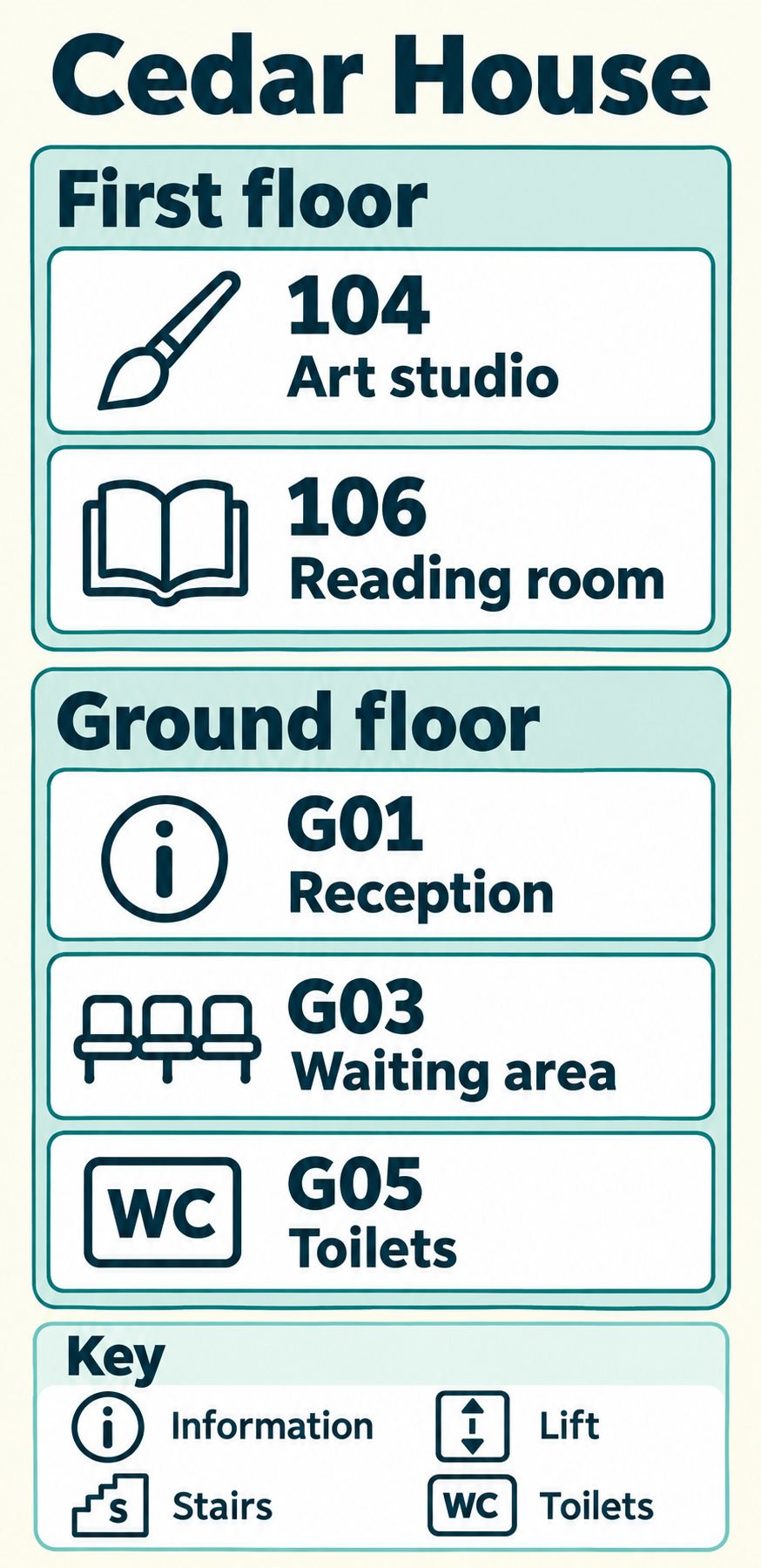
Floor | Room | Facility or service |
|---|---|---|
Ground floor | G01 | Reception: visitor questions and registration |
Ground floor | G03 | Waiting area: seats before appointments |
Ground floor | G05 | Toilets |
First floor | 104 | Art studio: painting class |
First floor | 106 | Reading room: quiet reading |
Common facilities and service points
Reception is the point where visitors can ask questions or register when the directory says so. An information desk offers information; a building may use either label or have separate desks. A waiting area has a place to sit before an appointment. An entrance is a way in, and an exit is a way out. These labels name places rather than appointment times.
A lift carries people between floors; elevator is a common alternative word, especially in American English. Stairs connect floors through steps. Toilets and restrooms are common regional alternatives. Learn the words, but still read the specific building's key. A label alone does not establish opening hours, available assistance or access conditions.
Floor labels and room numbers
Cedar House uses a British-style convention: the ground floor is the entrance level, and the first floor is one level above it. A basement is below the ground floor, although this directory does not list any basement services. In other buildings, first floor can name the entrance level. Never transfer one convention to every building.
Here, G starts a ground-floor room number. Three-digit numbers beginning with 1 are first-floor rooms. This is a stated Cedar House pattern, not a general law. Room 104 therefore combines a room identifier with the separately written floor label. If a number is unclear, ask which floor it is on rather than guessing from the digits.
Use a map key
A map key explains small symbols or letters. It may show i for information, L for the lift and S for stairs. The key is part of the source text, so use its definitions. A letter on a floor plan is not automatically a room number, and the same letter can mean something else in another plan.
Cedar House's simple plan has reception G01 and waiting area G03 on the ground floor. The art studio 104 and reading room 106 are on the first floor. L and S connect the two levels. This text description contains the same essential information as the visual; you do not have to read small picture labels to complete the checks.
Key label | Meaning here |
|---|---|
i | Information at reception |
L | Lift, called an elevator in some directories |
S | Stairs |
WC | Toilets, also called restrooms |
Match a need to a facility
A visitor says, 'I want to register for a class.' The reception row explicitly lists registration, so G01 on the ground floor matches that need. A visitor who is waiting for an appointment needs the waiting area, G03. A visitor attending the ordinary painting class follows the art-studio row to first-floor Room 104.
Use the stated purpose, not the person’s appearance or the size of a room. A quiet-reading request matches the reading room because the entry says quiet reading. The directory does not give a booking policy or prove that every room is available now. Those questions need extra information.
Check temporary notices
Temporary notices can change a normal entry. Cedar House notice: Today only: the painting class has moved to Room 106. The waiting area in G03 is closed today. Other listed services continue. Read the time limit today only as carefully as the new room number.
For today's painting class, use 106. This does not permanently rename Room 104, and it does not move reception. Closed today applies to G03's waiting area, not to all of Cedar House. Check exactly what noun the notice describes. For a real visit, check the building’s current information.
Eight checks and a three-step search
Complete eight checks using the directory, key and temporary notice. The first three check facility words; the next three separate floor, room and service; the final two apply today's updates. Submit an answer before reading its explanation.
Keep a three-step search routine: identify the need, find the matching directory entry, then check current notices. Write a complete result such as first-floor Room 106, not just 106, when the reader needs both pieces of information. If the directory lacks the service or a notice is unclear, state that you need more information.
Answer on paper, then open the explanations below. Enable JavaScript to check answers here.
Your turn · self-review
Your transfer task
Write your own response first, then open the model and compare. Check: current room, correct floor, limited time scope; no invented route or opening time.
Practice only. Your writing stays on this page; it is not submitted or saved.
-
Model answer and explanation
Today’s painting class is in first-floor Room 106 because the temporary notice moves it there for today only.
Related Guides





Continue learning this topic
Review an explanation, study examples or try a related practice test.
- Practice test UNLV Introduces a Minor in Teaching Mariachi as Demand for Instructors Grows — C2 English Reading Practice Test
- Practice test What Time Is It on the Moon? Scientists Consider How Lunar Clocks Could Work — C1 English Reading Practice Test
- Practice test Kalkan Keeps a Taste of Summer as Autumn Arrives — B2 English Reading Practice Test