
Guide
A1 · Beginner
Grammar
Subject, Object and Possessive Pronouns
Choose I or me, my or mine, and clear pronoun references. Includes a visual reference, six explained checks and a practical self-check.
6 min read
903 words
Updated Nov 2, 2026
On this page (8 sections)
One person, different words
Mia has a bag. She likes it. Ben helps her. The bag is hers. These short words stop us repeating names and nouns. Their form depends on their job in the sentence. Learn the job first, then choose the word. By the end, you can identify a subject, choose an object after a verb or preposition, and show who owns something.
1. The subject: who does the action?
A subject normally comes before the verb in a simple statement. Use I, you, he, she, it, we or they. I carry a bag. She knows Ben. We work here. They are friends. Use I with a capital letter, even in the middle of a sentence: Ben and I work here.
A subject can be a person or a thing. The book is new. It is interesting. Here, it means the book. Before using a pronoun, make sure the reader knows the person or thing. Start with a name or clear noun when necessary.
2. The object: who or what receives the action?
An object often follows a verb. Use me, you, him, her, it, us or them: Please call me. I know him. The teacher helps us. We need them. The subject and object can be different people: She helps him means a woman helps a man.
Use the same object forms after simple prepositions: with me, for her, to him, near us. Say Come with us, not Come with we. In Please help me, the person doing the action is the listener. Me is the person receiving the help.
3. A useful reference strip
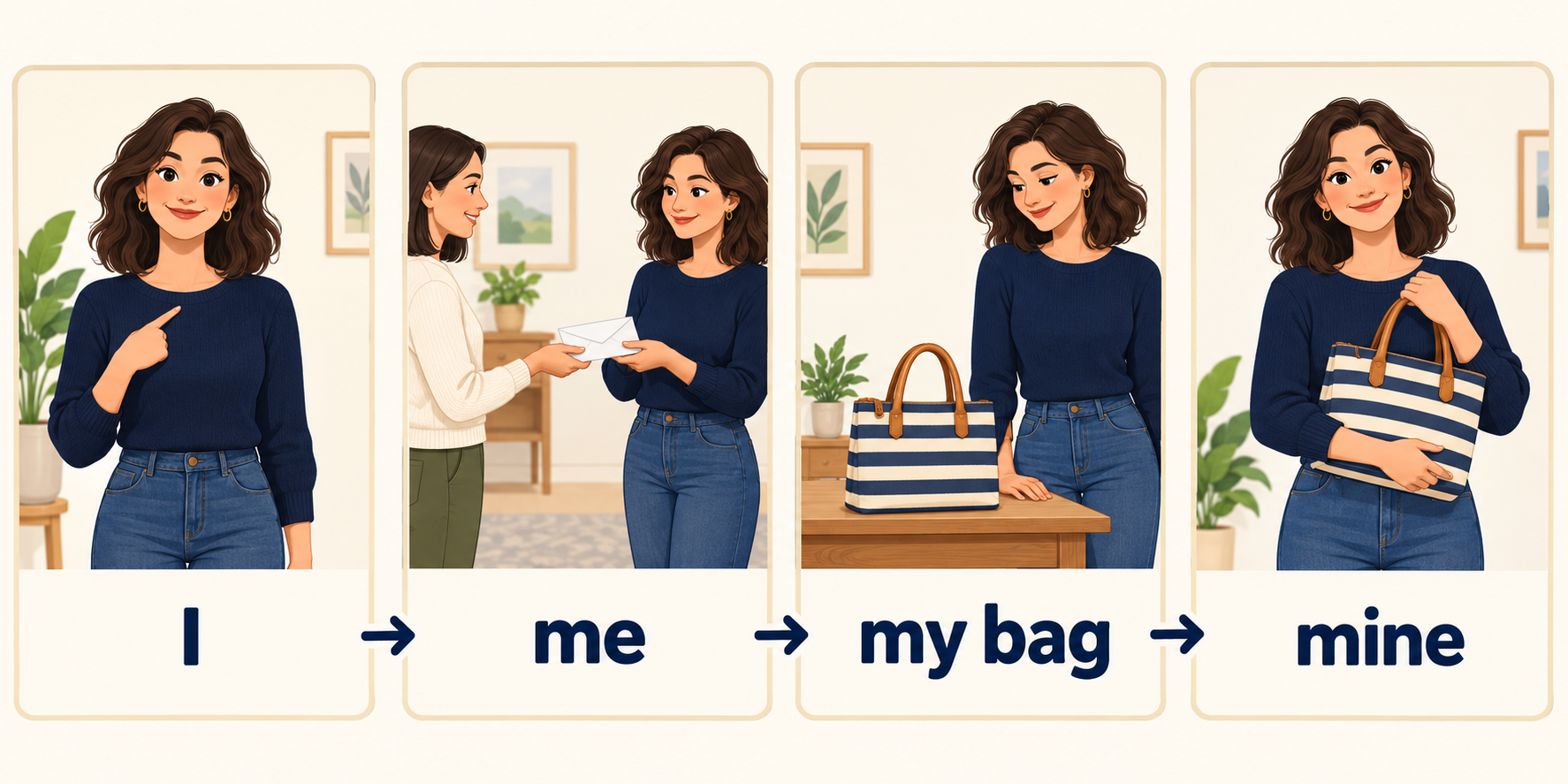
Read each line in this order: subject → object → ownership word before a noun → ownership word alone.
I → me → my bag → mine. You → you → your bag → yours. He → him → his bag → his. She → her → her bag → hers. We → us → our bags → ours. They → them → their bags → theirs.
For things, use it as subject and object: It is a box. Open it. Its shows ownership before a noun: The box has a lid. Its lid is open. We do not normally use its alone as a possessive pronoun.
4. My bag or mine?
My, your, his, her, its, our and their need a noun after them: my phone, her coat, our tickets. These words are possessive determiners. Mine, yours, his, hers, ours and theirs replace the whole ownership phrase. They stand without the noun: This phone is mine. Those tickets are ours.
Compare the job
her
Object after a verb
Please help her.
her bag
Possessive determiner before a noun
This is her bag.
hers
Possessive pronoun without a noun
This bag is hers.
His has the same form in both places: That is his umbrella. That umbrella is his. The form depends on the owner, not the number of objects: This bag is mine. These bags are mine. A plural bag noun does not change mine to another form.
5. Keep the meaning clear
Whose asks about ownership: Whose bag is this? It is mine. Who asks about a person: Who is that? It is Mia. If two people could match a pronoun, use a name again. Mia speaks to Anna about Mia's bag is clearer than Mia speaks to Anna about her bag.
Quick check: six questions
Choose an answer or complete the exact short correction. Read the explanation after checking.
Answer on paper, then open the explanations below. Enable JavaScript to check answers here.
Use it in everyday life
Point to three things and say who owns each one. First use a noun phrase: This is my notebook. Then replace the phrase: It is mine. Change the owner and try her notebook / hers, his notebook / his, and our notebook / ours. For each sentence, ask: Is the word a subject, an object, before a noun, or alone?
Related Guides


Continue learning this topic
Review an explanation, study examples or try a related practice test.
- Practice test Places Around Town Words — A1 English Vocabulary Practice Test
- Practice test Clothes and Weather Words — A1 English Vocabulary Practice Test
- Practice test Finding the Library on Green Street — A1 English Listening Practice Test
- Course lesson Subject pronouns and possessives: I and my – A1–A2: Grammar Foundations
- Course lesson Participle clauses: Clear subjects and time relationships – C1: Precision and Expression
- Course lesson Possessives: Anna's, my, mine and whose – A1–A2: Grammar Foundations