
Guide
B2 · Upper-intermediate
Grammar
Cohesive Paragraphs: Reference, Substitution and Linking Ideas
Build clear B2 paragraphs with reliable reference, useful substitution and logical connectors. Practise editing and compare explained models.
8 min read
1,352 words
Updated Nov 5, 2026

On this page (7 sections)
Give the reader a clear route
A cohesive paragraph helps the reader see how each sentence connects to the next. Coherence is the broader sense that the ideas make sense together. Cohesive devices such as pronouns and connectors support coherence, but they cannot turn unrelated ideas into a convincing explanation. Begin by choosing the paragraph’s main point. Then include information that develops that point in an order your reader can follow.
For example, a paragraph about a new bicycle store needs a clear purpose. Is it explaining the location, comparing services or reporting a problem? If it explains a repair service, details about opening hours and booking may belong together. A long description of the owner’s unrelated holiday probably does not. Before adding linking words, remove distractions and decide what each sentence contributes.
Make reference easy to follow
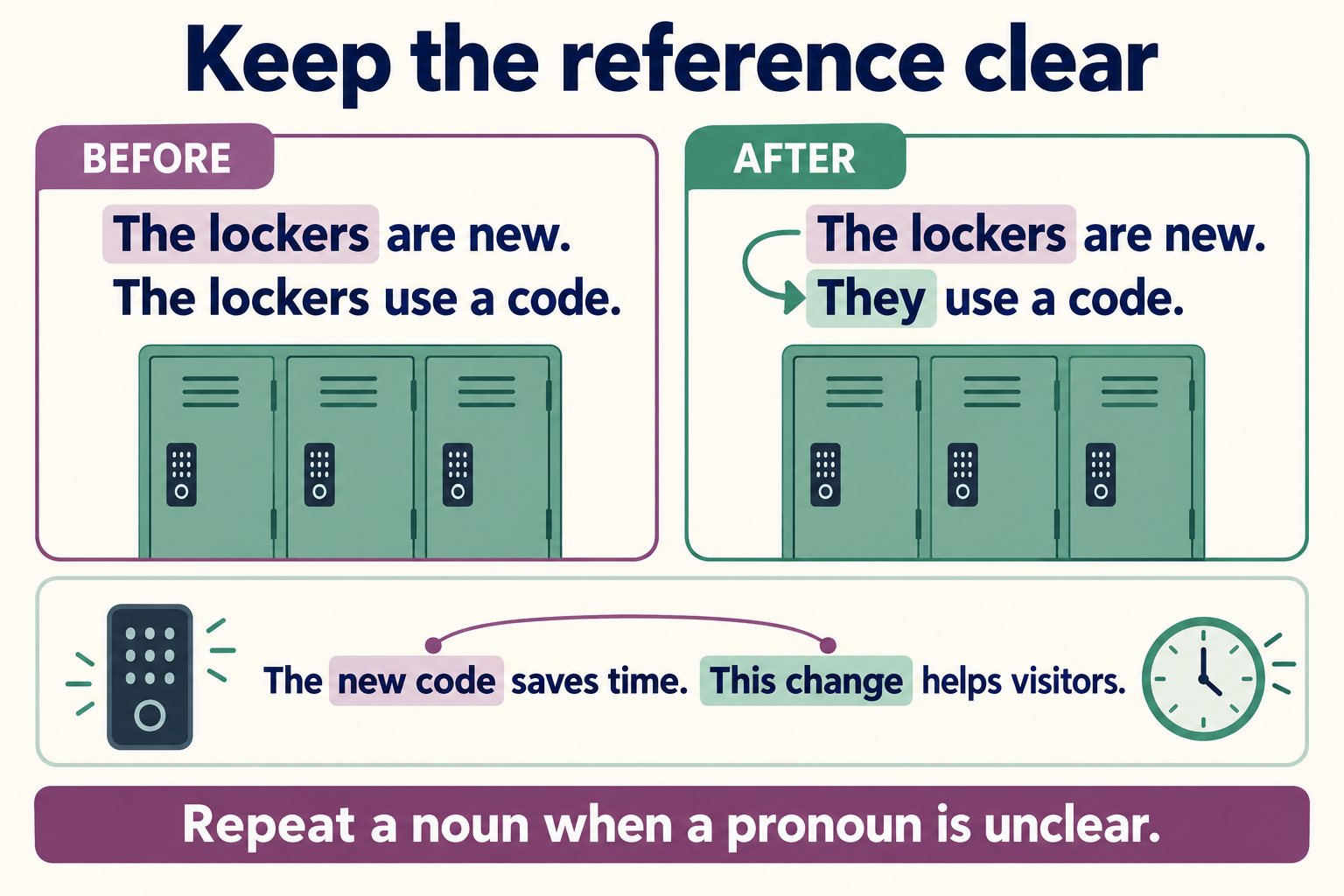
Reference words point to something already mentioned or understood. In ‘The centre has new lockers. They open with a code’, they clearly means the lockers. But in ‘Nora spoke to Leila after she finished the poster’, she could refer to either person. A grammatical sentence can still be unclear. Repeat the name when the distinction matters: ‘After Nora finished the poster, she spoke to Leila.’
This, that, these and those can refer to objects or ideas. In ‘The bus now runs every ten minutes. This change has reduced waiting times’, this change names the relationship explicitly. A bare ‘This is useful’ may be understandable, but a supporting noun such as change, problem, result or approach often makes the reference more precise. Choose the noun that reflects what the earlier sentence actually says.
Do not ask a pronoun to reach across several competing nouns. In ‘The boxes were beside the shelves near the windows. They were damaged’, the reader needs to know what was damaged. ‘The boxes were damaged’ is better than elegant-looking uncertainty. Repeating a key noun is a tool for clarity, not automatically a style error.
Reduce repetition without losing meaning
One and ones can replace a countable noun when the reference is clear: ‘The large noticeboard is full, but the smaller one has space.’ One means noticeboard. Use ones for a plural: ‘These labels are faded; use the new ones.’ They do not normally replace an uncountable noun in the same way. For ‘We need fresh information’, do not write ‘We need a fresh one’ unless a different countable object is intended.
Do so can replace a previously stated action, especially in more formal writing: ‘Residents may register online. Those who do so will receive an email.’ Here do so means register online. It is useful only when the action remains obvious. In a simple conversational message, ‘those who register’ or ‘people who sign up’ may sound more natural. Choose an expression that fits the reader rather than using substitution just to avoid every repeated word.
Choose a connector for the real relationship
Addition, contrast, cause and result are different relationships. ‘The room is small. However, it receives plenty of daylight’ contrasts a limitation with an advantage. ‘The room receives daylight, so we rarely use the lamps’ presents a result. Because introduces a reason: ‘We moved the meeting because the room was unavailable.’ A connector should make the logic more visible, not create a relationship the facts do not support.
Do not add however just because two sentences contain different information. ‘The room has six tables. However, it has a cupboard’ gives no obvious contrast. Either use also or explain why the cupboard changes the situation. Similarly, therefore can overstate causation. Two things happening together does not show that one caused the other. If the link is only temporal, use a time expression such as later or during the same period.
Keep punctuation and information flow clear
Because and although can join a dependent clause to a main clause: ‘Although the hall is small, it works well for short classes.’ A full stop or semicolon can separate independent clauses when using however: ‘The hall is small. However, it works well for short classes.’ A comma alone between two full sentences is usually unsuitable in this style: avoid ‘The hall is small, however, it works well.’
Move from familiar information to new information when that helps the reader. ‘A new shelf has been installed. The shelf holds equipment that was previously kept on the floor’ establishes shelf before adding its purpose. You can then use it if no other singular object competes. Variety is useful, but clarity is the priority. Your paragraph does not need a different connector at the start of every sentence.
Edit in three passes
First, write a one-sentence summary of the paragraph’s main point and check that every sentence serves it. Second, circle each pronoun and substitution and name what it refers to. If two answers are possible, rewrite. Third, label each connector’s relationship and check its punctuation. Read the paragraph aloud for flow, but verify the references in writing too; your own voice may hide an ambiguity that another reader will notice.
Check your understanding
Try each item before opening the answer. Read the explanation even when your answer is correct.
Answer on paper, then open the explanations below. Enable JavaScript to check answers here.
Your turn · self-review
Apply it and compare
Write or say your own answer first. The models are examples, not the only acceptable answers. Use the checklist to review your work; open responses are not automatically assessed.
Practice only. Your writing stays on this page; it is not submitted or saved.
-
Model answer and explanation
“After Ava checked the report, she gave it to Mei. Mei found the report helpful.” Repeating report and Mei removes the two unclear references. Other versions work if they preserve who checked it and who found it helpful.
-
Model answer and explanation
“The centre has installed a larger noticeboard near the entrance. This addition gives local groups more space to advertise their events. The old board is still available, but it now carries permanent information such as opening hours. As a result, visitors can find urgent announcements without searching through older notices.” Self-check: one main topic; clear this addition and it; a justified result; punctuation between complete sentences.
Related Guides






Continue learning this topic
Review an explanation, study examples or try a related practice test.
- Practice test At the University of Maryland, a historic campus farm remains a classroom — C2 English Listening Practice Test
- Practice test At the University of Maryland, a historic campus farm remains a classroom — C2 English Grammar Practice Test
- Practice test At the University of Maryland, a historic campus farm remains a classroom — C2 English Vocabulary Practice Test
- Course lesson Ellipsis and substitution: Avoiding repetition – C1: Precision and Expression
- Course lesson Linking ideas: Because, so, when and if – A1–A2: Grammar Foundations