
Guide
A2 · Elementary
Grammar
Too and Enough: Describing Limits and What You Need
Learn too and enough with adjectives, adverbs and nouns. Explain limits, compare very with too and practise six checks with answers and explanations.
6 min read
1,014 words
Updated Nov 6, 2026

On this page (9 sections)
Describe a problem or a suitable amount
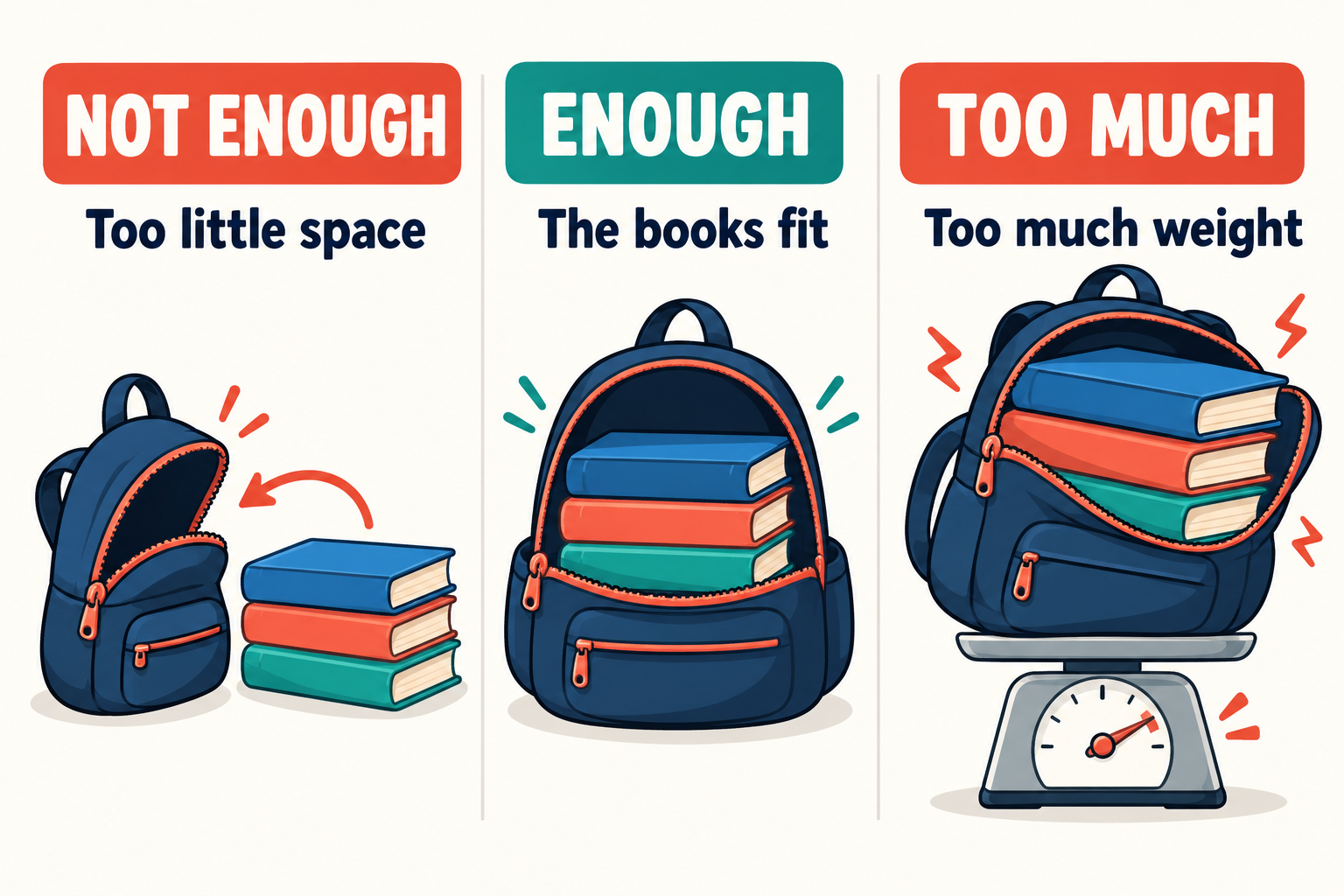
When choosing a bag, finding a room or planning your time, you often compare what you have with what you need. Too says something is beyond a suitable limit. Enough says the needed amount or quality is present. Not enough says it is missing. The limit comes from the situation, so explain it when possible.
Too comes before an adjective or adverb
Use too + adjective: The case is too heavy. This means the weight causes a problem for the purpose in mind. Use too + adverb: You are speaking too quickly for me to follow. Quickly describes how someone speaks.
Too does not simply mean very. “The tea is very hot” gives a strong description. “The tea is too hot to drink” says its heat prevents the action now. Very can describe something good: The view is very beautiful. Using too often suggests a problem, so do not choose it just to make praise stronger.
Enough follows an adjective or adverb
Use adjective + enough: The room is warm enough. The bag is light enough to carry. Put enough after the adjective, not before it. With an adverb, use the same order: Please speak slowly enough for everyone to understand.
Enough means sufficient for a particular need. A small room can be big enough for two people but not big enough for ten. Include for + person or thing when it helps make the requirement clear.
Enough comes before a noun
Use enough + noun: enough chairs, enough water, enough time. It works with plural countable nouns and uncountable nouns. We have enough chairs for six visitors. We don’t have enough water for the walk. Do not add an unnecessary a before an uncountable noun: enough time, not “enough a time”.
Not enough: below the needed limit
With an adjective: The box is not strong enough. With a noun: There are not enough boxes. These sentences identify different problems: weak material versus a small number. Choose the form that describes your real meaning.
The bag is too small and The bag is not big enough can describe the same size problem. Change to the opposite adjective when rewriting. Do not automatically replace too with not enough while keeping the same adjective: too heavy is not the same as not heavy enough.
Add the action or result with to
too + adjective + to + base verb: This bag is too heavy to lift.
adjective + enough + to + base verb: The ladder is tall enough to reach the shelf.
enough + noun + to + base verb: We have enough money to buy the tickets.
Use for + person before to when needed: The print is too small for me to read.
In “The box is too heavy to carry”, box is understood as the thing we carry. Do not repeat it as “too heavy to carry it”. An everyday exception to a simple threshold is context: “too good to miss” encourages you to take an opportunity, so always read the whole phrase.
Six quick checks
Choose or type the requested answer, then read the explanation.
Answer on paper, then open the explanations below. Enable JavaScript to check answers here.
Explain a real choice
Your turn · self-review
Make the limit clear
Write two sentences about a bag or room, then compare this model.
Practice only. Your writing stays on this page; it is not submitted or saved.
-
Model answer and explanation
It is light enough for me to carry. It has enough space for my books.
Self-check
I used too for a limit or problem, not simply as another word for very.
I put enough after adjectives and before nouns.
My rewrite keeps the original meaning.
I gave the relevant purpose, number or limit.
Related Guides






Continue learning this topic
Review an explanation, study examples or try a related practice test.
- Practice test New Mexico’s Alien Throne Rock Formation Collapses After Heavy Rain — B2 English Listening Practice Test
- Practice test New Mexico’s Alien Throne Rock Formation Collapses After Heavy Rain — B2 English Grammar Practice Test
- Practice test New Mexico’s Alien Throne Rock Formation Collapses After Heavy Rain — B2 English Vocabulary Practice Test
- Course lesson Past perfect: What had happened before? – B1–B2: Grammar in Context
- Course lesson Present continuous: What's happening now? – A1–A2: Grammar Foundations
- Course lesson Cleft sentences: It was…that and what…is – C1: Precision and Expression