
Guide
A2 · Elementary
Grammar
Past Simple: Regular and Irregular Verbs
Learn past simple forms, did and was/were, spelling rules and three -ed sounds, with recorded examples and six explained checks.
7 min read
1,166 words
Updated Nov 3, 2026

On this page (10 sections)
Tell a finished story
Use the past simple to put an event in a finished past time. Yesterday I cleaned the kitchen. Last Saturday we went to the market. The action can be short or long: I dropped my key; I worked there for five years. What matters is the finished past situation, not how many minutes the action took. A time expression can appear once and give the context for several sentences. We visited my aunt on Sunday. She cooked lunch. We talked for hours. You do not have to repeat on Sunday in every sentence. This guide helps you build the story one event at a time.
Build affirmative sentences
For most verbs, use the same past form with every subject: I worked, she worked, they worked. Add -ed to many regular verbs: clean → cleaned; help → helped. If a verb already ends in -e, add -d: live → lived. With a consonant before final -y, change y to i and add -ed: study → studied. Keep y after a vowel: play → played. Some short verbs double the final consonant: stop → stopped; plan → planned. This often happens with a stressed final consonant-vowel-consonant pattern. Do not double w, x or y. When unsure about spelling, check a learner dictionary rather than adding another letter automatically.
Learn useful irregular forms
Irregular verbs do not follow one -ed rule. Learn a small useful set in meaningful sentences: go → went; have → had; do → did; make → made; see → saw; take → took; get → got; buy → bought. Yesterday I went to a shop and bought bread. I saw a neighbour and took a photo of her dog. Keep the base form beside the past form in your notes. Read has the same spelling in the base and past forms but different pronunciation: the past form sounds like red. A verb being common does not mean it is regular. Practise recalling forms, not only recognising them.
Use did for questions and negatives
Most past-simple questions use did + subject + base verb: Did you call? Where did she go? Most negatives use subject + did not or didn’t + base verb: We didn’t buy milk. Did carries the past meaning, so the main verb returns to its base form. Did she went? is incorrect; write Did she go? I didn’t watched is incorrect; write I didn’t watch. Short answers repeat did: Yes, I did. No, she didn’t. A subject question such as Who called? is a different pattern: who is the subject, so ordinary affirmative subject questions do not need did.
Keep was and were separate
The past of be has its own pattern: I/he/she/it was; you/we/they were. Make a negative by adding not: She wasn’t late. They weren’t tired. Make a question by moving was or were before the subject: Was he at home? Where were you? Do not add did: Did you be busy? is incorrect for an ordinary past state; use Were you busy? Compare a state with an action: We were tired, but we finished the work. In short answers say Yes, I was or No, we weren’t. Check both the verb and the subject before choosing was or were.
Hear the three -ed endings
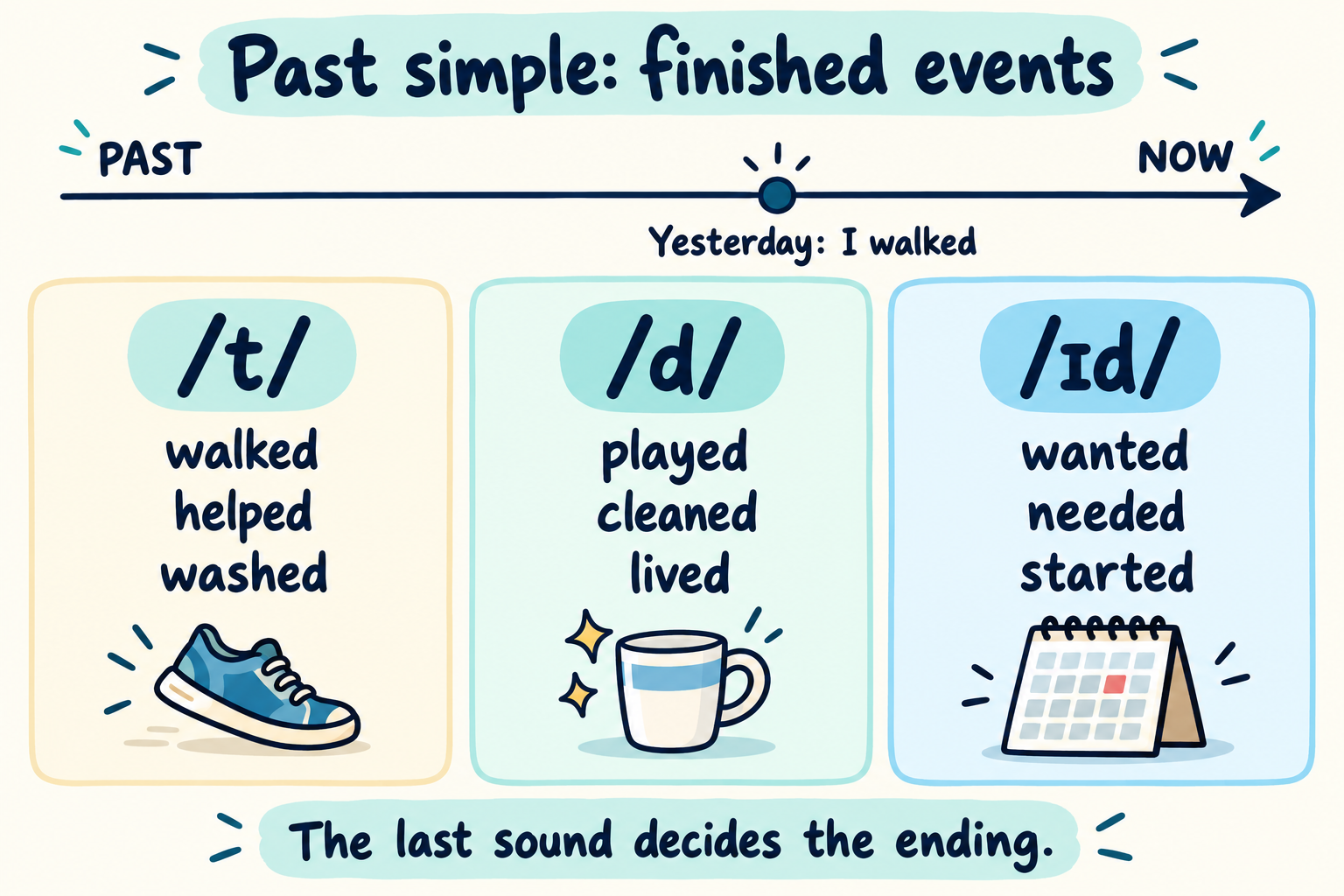
The ending depends on the last sound of the base verb, not just its last written letter. After an unvoiced sound other than /t/, the ending is /t/: walked, helped, washed. After a voiced sound other than /d/, it is /d/: played, cleaned, lived. After /t/ or /d/, it is /ɪd/ and adds a syllable: wanted, needed, started. Put a hand lightly on your throat to notice voicing in sounds such as /v/; compare /f/. Do not insert an extra syllable into every past verb. Walked is one syllable; wanted is two. Listen to the recording, pause, repeat, and group the nine words by sound.
Listen and learn
Three -ed sounds: nine examples
Open audio separatelyRead the transcript
Teacher: Walked
Teacher: Helped
Teacher: Washed
Teacher: Played
Teacher: Cleaned
Teacher: Lived
Teacher: Wanted
Teacher: Needed
Teacher: Started
Read the visual and transfer the pattern
The timeline places a finished event before now. Its sound chart repeats all nine recorded examples in three groups. These are also written above so the picture is never your only source of the rule. To write a short account, first decide the finished time. List the events, choose past forms, and connect them with first, then and finally. Read once for meaning and again for verb form. Check that verbs after didn’t and did are base forms and that be uses was or were. Try the six checks below before opening the explanations.
Quick check
Choose an answer, then check the explanation. If you prefer, note your answers before revealing the key.
Answer on paper, then open the explanations below. Enable JavaScript to check answers here.
Answer key and explanations
1. bought — Bought is the irregular past of buy. Yesterday gives a finished past time.
2. studied — Study ends in consonant + y, so change y to i and add -ed: studied.
3. Did they go home? — Use did + subject + base verb: Did they go home?
4. He didn’t watch the film. — Didn’t carries the past meaning; watch stays in the base form.
5. washed — Washed ends in /t/ because wash ends in the unvoiced /ʃ/ sound.
6. wanted and needed — Wanted and needed end in /ɪd/ because their base verbs end in /t/ and /d/.
Related learning
Related Guides






Continue learning this topic
Review an explanation, study examples or try a related practice test.
- Practice test How Hydroxyapatite Toothpaste Compares With Fluoride for Oral Health — C1 English Listening Practice Test
- Practice test How Hydroxyapatite Toothpaste Compares With Fluoride for Oral Health — C1 English Grammar Practice Test
- Practice test How Hydroxyapatite Toothpaste Compares With Fluoride for Oral Health — C1 English Vocabulary Practice Test
- Course lesson Present perfect or past simple: Choosing the right tense – B1–B2: Grammar in Context
- Course lesson Present perfect simple or continuous: Result or duration? – B1–B2: Grammar in Context
- Course lesson Past perfect: What had happened before? – B1–B2: Grammar in Context