
Guide
B1 · Intermediate
Grammar
Passive Voice: Describing Processes and What Happens
Learn present and past simple passives, choose useful agents, and practise changing focus with six explained checks.
8 min read
1,270 words
Updated Nov 3, 2026

On this page (10 sections)
Start with what matters
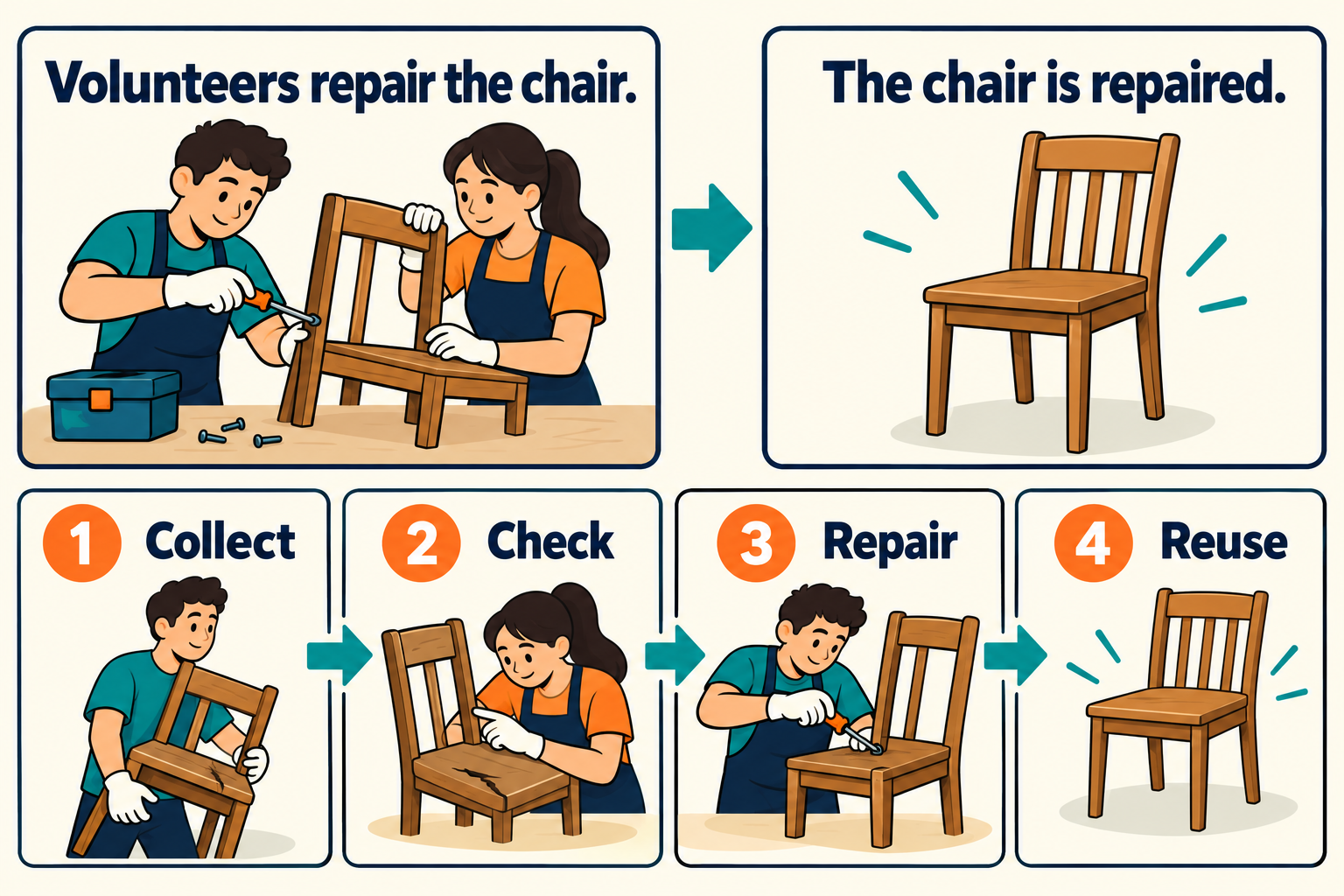
A repair workshop receives a broken chair. You can describe the same event in two ways: Volunteers repair the chair. The chair is repaired by volunteers. In the active sentence, volunteers come first. In the passive sentence, the chair comes first. Both sentences can describe the same action. The choice helps you connect your sentence to what your listener already knows.
If your paragraph is about a chair, keeping the chair as the subject often makes it easier to follow: The chair is collected on Monday. It is checked at the workshop. Its broken leg is repaired. If your paragraph is about the volunteers and their work, active sentences may be clearer. Passive does not mean better, more polite, or more academic in every situation.
Build a present simple passive
Use a form of be followed by a past participle. For a regular process, choose am, is or are: I am trained; the kettle is tested; the chairs are cleaned. Match be to the new subject. The past participle does not change for singular or plural subjects.
Regular participles often end in -ed: checked, repaired, collected. Some useful irregular participles are made, taken, sent, written and built. Compare make → made and send → sent. Do not use the base verb after be: The items are check is incorrect. The items are checked is correct.
For a negative, put not after be: Damaged cables are not reused. For a question, put be before the subject: Are the lamps tested? A short answer is Yes, they are or No, they aren’t. You do not need do or does with this passive construction.
Keep past actions in the past
Use was or were plus the past participle for a completed past event: The chair was collected yesterday. Two lamps were repaired last week. A singular subject usually takes was; a plural subject takes were. Negatives include The kettle wasn’t repaired and The lamps weren’t sold.
When you change voice, preserve time and meaning. Volunteers repaired the chair yesterday becomes The chair was repaired by volunteers yesterday. The chair is repaired yesterday is incorrect because is changes the tense. The chair was repairing yesterday is also not the intended passive: repairing is an -ing form, not the past participle.
Decide whether the agent helps
The agent is the person or thing that performs the action. Use by when the agent adds useful information: The chair was designed by a local artist. The artist matters here. In The parcels are delivered every morning, the delivery process matters more than the obvious delivery workers, so an agent is unnecessary.
By and with have different jobs. The box was opened by the technician names the agent. It was opened with a small tool names the instrument. Do not add by someone to every passive sentence. It often adds no useful information. Also avoid hiding responsibility when your reader needs to know who acted.
Change active to passive carefully
First find the object that receives the action. In The team checks the lamps, the lamps is the object. Make it the new subject. Next choose be in the original tense and match it to that subject. Add the original verb’s past participle. Finally decide whether to include the original subject with by: The lamps are checked by the team.
Not every sentence has an object that can become a passive subject. The volunteer arrived has no direct object, so The volunteer was arrived is not a standard passive. This guide stays with simple verbs such as collect, clean, repair and make, whose objects are easy to identify.
Describe a process in a clear order
Use first, next, then and finally to connect stages. First, returned items are collected. Next, they are checked. Useful parts are repaired. Finally, safe items are offered for reuse. Keep your main topic in focus and avoid repeating a long noun phrase in every sentence.
The process strip shows collect → check → repair → reuse. Its arrows represent order, not grammatical tense. A regular workshop routine takes present forms; a report about yesterday takes past forms. Always ask two questions: What receives the action? When does it happen?
Check your understanding
Choose or type your answers. Then read every explanation. The short checks give feedback on these answers only.
Answer on paper, then open the explanations below. Enable JavaScript to check answers here.
Answer key and explanations
1. The bicycle was repaired yesterday. — Both can be true, but the passive starts with the bicycle and continues that topic.
2. The mural was painted by the artist we are interviewing. — The artist’s identity is relevant; by someone adds no useful detail.
3. is — Every lamp is singular; this is a present routine.
4. were — Chairs is plural and yesterday needs the past form were.
5. The radio was repaired by the team last week. — Past repaired becomes was repaired, preserving past time and the agent.
6. The batteries are checked by volunteers. — The new plural subject batteries takes are; checked is the past participle.
Your turn · self-review
Use the language yourself
Write or speak first, then compare these possible models. Your wording may be different. This is self-check practice; it does not automatically score your writing or pronunciation.
Practice only. Your writing stays on this page; it is not submitted or saved.
-
Model answer and explanation
First, the chair is collected. Next, it is checked for damage. Any loose parts are repaired. Finally, the chair is offered for reuse.
-
Model answer and explanation
The chair was collected yesterday. It was checked for damage. Its loose leg was repaired. Finally, it was offered for reuse.
Self-check and next step
Check the meaning first, then the form. Read your answer aloud at a comfortable speed. Correct one feature, try again, and compare with the examples. Ask a teacher or partner for feedback if you are unsure.
Useful reference
Related Guides






Continue learning this topic
Review an explanation, study examples or try a related practice test.
- Practice test First-Time Homebuyers Are Scarce, but More Are Paying Cash — B1 English Listening Practice Test
- Practice test First-Time Homebuyers Are Scarce, but More Are Paying Cash — B1 English Grammar Practice Test
- Practice test First-Time Homebuyers Are Scarce, but More Are Paying Cash — B1 English Vocabulary Practice Test
- Course lesson Advanced passives: Reporting beliefs and expectations – C1: Precision and Expression
- Course lesson Past perfect: What had happened before? – B1–B2: Grammar in Context
- Course lesson Cleft sentences: It was…that and what…is – C1: Precision and Expression